 TEST-YO!· Kink Test
Kink Test: What's Your Archetype?
Answer 24 statements about what actually appeals to you, not the version you'd say on a first date. It takes about 3 minutes, is free, and sorts you into one of six kink archetypes.
Full result at the end — no email needed
- 3 min
- 24 questions
- No signup
- Free
Possible results · which one are you?
- Vanilla+
- Sensory
- Power Play
- Watching
- Roleplay
- Devotion
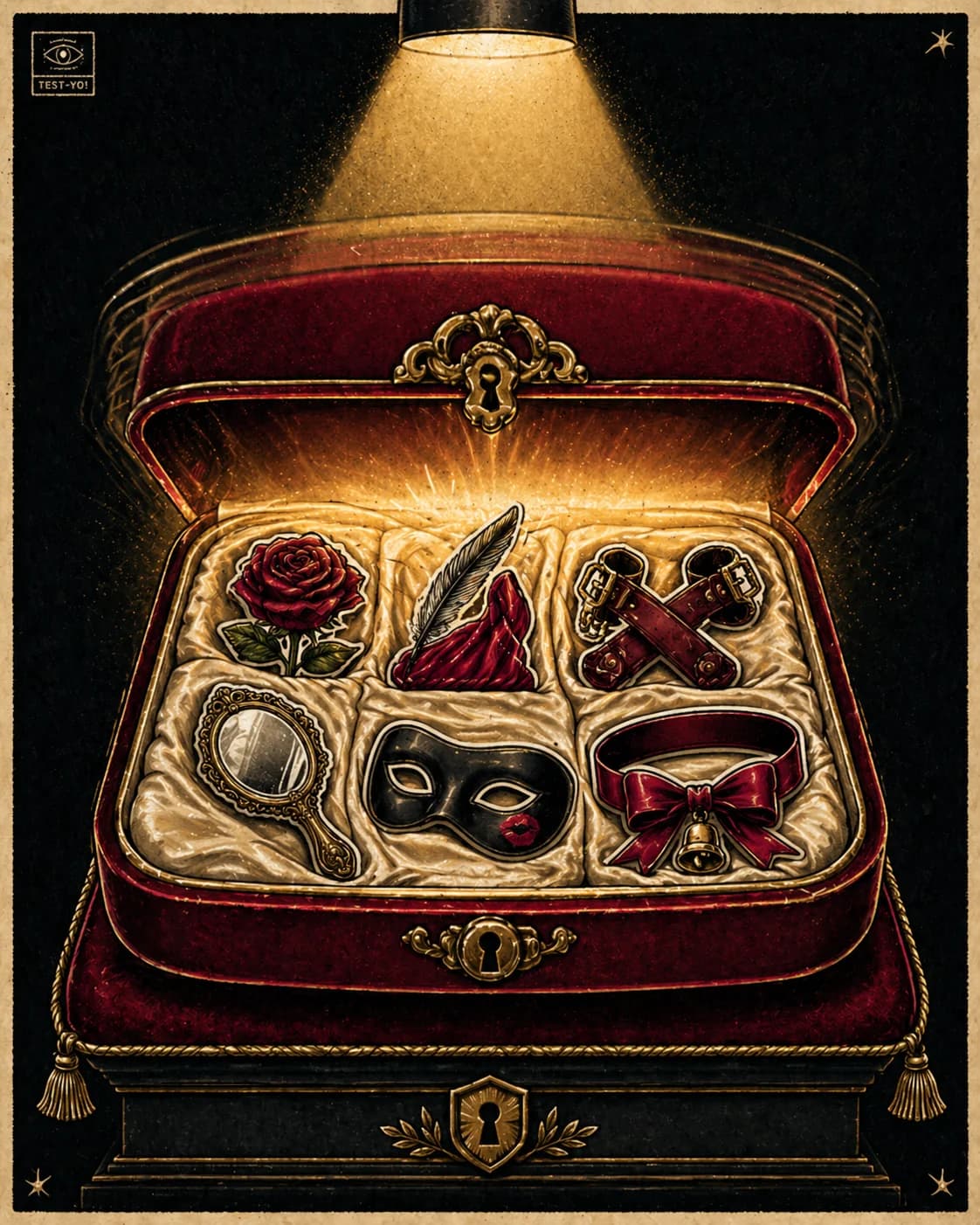
Quick answer
This free kink test takes about 3 minutes. You rate 24 statements from strongly disagree to strongly agree, and your answers point to one of six kink archetypes: Vanilla+, Sensory, Power Play, Watching, Roleplay or Devotion. It measures what appeals to you, not what you have done, and it is for adults aged 18 and over.
- 24 questions · ~3 min
- Cost: free · no signup
- Updated:
About this test
Not what you've done — what you're drawn to. Twenty-four statements about heat, control, attention and touch score you across six kink archetypes and return the one you lean into hardest. It includes Vanilla+ alongside the BDSM-oriented Power Play and Devotion patterns, while leaving room for people who do not identify with a kink. Adults only, and a conversation starter with a partner rather than a label to live under.
Methodology
24 items, 4 per archetype, 5-point Likert. Dominant-archetype scoring across six kink-energy types. Self-report only: it measures what appeals to you, not what you've done.
How the kink test scoring works
Each of the 24 statements counts toward one of six patterns, four statements per pattern. There are no right or wrong answers, so go with your first honest reaction.
- Answer every statement from 1 (strongly disagree) to 5 (strongly agree).
- Your answers are added up for each pattern, so every pattern ends with a total between 4 and 20.
- The pattern with the highest total is your lead archetype. If two patterns tie, a fixed order settles it, so the same answers always give the same result.
- Your result page also shows all six patterns as percentages of the maximum, so you can see your second and third as well as your top one.
This is a self-report quiz about what appeals to you today, not about what you have done. It is not a clinical, diagnostic or validated scale, and no result is a verdict on you.
Kink test, kink quiz, fetish test, BDSM test: which is this?
This is the same quiz described by the names above, or sometimes called a kinky test, for consenting adults who want words for their preferences. It reads what appeals to you today, not what you have done or what you owe anyone.
- Kink and quiz labels
- These names describe a broad reflection on interests, including familiarity, sensory attention and imagination. Here, answers are grouped into six patterns rather than a checklist of experiences, so curiosity does not mean you want to turn an idea into reality.
- Fetish
- In everyday language, this usually points to a more specific focus than kink, though people use the words differently. This quiz cannot identify a fetish or diagnose a disorder; its broad categories cannot settle that narrower question.
- BDSM kink test
- Power Play and Devotion touch on control and surrender, themes that overlap with BDSM. Neither result assigns a dom, sub or switch role, and an interest in these themes does not decide who should lead in any situation.
How to read your result
Read the leading archetype alongside the others and notice which parts fit your answers. These are preference patterns within this quiz, not a ranking of intensity or a complete description of you; you can keep useful language and leave the label aside.
- Vanilla+: Closeness, unhurried attention and eye contact appeal more than elaborate staging, without ruling out curiosity.
- Sensory: Texture, sound and atmosphere shape the appeal, with your own comfort setting the boundaries.
- Power Play: Clearly agreed control and roles appeal, while the direction remains a separate conversation.
- Watching: Visual attention and being seen appeal, with privacy and permission belonging to everyone involved.
- Roleplay: Imagination and a change of character or setting add interest within a frame everyone agrees to.
- Devotion: Focused giving and a partner's enjoyment appeal, while your own needs and limits still count.
Taking it with a partner
Only take or discuss this together if both adults freely want to; keeping a result private is also a complete choice.
- Answer separately, using your own reactions rather than guessing what would please your partner.
- A match opens a conversation and does not establish consent or prove compatibility; discuss individual preferences without assuming shared limits.
- Skip anything you do not want to discuss or change your mind at any time, without needing to justify it.
Possible archetypes
- Vanilla+ · Eye-contact kink
- No costume. No script. Just eye contact and a long Tuesday. Devastating.
About: Vanilla+
Vanilla+ names a preference pattern rather than the absence of one. In this quiz it is the mild end of the same reflection exercise, with its own shape rather than a default verdict. The statements that scored highest favour presence over production: slow pacing, sustained eye contact, familiarity, and the pull of being with one specific person rather than inside a specific scene. Nothing in that pattern rules anything out. The quiz reads what appeals rather than what has happened, so this result belongs equally to somebody with years behind them and somebody with almost none, and it carries no standing beyond a set of self-reported answers among consenting adults. The search vocabulary around this subject can make the pattern easy to misfile. This quiz groups a preference defined partly by wanting less staging alongside other routes to intensity; it is not a formal label for anybody. The more useful reading is about where intensity comes from — attention and timing rather than props, roles or novelty. Communication tends to be both the easy part here and the underrated one. Saying that simple is a choice, plainly and early, heads off the common misreading in which a partner concludes they are looking at low appetite or low effort. Naming what actually raises the temperature gives somebody concrete to work with instead of a vague reassurance. Curiosity is worth protecting anyway: a leaning towards the familiar is not an argument against ever trying anything, and treating a quiz result as a fence tends to make it into one. Boundaries are usually clear on this pattern, which is an advantage, and the work is keeping them mutual rather than assumed. Over years the strength is durability, because an approach that never depended on escalation does not run out of road. The matching risk is drift — mistaking a well-worn routine for presence once the attention behind it has quietly gone somewhere else.
- Sensory · Blindfold-curious
- You'd let someone trace your forearm with silk and call it a love language.
About: Sensory
The Sensory result describes a preference organised around input: texture, temperature, sound, scent, light, and the difference a blindfold or a change of fabric makes to an otherwise ordinary evening. Across the twenty-four statements, the items about noticing small physical detail outscored the ones about roles, watching and scenarios. That names a route rather than a fixed identity, and like every result here it reflects self-reported appeal among consenting adults — not experience, and not an assessment of anybody. People may expect an object-focused result from a fetish quiz, but this result describes a broader sensory preference. The distinction is worth keeping. This result describes a broad preference for sensory input. People use the word fetish differently; this result is limited to the answers you gave and is not a formal assessment. Sensitivity to texture and sound is also the part of any kink test that overlaps most with ordinary life, where the same wiring turns up in music, food and the feel of a shirt. The practical consequence is that setting is not decoration on this pattern. Overhead light, background noise, a rushed hour or an anxious atmosphere can flatten interest faster than any missing technique, and a partner will read that as rejection unless it has been explained. Saying that environment carries real weight, and saying which parts of it matter, turns a vague mood problem into something two people can fix together. Curiosity tends to point outward in small steps. A change of material, of temperature, or of what one sense does while another is quiet is a cheap experiment, and staying with one variable at a time keeps it enjoyable instead of overwhelming. Boundaries deserve the same detail as everything else. Anything that limits a sense — something as simple as a blindfold included — asks for a clear agreement first: what is happening, what is not, and the words either person uses to slow it down or stop it outright. Across years these preferences stay interesting because the variables are close to endless and cost almost nothing. The quieter failure is that sensitivity dulls under stress and exhaustion, and reading a flat evening as a verdict on the relationship is usually the wrong conclusion.
- Power Play · Tell me what to do
- 'In charge' or 'clearly not' — anything in between bores you. We've heard.
About: Power Play
Power Play is the result on this quiz that sits most squarely in what people mean when they search for a BDSM test. It describes a preference for clear, agreed roles — one person leading and one person not — over an evenly shared dynamic in which nobody is deciding anything. The items that scored highest are about charge arriving through that clarity: a choice made on your behalf, a choice you make instead, a voice that has already settled the question. Which side of it appeals is a separate matter, and plenty of people find that both do at different times. Two things deserve stating flatly. The first is that all of this rests on agreement between adults, negotiated in advance and revisable at any moment; without that, none of what follows describes anything worth having. The second is that a preference is not experience — this result comes back for people who have tried none of it, and wanting a dynamic is a different thing from having found somebody to share one with. Communication does more work on this pattern than on any other in the set, and not the improvised kind. What is on the table, what is not, how either person pauses or ends things, and what happens once it is over are all conversations for a moment when nothing is happening, while saying no is still cheap. Roles agreed in detail are the ones that feel safe enough to enjoy. Curiosity is usually about degree rather than direction. Small, low-stakes versions — who chooses the evening, who asks and who answers — reveal a great deal before anything more involved comes up, and they leave an easy exit if the answer turns out to be no. Boundaries are the load-bearing part. A limit named out loud is not a mood-killer; it is what makes the rest possible, and it can move in either direction later. The step most often skipped is the one afterwards: checking in, returning to level ground, treating the other person as a partner rather than a role. In a long relationship the real risk is mismatch rather than intensity — somebody who can play a part briefly without ever wanting it. That gap tends to surface as loneliness rather than argument, and it is worth naming early.
- Watching · Put a mirror up
- A mirror in the right spot does more for you than 30 minutes of dirty talk.
About: Watching
The Watching result describes a preference in which the visual channel carries much of the weight. Mirrors, angles, lighting, and the awareness of seeing or of being seen scored higher across the twenty-four statements than the touch-led, role-led and dynamic-led items did. In the vocabulary a kink test usually borrows, this gets filed near voyeurism and exhibitionism — but those words describe behaviour, while the quiz reads appeal rather than experience: what draws attention, not what anybody has actually done, and always among consenting adults. There is a reason this pattern needs more care around agreement than most. Anything visual can involve a second person's image, and an image travels in ways a moment never does. A mirror concerns only the people in the room. A photograph or a recording is a different category with a different conversation attached: who appears in it, who holds it, where it lives, and what becomes of it if the relationship ends. That conversation belongs before anything is made, and a yes to one part of it is not a yes to the rest. Anybody who has not agreed, in person and in advance, is simply not part of this. Communication here is often about relieving pressure rather than adding any. A partner who hears a request for a mirror or for different lighting can easily take it as being graded, especially when the reason has never been explained. Saying what the visual actually does — atmosphere, presence, the pleasure of seeing somebody enjoy themselves — usually turns an anxious request into an easy one. Curiosity has an obvious low-cost end: lighting, a change of room, whether a mirror is in view at all. Each is reversible, involves nobody outside the relationship, and answers the question cheaply. Boundaries on this pattern reach outside the room as well. Anything involving a phone, a camera or another person raises questions of privacy and permission that have nothing to do with desire and everything to do with looking after somebody. A limit there is not squeamishness. Over a long relationship the preference ages well, since attention to setting is a habit rather than an escalation. The thing to watch is the slide from atmosphere into perfectionism, where an evening ends up judged on how it looked instead of how it felt.
- Roleplay · Stranger at the bar
- You'd rather meet your partner as strangers in a hotel bar. Tonight, ideally.
About: Roleplay
Roleplay describes a preference in which imagination does a share of the work: a scenario, a change of character, meeting as strangers on purpose, a small alteration of clothes or manner that makes a familiar person briefly unfamiliar. Those items outscored the ones about sensation, dynamic and visual attention. It is a pattern of appeal, self-reported by adults answering for themselves — not a claim about experience, and not a description of anybody's whole self. This result uses a different grouping from an activity-focused BDSM or fetish quiz because it describes imaginative scenarios rather than a single act or object. What it points at is a route rather than a thing: novelty arriving through a frame that both people agree to step into and back out of. The frame is the part that has to be said out loud. A scenario works precisely because everyone involved knows it is one, which means agreeing beforehand on roughly what happens, on how either person leaves it, and on the understanding that leaving is never an insult. Words that exist only inside the scene need a word that belongs outside it. Where a role touches something either person finds genuinely uncomfortable, the answer is to change the role rather than push through, and none of this is a route to rehearsing anything that was never agreed. Curiosity is unusually cheap here. A different name for one evening, a meeting arranged as though for the first time, a small shift in how somebody speaks — each is reversible, and the small versions answer most questions before the larger ones arise. One misunderstanding is worth heading off directly: wanting to play at being other people is not a complaint about the actual relationship, and a partner who hears it as one will generally say so indirectly rather than plainly. Saying what the play adds — attention, curiosity, a reason to notice each other again — beats defending it. Across years this is among the more durable patterns in the set, because imagination does not deplete the way novelty does. The risk runs the other way: a partner with no appetite for pretending can leave an interest quietly parked, and an interest never mentioned tends to curdle into resentment rather than patience.
- Devotion · Watch them dissolve
- You're not into giving — you're into watching them dissolve. Difference.
About: Devotion
Devotion names a preference pattern organised around somebody else's pleasure. Across the twenty-four statements, the items about focused giving and about the pull of watching a partner let go outscored the ones about sensation, dynamic, visual detail and invented scenarios. That points at where the charge originates rather than at how selfless anybody happens to be, and nothing in the pattern says that wanting something back sits outside it. Labels used in BDSM tests may place this pattern near submission, but that is not the same description: submission is a position inside an agreed dynamic, while this result describes where satisfaction comes from. An object-focused fetish quiz addresses a narrower question, while this result describes a pattern of giving. The quiz sorts by what appeals rather than by experience, so the result reads the same for somebody with a long history and somebody with none — consenting adults answering two dozen statements about themselves is all any of it ever is. Communication carries an unusual load here, because the common misreading is a flattering one. A partner who watches attention flow steadily in one direction often concludes that nothing is wanted in return, then carries a quiet guilt about it instead of saying so. The repair is to say the true version out loud: giving is the pleasure rather than a favour being done, and being noticed still matters. Both halves have to be said, since either alone gets heard as politeness. Curiosity meets a specific obstacle, which is that the instinctive move is always to ask what the other person would like. Naming one thing wanted for its own sake, and letting a partner supply it, is the harder experiment and the more useful one. It also answers something worth knowing early: whether the person receiving can receive at all, or hands every offer straight back. Boundaries are the piece most easily skipped, because a limit can feel like a lapse in generosity. It is not one. Consent runs both ways, and somebody who gives readily needs the same agreed words for slowing down and for stopping as anybody else. Over a long relationship the pattern ages well, since attention does not deplete the way novelty does. The failure runs slower and quieter: giving that is never returned turns into scorekeeping without anybody deciding to keep score, and it tends to get noticed only once the resentment has arrived. Naming an imbalance early, while it is still small enough to sound like a preference rather than an accusation, is what stops the strength from becoming the problem.
Related tests
Related tests
Related reading
Best Sex Toys for Couples: A Consent-First Guide by Kink Type
How to choose sex toys as a couple: body-safe materials, the best first picks for each of six kink types, and how to talk about it first. No rankings, no hype. 18+.
Types of Kinks: A Plain-Language List (18+)
A plain-language list of the types of kinks in six families, what kink means versus fetish, the consent terms to know, and how to find your own. 18+.
BDSM Kink Test: What a Kink Quiz Can and Can't Tell You (18+)
Understand what a BDSM kink test can tell you. Read six preference patterns, separate curiosity from consent, and use a fetish quiz result with care. 18+.
Kink test FAQ
What is a kink test?
A quiz about what appeals to you, not what you have tried. This one uses 24 statements to suggest one of six archetypes: Vanilla+, Sensory, Power Play, Watching, Roleplay or Devotion.
Is the kink quiz free, and do I have to be 18?
Yes: this kink test is free, takes about three minutes and needs no signup or email. It is only for consenting adults aged 18+. A result never replaces consent.
How many questions are in the kink test, and how long does it take?
There are 24 statements, four for each of the six archetypes, answered on a five-point scale from strongly disagree to strongly agree. It takes about 3 minutes, and your progress is saved in your browser if you pause.
How accurate is a kink test?
This quiz is a self-reflection tool, not a validated assessment or a kinkiness score. Treat the result as a starting point for conversation, not a diagnosis or a measure of experience.
Is the kink test private?
No account, name or email is needed, and we keep no database of answers. Your progress stays in your own browser until you finish, and analytics do not receive your individual answers. Use a private window on a shared device.
What are my kinks? How do I find my kinks?
Start with what interests you and where your boundaries are. Your archetype can help you put preferences into words; you can feel unsure, skip labels or change your mind without trying anything.
Is this a BDSM kink test?
It is a light, consent-first archetype quiz, not a BDSM checklist. Power Play and Devotion explore themes of control and surrender, but the result does not assign a dom, sub or switch role.
What's the difference between a kink and a fetish?
People use these terms differently. In everyday use, kink can mean an erotic interest, while fetish often refers to a more specific focus. This self-reflection quiz maps patterns of appeal; it cannot identify a fetish or diagnose a disorder.
Can couples take it together?
Yes, if both adults freely want to. Answer separately, then use the partner-compare invite on your result when available to see your shared interests. A match opens a conversation; it does not establish consent or compatibility.
Is "vanilla+" a real kink?
Vanilla+ is this quiz's name for a preference for slow, simple, eye-contact heat. You can also prefer conventional sex, feel unsure, or skip the label.
What are the main types of kinks this quiz covers?
Six broad patterns of appeal: Vanilla+ (slow, simple, eye-contact intimacy), Sensory (texture, temperature, intensity of touch), Power Play (control and giving it up), Watching (being seen or seeing), Roleplay (scenes and characters) and Devotion (service and surrender). It groups interests into patterns rather than listing every specific kink.
Will it tell me if I am a dom, sub or switch?
Not directly. Power Play and Devotion show whether control and surrender appeal to you, but the quiz does not assign a dominant, submissive or switch role. Many people find that the role they enjoy depends on the partner and the moment.
Does having a kink say anything bad about you?
Research does not support that assumption. A 2013 study in The Journal of Sexual Medicine (Wismeijer and van Assen) compared Dutch BDSM practitioners with a control group and found them, on average, less neurotic, more extraverted and more open to experience, with equal or higher subjective well-being. It was a self-selected sample, so it shows kink is not a sign of poor mental health, not that it makes people healthier.