 TEST-YO!· How You Love
ECR-S · Wei et al. 2007
What Is My Attachment Style? How Do You Actually Love?
What is my attachment style? Take this free 12-question quiz on closeness and trust. Explore anxious and avoidant patterns for reflection, not diagnosis.
- 5 min
- 12 questions
- No signup
- Free
Full result at the end — no email needed
Possible results · which one are you?
- Secure
- Anxious
- Avoidant
- Fearful-Avoidant
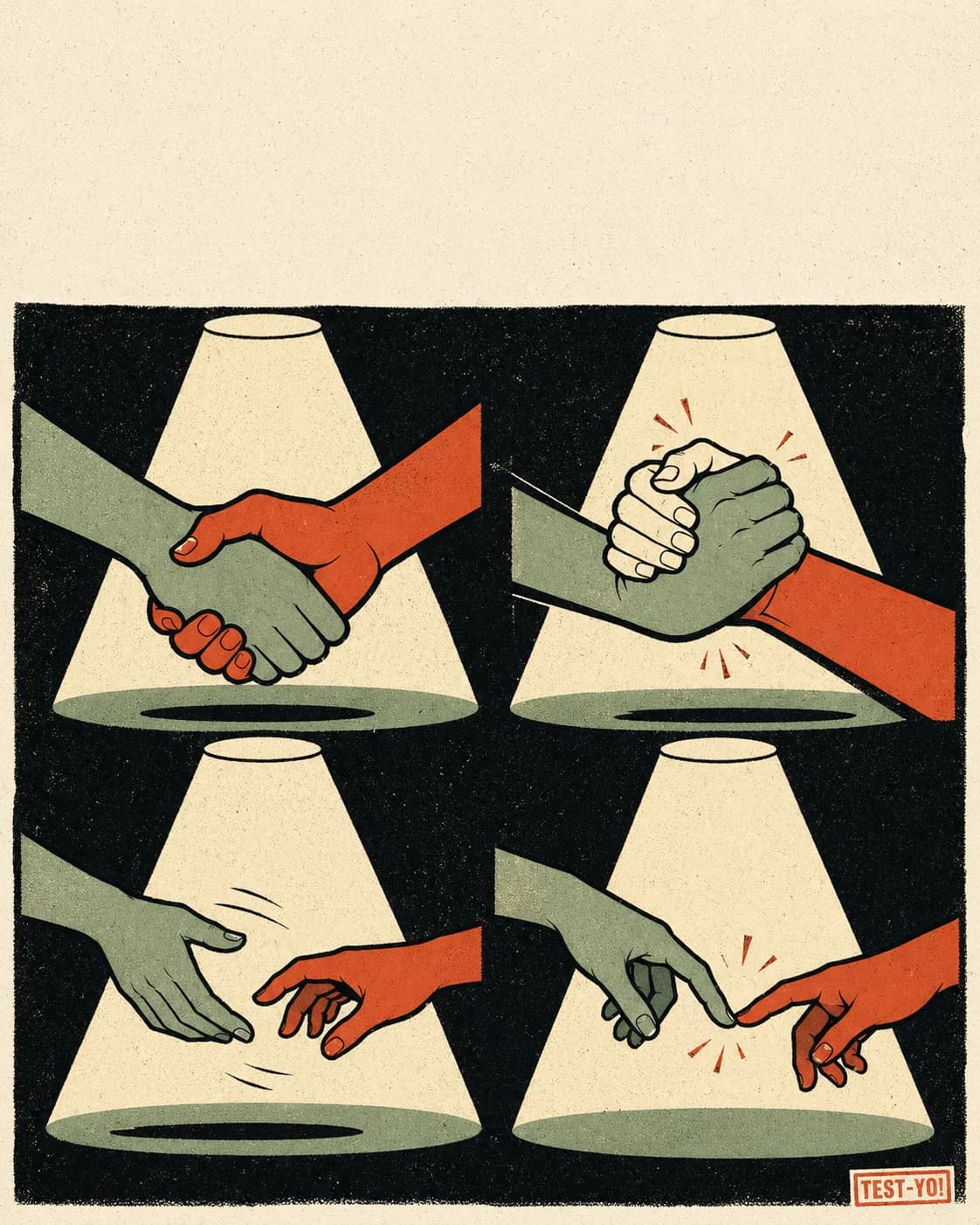
Quick answer
Your answers lead to one of 4 results: Secure, Anxious, Avoidant, or Fearful-Avoidant.
- 12 questions · ~5 min
- Framework: Adult attachment styles
- Based on: Wei, M., Russell, D. W., Mallinckrodt, B., & Vogel, D. L. (2007)
- Cost: free · no signup
About this test
How you love is also how you fear. This 12-item self-report adaptation from the published ECR-Short Form explores attachment anxiety and avoidance through statements about closeness and trust. The two dimensions offer a snapshot for reflection; Test-Yo’s four quadrant labels are custom and non-clinical.
Methodology
Wei, M., Russell, D. W., Mallinckrodt, B., & Vogel, D. L. (2007). The Experiences in Close Relationship Scale (ECR)-Short Form: Reliability, validity, and factor structure. Journal of Personality Assessment, 88(2), 187–204.
Possible archetypes
- Secure · Texts back, normal
- You ask for what you need, in words. Out loud. Disgusting.
About: Secure
Low anxiety, low avoidance. You can ask for what you need, accept what a partner offers, and tolerate both proximity and distance without it spiking alarm bells. This is the pattern most relationship research associates with stable, satisfying bonds.
- Anxious · 'K.' sends me spiral
- They take 12 minutes to reply and you've already drafted the breakup.
About: Anxious
High anxiety, low avoidance. You value closeness and invest in it — and your system runs a background process scanning for signs of rejection. When a partner can hold steady and reassure, you regulate beautifully; when they pull back, the alarm gets loud fast.
- Avoidant · Allergic to L-word
- Things got good, so naturally you started replying every 3 days.
About: Avoidant
Low anxiety, high avoidance. You prefer autonomy, keep emotional expression low-volume, and tend to deactivate when a partner presses for more closeness. This is a strategy, not a flaw — it protected something at some point. The hard part is when warmth is available and you reach for distance anyway.
- Fearful-Avoidant · Come-here-go-away
- You initiate at 11pm, panic at 9am, disappear by lunch.
About: Fearful-Avoidant
High anxiety AND high avoidance. You long for connection and distrust it at the same time, so you can find yourself pulling in and pushing away in the same week — or the same hour. Often this pattern makes sense given the relational history that shaped it. It is also the most workable one, step by step.
Related tests
Related reading
Attachment Theory Explained: Anxiety, Avoidance and Four Patterns
A careful introduction to adult attachment theory, its two dimensions, four contextual patterns and the limits of self-reflection quizzes.
The Big Five Personality Traits Explained
What Openness, Conscientiousness, Extraversion, Agreeableness and Neuroticism actually measure — and why researchers trust this model.
Sources & references
- Wei, M., Russell, D. W., Mallinckrodt, B., & Vogel, D. L. (2007). The Experiences in Close Relationships scale — Short form (ECR-S). Journal of Personality Assessment.
FAQ + disclaimer
Can my attachment style change?
Attachment patterns can shift over time and across relationships. A 12-item self-report snapshot cannot establish what will change for you; if distress persists, consider qualified support.
How long does it take?
About 5 minutes — 12 Likert items.
Which style is “best”?
No style is a clinical grade or verdict. These four labels are shorthand regions in two continuous dimensions; use the result for reflection, not relationship prediction.
What is my attachment style?
Your answers about closeness and trust give a snapshot of attachment anxiety and avoidance. The quiz maps those two scores to one of four informal labels. Treat it as a starting point for reflection, not a diagnosis or a fixed identity.