 TEST-YO!· Personality
IPIP-50 · Goldberg 1999
Who Are You, Really?
Explore your personality with thirty everyday statements about curiosity, habits, social energy, cooperation and emotional reactions. This free Big Five quiz takes about five minutes and highlights your strongest trait. Use the result for reflection, with no signup or diagnosis.
- 5 min
- 30 questions
- No signup
- Free
Full result at the end — no email needed
Possible results · which one are you?
- Explorer
- Organiser
- Energiser
- Harmoniser
- Sensitive
Quick answer
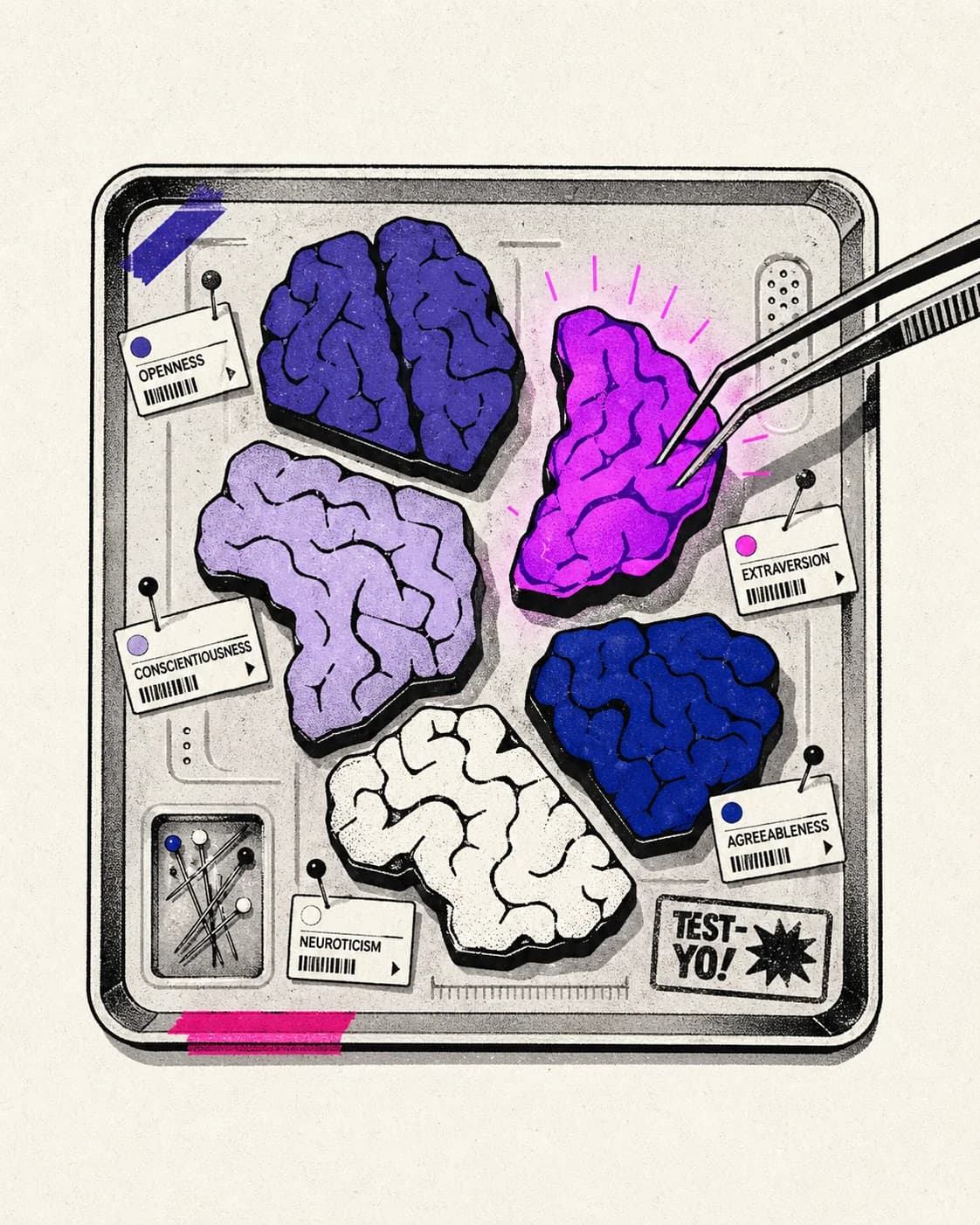
Your answers lead to one of 5 results: Explorer, Organiser, Energiser, Harmoniser, or Sensitive.
- 30 questions · ~5 min
- Framework: Big Five personality traits
- Based on: Goldberg, L. R. (1999)
- Cost: free · no signup
About this test
This original 30-item quiz explores Openness, Conscientiousness, Extraversion, Agreeableness and Neuroticism (emotional reactivity). Six statements per trait use a five-point agreement scale, with some scored in reverse. It is inspired by the Big Five model, not a validated BFI or IPIP questionnaire, and has no population norms.
Methodology
30 original self-report items, 6 per Big Five trait, with forward- and reverse-keyed statements. Each answer contributes −2 to +2 to its trait. The highest total determines the result archetype; ties use O, C, E, A, N order. This independent quiz is not a validated BFI or IPIP questionnaire and has no population norms.
The five traits
Big Five describes tendencies on continuous scales, not five exclusive types. OCEAN stands for openness, conscientiousness, extraversion, agreeableness and neuroticism. Everyone has a pattern across all five; these everyday examples illustrate tendencies rather than rules.
- Openness
- Curiosity about unfamiliar ideas, experiences and creative possibilities. You might try a recipe from a cuisine you do not know. You might explore a different interpretation of a favourite film.
- Conscientiousness
- A tendency towards organisation, responsibility and following through. You might plan your week before Monday. You might check the details of a task before handing it over.
- Extraversion
- A tendency towards sociability, assertiveness and outward activity. You might start a conversation at a gathering. You might volunteer to speak during a group discussion.
- Agreeableness
- A tendency towards cooperation, consideration and trust. You might listen to both sides of a disagreement. You might offer a colleague help when they are overloaded.
- Neuroticism
- A tendency to experience stress and difficult emotions more readily, also called emotional reactivity. You might worry about a delayed reply. You might feel unsettled after a small change of plans. This is a trait description, not a diagnosis.
Independent Big Five quiz, not an MBTI assessment and not affiliated with its publisher. Myers-Briggs Type Indicator and MBTI are trademarks of their respective owners.
How to read your result
Your archetype names the trait with the highest total across your answers, not your whole personality. Some statements are scored in reverse. If totals tie, the quiz uses O, C, E, A, N order, so a close result deserves caution. The profile bars show each total relative to that trait’s possible positive maximum; negative totals display as zero. These are not population percentiles, and the five percentages do not need to add up to 100. Compare the descriptions with real situations, including examples that do not fit. A higher score is not a better person, and a lower one is not a flaw.
Big Five vs MBTI
Big Five describes five continuous traits. The Myers-Briggs Type Indicator (MBTI) describes preferences through four pairs and reports a type combination. Both use self-report, but they organise the answers differently; there is no direct conversion from an OCEAN score to a four-letter type. Big Five is more widely used in academic personality research. That research does not establish the validity of this original quiz. Choose a validated instrument when you need a formal assessment, rather than treating a shareable label as a verdict.
Possible archetypes
- Explorer · Brain on 47 tabs
- Six half-read books, one abandoned language app, and a genuinely good idea you had in the shower and never wrote down.
About: Explorer
Openness to experience is the Big Five dimension that deals with appetite: for unfamiliar ideas, for art, for the version of a plan nobody has tried yet. It is the trait the other popular frameworks have the most trouble placing. MBTI splits something adjacent into its N and S letters, but forces into an either/or what Openness deliberately leaves as a scale. DISC has no room for it at all, because DISC describes behaviour at work rather than the shape of a mind. The four-colour workshop decks divide the same appetite between the analytical type and the enthusiastic one, which is why somebody unmistakably curious can come out a different colour depending on whose deck the trainer bought. This quiz keeps it on a single scale, and the Explorer archetype names the group of statements that scored highest across the thirty items — a ranking of your own answers against each other, not a placement against everybody else, and not a description of the whole person. At work the pattern shows up early in a project and thins out late. The Openness items reward wanting the brief reopened, the assumption questioned and a second option costed before the first is signed off, which is worth a great deal at the start and expensive at the point where a thing simply has to ship. Among friends the same appetite arrives as the person who has already read about the restaurant, the country and the argument, and who will change the subject four times before the starters land. Under pressure the model expects the mind to widen rather than narrow: deadlines get met by inventing a new approach at hour ten, which sometimes rescues the week and sometimes replaces a boring plan that would have worked. In love, curiosity reads as attention — questions asked, plans made, small things noticed — and the failure mode is restlessness rather than coldness, boredom mistaken for a verdict about somebody else.
- Organiser · Organised at heart
- The calendar is colour-coded, the spare charger has a designated pocket, and you know which of your friends is always late.
About: Organiser
Conscientiousness is the Big Five dimension covering order, planning and follow-through — the distance between intending something and having done it. It also owns the most confusing name in personality testing, because DISC uses a C for Conscientiousness too and means something narrower by it: care and accuracy inside a working style, rather than the general tendency to finish what you start. MBTI puts a slice of the same ground in the J of its judging and perceiving letter, and the four-colour decks hand it to gold or to cool blue depending on which system a trainer was taught. The Organiser archetype in this quiz is plainer than any of those readings: across the thirty statements, the items about plans, tidiness, deadlines and detail outscored the other four sets. That is a comparison between one person's own answers, and a high score says nothing about whether the plans themselves are any good. At work this is the pattern other people quietly build their timelines around. It appears as the version of the document with dates in it, the follow-up nobody asked for, and a standard applied to your own output that would look harsh applied to anyone else's. Among friends it usually means holding the booking reference — genuinely useful, and almost never noticed until the week it is not done. Under pressure the model expects structure to tighten rather than loosen: more lists, tighter sequencing, and real difficulty when a change of direction makes careful sequencing worthless. That is where the cost sits, because a plan built this well is hard to abandon even after the world has stopped agreeing with it. In love the pattern reads as reliability — arriving, remembering, arranging — and the friction, when it comes, is usually about somebody treating time and tidiness as smaller matters than they feel from the inside.
- Energiser · Walking serotonin
- You made a friend in the queue, heard about their divorce, and offered them a place to stay in a city you do not live in.
About: Energiser
Extraversion is the one trait every personality framework agrees on, which is also why it gets misquoted most often. In the Big Five it describes where attention naturally points and what leaves you with more energy than you started with: company, activity, and the reward of something happening. MBTI turns the idea into the E and I of a four-letter code, a binary that most people sit fairly close to the middle of. DISC spreads it across two styles, the outgoing warmth of Influence and the forwardness of Dominance. The colour decks call it sunshine yellow, or orange if the trainer uses True Colors. What none of them mean by it is confidence, and the Energiser result in this quiz means only that the statements about starting conversations, enjoying company and thinking out loud outscored the other four groups. Plenty of people who score high on those are nervous about plenty of things. At work this pattern moves information faster than any process does. Talking a half-formed problem through is how the thinking gets finished, which is why a good conversation can feel like a productive morning and a silent one can feel like wading. Meetings warm up, new arrivals get spoken to, and the awkward pause gets filled — usually usefully, occasionally a beat before the quieter person had finished deciding what to say. Among friends this is the pattern that makes plans exist at all, since a group where nobody is willing to send the first message simply stays home. Under pressure the model expects reaching outward: more calls, more talking, more people brought in, which handles stress well until the problem turns out to be one that needed an hour alone rather than an audience. In love it shows as warmth and momentum, and the strain, when it arrives, is usually about how much company counts as enough.
- Harmoniser · Soft peacekeeper
- You have said no worries and meant it, right up until the third time, and nobody has any idea there was a third time.
About: Harmoniser
Agreeableness is the Big Five dimension about how much weight other people's interests carry when they compete with your own — trust, warmth, and the reflex to reach for an answer that costs nobody too much. The other frameworks cut it differently. DISC calls the nearest thing Steadiness and treats it as a working style: patient, consistent, hard to rattle. The four-colour decks file it under earth green, except True Colors, which uses blue for the warm type and so confuses every conversation between people trained on different systems. MBTI keeps a piece of it in the F of its thinking and feeling letter. The Harmoniser result in this quiz is narrower than any of those readings: statements about sympathy, helping and giving people the benefit of the doubt outscored the other four sets across the thirty items. That is a pattern in one set of answers, not a measure of how kind anybody is. At work it is the thing that makes a team function without anyone being able to point at what it does. Disagreements get translated instead of escalated, new arrivals get looked after, and the version of a decision everyone can live with tends to come from this direction — work that is real and almost impossible to invoice. Among friends the same instinct produces the person everybody tells things to, which is a privilege and a load, usually carried without mention. Under pressure the model expects accommodation rather than confrontation: agreement offered faster than it is felt, and the disagreement surfacing later as tiredness instead of a sentence. In love the pattern is generous and easy to be around, and its failure mode is not conflict but silence — small wants left unsaid long enough that neither person can remember when they stopped coming up.
- Sensitive · Feels everything
- A song from 2009 came on in a supermarket and took eleven minutes of your afternoon. Also, that text from Tuesday.
About: Sensitive
Emotional reactivity — what the Big Five labels Neuroticism, a word that has aged badly — describes how strongly and how quickly feelings register, and how long they take to settle again. It is the trait the popular type systems leave out. MBTI has no letter for it, DISC has no style for it, and none of the four-colour decks carry it, which is part of why those models feel tidier than they are: the most variable part of a person is simply not in the picture. Keeping it in is what separates a five-dimension model from a four-box one, and the Sensitive result in this quiz means the statements about worry, mood and recovery outscored the other four groups across the thirty items. High reactivity is an ordinary trait with real advantages rather than a fault, and a quiz score is not information about anybody's health. At work the pattern behaves like an early-warning system. The tone of a short reply, the thing left out of an update, the number that feels wrong before anyone can say why — those signals come from this direction, and teams that wave them away tend to discover later that they were right. The same sensitivity makes ambiguous feedback expensive: a sentence meant lightly can be read four times before lunch. Among friends it shows as being genuinely moved by things and remembering how a room felt years afterwards, which is why people with this pattern are often the ones others come to when something real has happened. Under pressure the model expects amplification rather than shutdown: the reaction arrives fast and large, and the useful question is less how to stop having it than how much of the afternoon it gets to run. In love it means depth, attentiveness, a low tolerance for being managed, and a habit of hearing an ordinary silence as the start of something bad.
Related tests
Related reading
The Big Five Personality Traits Explained
What Openness, Conscientiousness, Extraversion, Agreeableness and Neuroticism actually measure — and why researchers trust this model.
How to Interpret Your Big Five Results
A practical guide to reading your OCEAN scores — what percentiles mean, which combinations matter, and common misreadings.
Big Five (OCEAN) vs MBTI: Which Is More Accurate?
A careful comparison of two popular personality models — and why trait-based models are generally preferred when a decision requires trait-level measurement.
Sources & references
- Goldberg, L. R. (1999). A broad-bandwidth, public domain, personality inventory measuring the lower-level facets of several five-factor models. Tilburg University Press.
- Costa, P. T., & McCrae, R. R. (1992). Revised NEO Personality Inventory (NEO-PI-R) and NEO Five-Factor Inventory (NEO-FFI) Professional Manual. Psychological Assessment Resources.
FAQ + disclaimer
Is this personality test free?
Yes. All 30 questions and the Big Five result are free, with no signup or email required.
How accurate is this Big Five personality test?
It is an original self-reflection quiz inspired by a research framework. This particular questionnaire has not been independently validated or normed, so we cannot give an accuracy percentage. Answers depend on how you see yourself and your current situation.
Can my personality test result change?
Yes. Habits and personality can develop over time, and mood, context and how you interpret a question can affect your answers. A different result does not by itself prove a lasting personality change.
Which is more scientific: Big Five or MBTI?
The Big Five is more widely used in academic personality research and describes continuous traits. MBTI describes type preferences. Evidence for a framework does not automatically validate every quiz based on it, including this one.
How is my Big Five result calculated?
Each statement contributes to one trait, with some answers scored in reverse. The trait with the highest total names your archetype. If totals tie, the order is openness, conscientiousness, extraversion, agreeableness, then neuroticism. Scores are not population percentiles.
Does a high neuroticism score mean a diagnosis?
No. Here neuroticism means a tendency to react to stress and difficult emotions. This quiz cannot diagnose a mental health condition or replace a professional assessment.