
The Myers-Briggs Type Indicator is the personality test most people have taken. The Big Five (OCEAN) is the personality model most researchers use. They don't give the same answers and they weren't built the same way. Here's an honest comparison.
How each was built
The MBTI was developed in the 1940s by Katharine Briggs and Isabel Myers, a mother-daughter team with no formal psychology training, based on a popularised version of Carl Jung's theories. Jung himself never claimed his types were scientific categories.
The Big Five emerged from 50+ years of statistical analysis of how people actually describe personality across languages. It was discovered, not designed. Related broad dimensions recur across many measures and samples, although the exact structure and interpretation vary with language, method and population.
That difference in origin matters for reliability.
Test-retest reliability
If a test is reliable, retaking it should give you a similar result. Here's what the evidence shows:
MBTI: A substantial minority of people can receive a different four-letter type on retest, with the exact rate varying by form, interval and sample. That does not mean their personality changed: several MBTI dimensions turn continuous preferences into categories at a threshold. Someone near the Thinking/Feeling boundary can therefore be labelled "T" on one occasion and "F" on another.
Big Five: Trait scores are usually fairly stable across weeks and months, while rank-order stability tends to increase with age and can remain substantial across decades. If you're more Conscientious than your sibling at 25, you may still be more Conscientious at 55, although neither result is guaranteed.
What each measures
MBTI claims four binary categories: Extraversion/Introversion, Sensing/Intuition, Thinking/Feeling, Judging/Perceiving. 16 possible types.
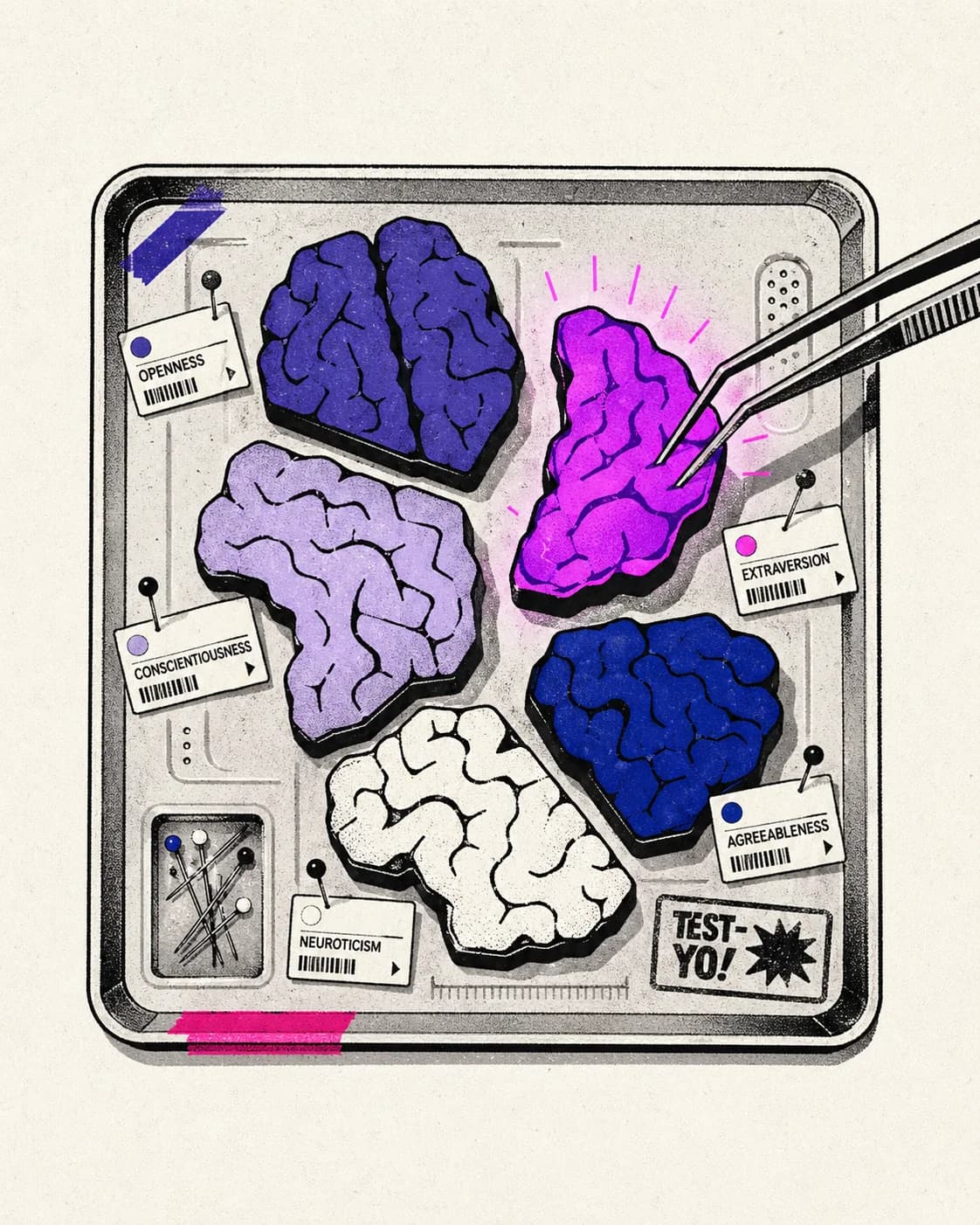
Big Five measures five continuous traits: Openness, Conscientiousness, Extraversion, Agreeableness, Neuroticism. Infinite shades.
Research comparing the measures has found associations between E/I and Extraversion, S/N and Openness, T/F and Agreeableness, and J/P and Conscientiousness. These are approximate associations, not interchangeable scores or a conversion formula. The MBTI has no direct Neuroticism dimension.
Predictive validity
Does the test predict anything useful?
MBTI: Its type categories are a weak basis for predicting job performance, academic success, relationship satisfaction or leadership effectiveness. It should not be treated as the sole basis for hiring, promotion, relationship-compatibility or clinical decisions.
Big Five: Research links some traits with some outcomes at a group level. For example, Conscientiousness has shown associations with job-performance criteria in a meta-analysis. These relationships depend on the measure and context; they do not predict an individual outcome with certainty or validate every quiz using the five labels.
Why is MBTI still popular?
Three reasons: 1. Typology is satisfying. "I'm an INFJ" feels more meaningful than "I score 62nd percentile on Openness." Identity is easier to share than percentiles. 2. The Barnum effect. MBTI type descriptions are written to sound specific while being general enough to fit most people. Everyone reads their type and nods. 3. Corporate habit. MBTI has a big training industry around it. That industry doesn't have incentives to update.
When MBTI is OK
For self-reflection exercises, team bonding, or initial conversation starters, MBTI can be useful as a shared vocabulary — as long as no one treats the result as a diagnosis or a precise measurement. Use a more suitable, validated instrument when a decision requires dependable trait-level measurement.
Which should you take?
Choose according to your purpose and the evidence for the specific instrument. Our original 30-item quiz uses the five-domain framework to produce a self-reflection archetype in about five minutes. It has not been validated as a BFI, IPIP or normed instrument; its labels are for reflection, not hiring, diagnosis or predicting success.
If you want a conversation-starter with friends who know their MBTI type, by all means take both. Just don't expect the results to agree.