You took the test. You got scores on five traits. Now what? Big Five results are more informative than MBTI types but take more interpretation. Here's how to read them without over-reading.
The five scores, quickly
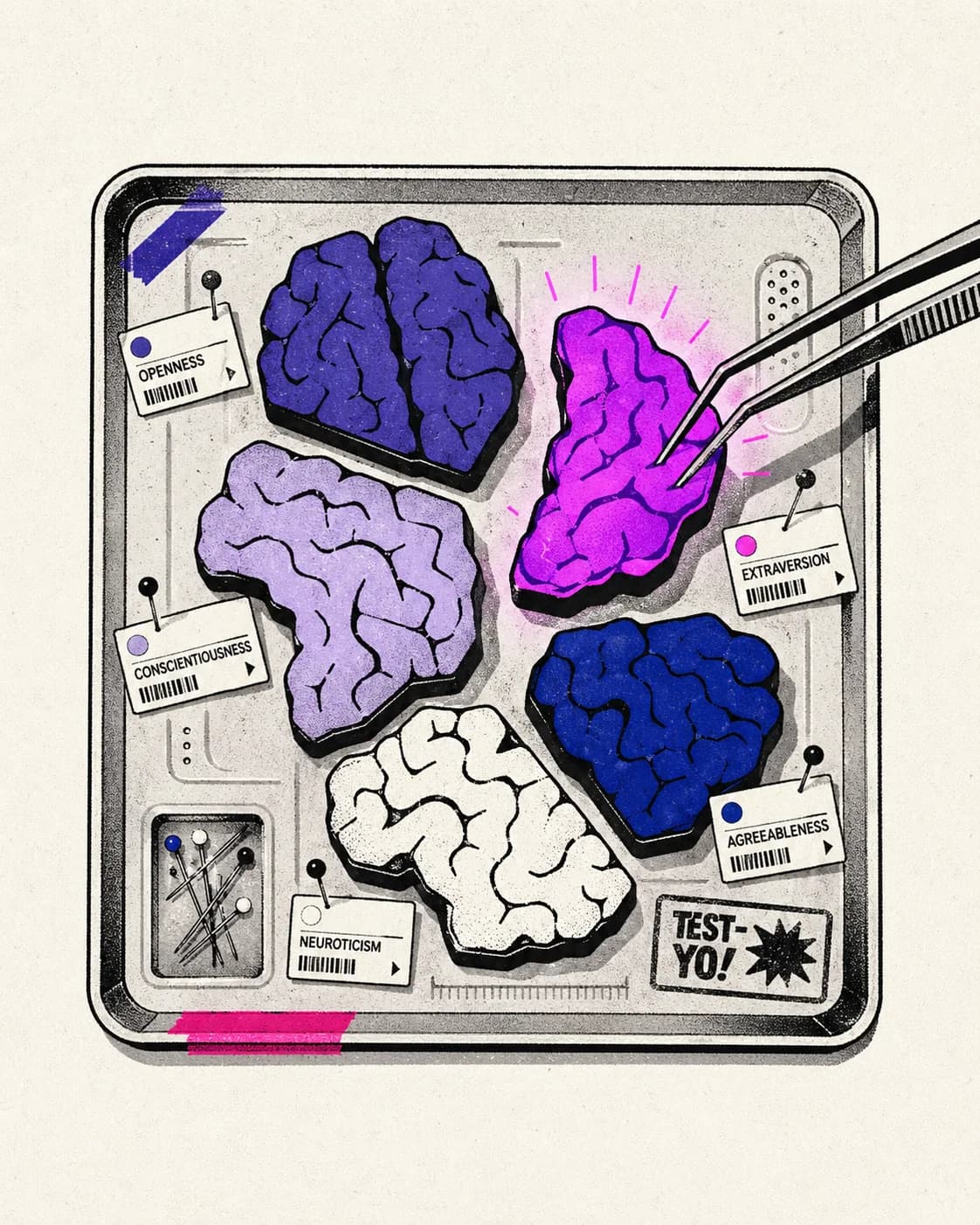
Our test (like most Big Five instruments) returns your standing on: - Openness — curiosity, art, abstraction - Conscientiousness — discipline, planning, follow-through - Extraversion — external energy, social drive - Agreeableness — warmth, cooperation, trust - Neuroticism — emotional reactivity to setbacks
The short-form we show tells you which trait is your dominant one. That's the clearest signal but only part of the picture.
Reading trait scores
A trait score is a percentile — where you sit compared to a reference population. A score in the 70th percentile doesn't mean you're "70% Open" — it means you're more Open than about 70% of people in the sample.
What the ranges typically mean: - Below 30th percentile: Strongly low. A defining feature of your profile. - 30th-70th: Typical range. Present but not a distinguishing feature. - Above 70th: Strongly high. A defining feature. - Above 90th: Distinctive. This is the trait you'd likely be described by.
Having "average" scores on several traits isn't bland — it's just the middle of a bell curve. The meaningful signal is which traits are clearly high or clearly low.
Trait combinations that actually matter
Individual traits are useful. Combinations are often more descriptive:
High Openness + High Conscientiousness — the productive creative. Generates ideas AND ships them. Rare and valuable.
High Openness + Low Conscientiousness — the idea person. Endless creativity but struggles with follow-through. Often needs a disciplined collaborator.
High Conscientiousness + Low Openness — the reliable operator. Excellent execution, less comfortable with ambiguity or innovation.
High Extraversion + Low Agreeableness — the dominant leader. Comfortable with conflict, builds momentum, harder on people.
High Extraversion + High Agreeableness — the connector. Warm, energising, harmony-seeking. Often ends up in HR, teaching, team leadership.
High Conscientiousness + High Neuroticism — the anxious achiever. High performer fuelled partly by fear of failure. Effective but at a personal cost.
Low Neuroticism + High Extraversion — the easy-going optimist. Often high life satisfaction, sometimes misses early warning signs in others.
Common misreadings
"I got Extraversion — I must be an extrovert": Your dominant trait is the one that stands out most in your profile, not necessarily the one you score highest on in absolute terms. If your Extraversion is 65th percentile and your Agreeableness is 62nd, Extraversion "won" but you're about equally describable by both.
"My Neuroticism is high — I must have mental health issues": No. Neuroticism measures a normal trait range. Clinical depression and anxiety are diagnosed via different criteria. A high Neuroticism score means you're more emotionally reactive than average, not that you're unwell.
"My scores changed from two years ago — the test is unreliable": Possibly — or your personality moved. Personality shifts over years of life events are real (see our personality-change article). Retest reliability for Big Five is high within weeks, lower over years.
"I'm low on Agreeableness so I'm a bad person": Agreeableness isn't ethics. People low in Agreeableness can be highly ethical; people high in Agreeableness can be unethical when the group rewards it. They're separate dimensions.
What your result doesn't tell you
- Your intelligence
- Your values
- Your ethics
- Your competence at any specific skill
- Whether you'd be happy in a specific job or relationship
Using your result productively
1. Look at your top and bottom traits. Those are your defining features. 2. Read the archetype page for your dominant trait — it expands on patterns you'll recognise. 3. Read the trait deep-dive for your weakest-scoring trait — that's where growth usually lives. 4. Retake in 6-12 months to see drift.
Results are descriptive, not prescriptive. They tell you where you currently are — not where you have to stay.