18+. This article is for adults. It explains the vocabulary of kink in plain language, groups common interests into six families and shows how to work out your own. It does not describe sex, and it does not tell anyone what they should want.
Search for a list of kinks and you will often find long, blunt lists with no explanation. This one goes the other way: fewer items, clear definitions, and the context that makes the list useful, namely what the words mean, how common these interests are and how people talk about them safely.
What is a kink?
A kink is a sexual interest, activity or fantasy that goes beyond what a given culture treats as conventional. The word is deliberately loose. It can mean a preference for a particular kind of touch, an interest in taking or giving up control, or a liking for costumes and scenarios. What counts as "kinky" depends on who you ask, and it changes over time.
Two things stay constant in the way the word is used. First, a kink is between adults who have agreed to it. Second, a kink is an interest, not an identity you are obliged to adopt. Plenty of people have a fantasy they never act on, and that is just as valid as acting on one.
Kink versus vanilla
"Vanilla" is the everyday word for sex without kink elements. It is not an insult and not a rank: vanilla and kinky are ends of a spectrum, and most people sit somewhere in the middle. Someone who enjoys a blindfold once a year and someone who builds their whole intimate life around a dynamic are both on the same spectrum, just at different points.
Kink versus fetish
The two words overlap in everyday use, but they are not the same. In common use, a kink is any unconventional interest, while a fetish is a strong, often specific attachment to a particular object, material or situation, one that can feel necessary for arousal.
Clinicians draw a sharper line. The DSM-5, the diagnostic manual used in psychiatry, separates an unusual interest from a disorder. A disorder is diagnosed only when the interest causes real distress or impairment for the person, or involves harm to or a lack of consent from another person. An interest that is practised between consenting adults and does not cause the person distress is not a disorder. In other words, having a kink or a fetish is not a diagnosis; what matters is distress, harm and consent.
How common are kinky interests?
More common than most people assume, although the exact numbers depend on how a study asks the question.
- Fantasies. In a 2015 survey of 1,516 adults from the general population in Quebec, Joyal, Cossette and Lapierre asked people to rate a long list of sexual fantasies. Many fantasies often labelled "unusual" turned out to be common. The authors concluded that we should be careful about calling a fantasy unusual, let alone deviant, and that what matters more is its effect on the person than its content.
- Activities. A Belgian study of 1,027 adults, representative of the general population, asked about dozens of BDSM-related activities. Holvoet and colleagues found that a substantial share of people had tried at least one such activity, and a smaller share did so regularly. (BDSM is short for bondage and discipline, dominance and submission, and sadism and masochism.)
- Well-being. Wismeijer and van Assen compared 902 BDSM practitioners with 434 controls in 2013. On several measures the practitioners scored as well as or better than the control group, for instance on subjective well-being. The authors suggested that BDSM may be better seen as a leisure interest than as a sign of psychological problems. This is one study of people who chose to take part, so read it modestly: it shows that kink and good mental health can go together, not that kink improves mental health.
A list of kinks in six families
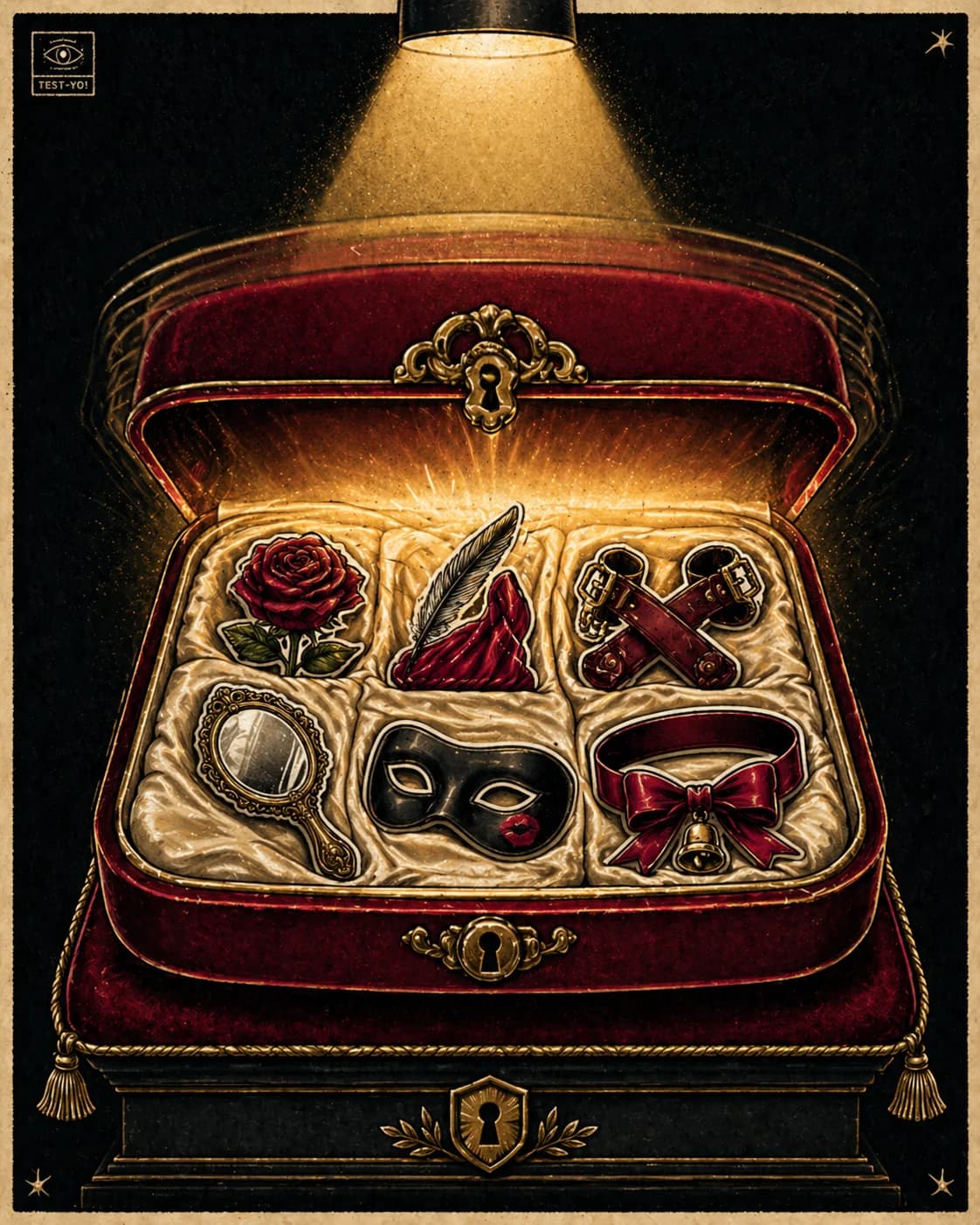
Long lists of individual kinks are hard to use, because most interests cluster. Test-Yo's free kink test groups them into six families, and this list follows the same grouping. Each family has a neutral definition, a few common interests named in mainstream terms, and a link to the matching result page. Every item is understood as something between consenting adults, agreed in advance.
Vanilla+
Vanilla+ describes people whose intensity comes from presence and closeness rather than props or roles. It is the family closest to conventional intimacy, with a small twist. See the Vanilla+ result.
- Slow, unhurried time: deliberately taking an evening with no rush and no agenda.
- Eye contact and closeness: paying deliberate attention to each other.
- Massage: giving and receiving touch for its own sake.
- Trying one new thing: a change of place, time or routine agreed in advance.
- Talking during intimacy: saying aloud what feels good.
Sensory
Sensory interests centre on how things feel, sound and smell. The appeal is heightened attention to the body: texture, temperature and anticipation. See the Sensory result.
- Blindfolds: taking away sight so that other senses stand out.
- Temperature play: contrasts between warm and cool.
- Textures: fabrics, feathers or other soft materials.
- Light impact play: playful, agreed-on firm touch, kept gentle and stopped at once if either person says so.
- Massage with oils: slow touch with a scent or warmth added.
Power Play
Power Play is about negotiated differences in control. One person leads, one follows, or roles switch, and both know it is an agreement rather than a real hierarchy. See the Power Play result.
- Dominance and submission (D/s): an agreed dynamic in which one partner leads and the other follows.
- Bondage and restraint: agreed, easily released restraints, always with a way to stop at any moment.
- Switching: trading the leading and following roles.
- Rules and rituals: small agreed rules that shape an evening.
- Choosing who decides: handing one decision, such as what to do next, to a partner.
Watching
Watching interests centre on seeing and being seen. The important word is "consenting": these interests concern people who know about and want the attention. See the Watching result.
- Voyeurism between consenting adults: enjoying being watched by a partner who has agreed, never watching someone who does not know.
- Exhibitionism between consenting adults: enjoying being seen by a partner who wants to see, and only within private, agreed settings.
- Dressing up: choosing clothes to be looked at.
- Mirrors and lighting: setting a scene so that seeing is part of it.
- Privacy rules: agreeing in advance what is never photographed, recorded or shared.
Roleplay
Roleplay is imagination with an agreed frame. Adults step into characters or scenarios and step out again, and everyone involved knows it is play. Every role is an adult role. See the Roleplay result.
- Scenarios: meeting as strangers, a first date or a fantasy setting.
- Costumes: clothes that mark the character.
- New names: using a different name for an evening.
- Characters: adult roles such as two strangers at a hotel bar, a film star and a fan, or two travellers.
- A word to leave the scene: an agreed phrase that ends the play at once.
Devotion
Devotion centres on care, attention and the other person's enjoyment. It is often the gentlest family and can sit inside any of the others. See the Devotion result.
- Acts of service: doing something thoughtful for a partner as part of the evening.
- Praise: saying aloud what you appreciate.
- Aftercare: time set aside afterwards for comfort, water, talking and closeness.
- Care rituals: running a bath, brushing hair, tucking in.
- Attentiveness: putting the other person's pleasure first, by agreement.
The six families at a glance
| Family | What it centres on | Common first step couples talk about |
|---|---|---|
| Vanilla+ | Presence and closeness | An unhurried evening with no agenda |
| Sensory | Texture, temperature, anticipation | A blindfold or massage with oils |
| Power Play | Agreed control and roles | Who chooses what happens next |
| Watching | Seeing and being seen | Lighting, mirrors and privacy rules |
| Roleplay | Imagination and characters | A different name for one evening |
| Devotion | Care and attention | Praise and what comfort looks like afterwards |
Most people are a mix. The result of a quiz names your strongest pattern, not your whole self.
Terms you will see
Kink communities have built a vocabulary to keep things safe. These are the terms worth knowing.
- Consent: a clear, freely given yes from every person involved, that can be withdrawn at any time. Saying nothing is not consent. Being intoxicated or pressured is not consent.
- Negotiation: the conversation before anything happens about what you want, what you do not, and how you will stop.
- Safe word: a word or phrase that stops everything at once, no questions asked. Some people also use a simple "pause".
- Traffic-light system: green means keep going, yellow means slow down or check in, red means stop.
- Aftercare: the time afterwards for comfort, reassurance and talking, since intense moments can leave people feeling emotional.
- SSC: "safe, sane and consensual". An older and widely used guideline: keep activities safe, be of clear mind, and agree first.
- RACK: "risk-aware consensual kink". A newer framing that acknowledges that no activity is risk-free, so the emphasis is on knowing the risks and agreeing to them with open eyes.
- Hard limits: things you will never do. They are not up for debate.
- Soft limits: things you are unsure about and might try in certain conditions, or only with more trust.
- Yes, no, maybe list: a private checklist where each person marks every idea as yes, no or maybe, and then you compare only where you overlap.
How to find your kinks
You do not have to know what you like in advance, and you do not have to pick a label. These steps help.
1. Reflect privately. Notice what you find yourself thinking about, reading about or drawn to. Curiosity counts, and so does "I am not sure". 2. Use a yes, no, maybe list. Marking ideas privately removes the pressure of answering aloud. 3. Take the [kink test](/en/tests/kink-archetype-test). It is free, has 24 questions, takes about three minutes and needs no sign-up. It places you in one of the six families above. It is not a validated clinical instrument, so treat the result as a starting vocabulary, not a verdict. 4. Try a private partner match. If you and a partner both take the test, the partner match shows only the statements you both agreed with, so neither of you has to reveal anything one-sided. 5. Talk. Bring curiosity, not a demand: "I read about this and I am curious what you think." A no or a maybe is a fine answer. The couples' guide has conversation starters for each family. 6. Start small and check in. One small step, then talk about it afterwards: what you liked, what you would change, and whether to continue.
Safety, briefly
- Agree before, not during. Limits and a stop word belong in the conversation before anything starts.
- Sober and unhurried. Clear heads are part of consent.
- Easy release. Anything that limits movement needs an immediate way out.
- Skip what is widely considered unsafe. Restricting breathing is generally regarded as unsafe and is not covered here.
- Privacy. Agree what is never photographed, recorded or shared, and keep to it.
- Aftercare. Give it time, even after mild play.
When to talk to a professional
Kink is not a problem in itself. It is worth talking to a professional when:
- an interest causes you ongoing distress, shame that will not lift or trouble in your relationship;
- it feels compulsive, or gets in the way of work, relationships or daily life;
- anyone involved is not freely consenting, or you feel pressured into something you do not want.
A kink-aware or sex-positive therapist is a good fit, because you do not have to spend the session defending the interest itself. Directories such as the one kept by AASECT, the American Association of Sexuality Educators, Counselors and Therapists, list certified sex therapists. If you or someone else is in danger, contact local emergency services.
The short version
Kinks are common, varied and mostly harmless when they are agreed between adults. The label matters less than the process: talk first, agree limits, keep a stop word, and check in afterwards. Start from your own curiosity, go at the pace of the more cautious person, and remember that a no is always allowed.