 TEST-YO!· Growth Mindset
Implicit Theories · Dweck 2006
Are You Fixed or Growing?
Is your mind a fortress — or still growing? 16 honest questions.
- 5 min
- 16 questions
- No signup
- Free
Full result at the end — no email needed
Possible results · which one are you?
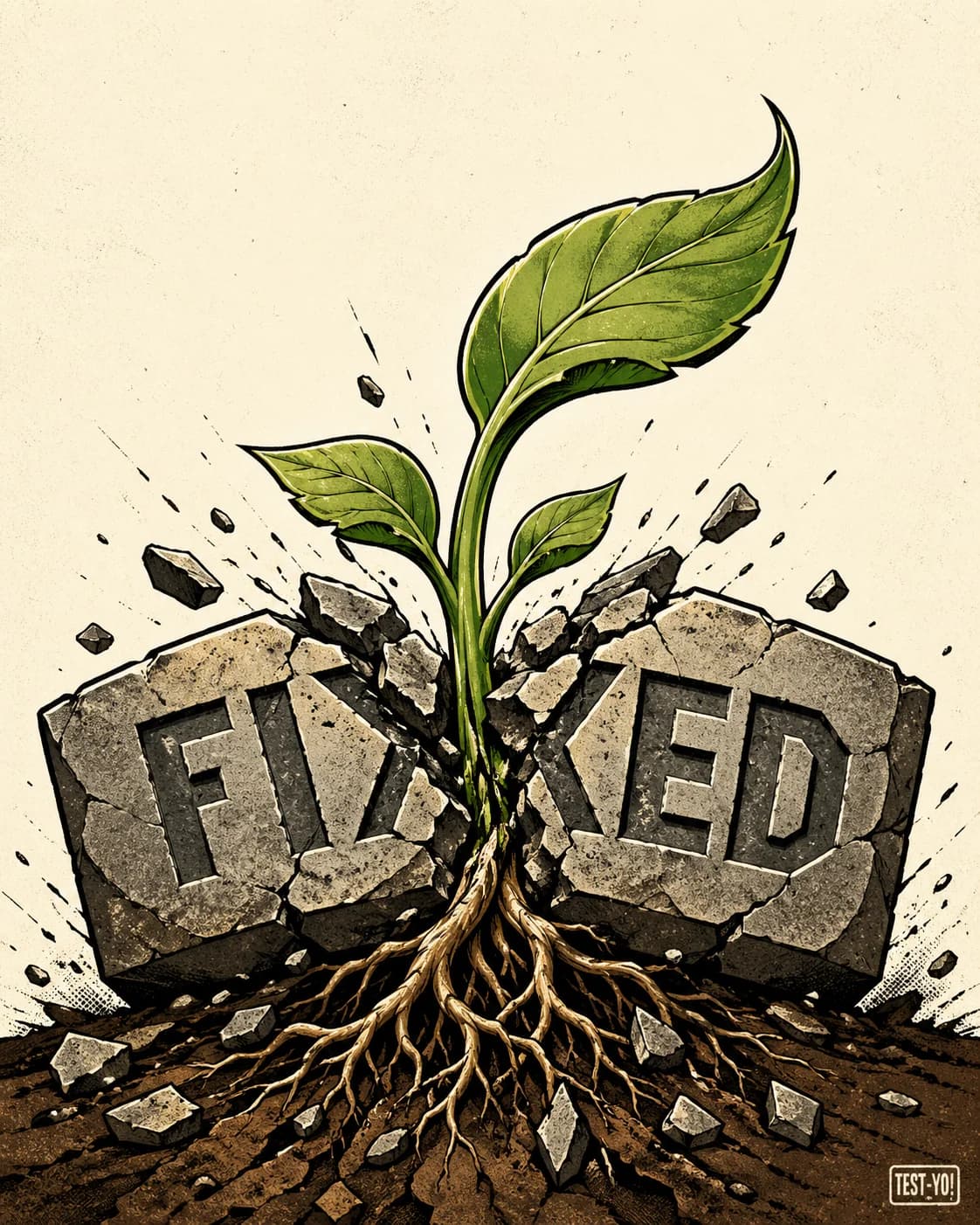
- Fixed Fortress
- At the Crossroads
- Rising Learner
- Open Grower
Quick answer
Your answers lead to one of 4 results: Fixed Fortress, At the Crossroads, Rising Learner, or Open Grower.
- 16 questions · ~5 min
- Based on: Dweck, C. S. (2006)
- Cost: free · no signup
About this test
A 16-item form drawn from Carol Dweck's Implicit Theories scales (intelligence, personality, and character). Eight items describe a fixed view of ability and character, eight describe a growth view. Your answers are summed (fixed items reverse-scored) to place you on a single axis from Fixed Fortress to Open Grower.
Methodology
Based on Dweck, C.S. (1999) Self-theories: Their role in motivation, personality and development, and Dweck, C.S. (2006) Mindset: The New Psychology of Success. This 16-item form draws on Dweck's Implicit Theories of Intelligence, Personality, and Character scales, pairing 8 fixed-mindset items with 8 growth-mindset items on a 6-point Likert scale; fixed items are reverse-scored and summed (range 16–96).
Possible archetypes
- Fixed Fortress · Born-this-way energy
- You came pre-installed and the receipt is missing. Lo sabemos.
About: Fixed Fortress
Your answers lean strongly toward an entity view of intelligence: you see ability and talent as mostly fixed. This can help you play to your strengths, but Dweck's research links strong fixed mindsets with avoidance of challenge and fragile responses to setbacks.
- At the Crossroads · Delulu-meets-real
- Growth, in theory. Talent, in your case. We see the loophole.
About: At the Crossroads
You scored in the mostly-fixed band. People here often believe growth is possible in principle but doubt it in their own case, especially for intelligence. Small wins on effortful tasks can shift this position.
- Rising Learner · Failure-as-data
- You treat every L as a tutorial. Annoyingly healthy of you.
About: Rising Learner
You scored in the mostly-growth band. You see intelligence and talent as trainable, interpret setbacks as information, and generally believe effort pays off. Research associates this stance with mastery-oriented goals and resilience.
- Open Grower · Delulu-but-it-works
- You believe you can become anything. Slightly soñador, fully working.
About: Open Grower
You sit at the top of the growth band. You treat intelligence and talent as mostly trainable and welcome hard feedback. The literature links strong growth mindsets with higher engagement on difficult tasks and better recovery from failure.
Related tests
Related reading
The Big Five Personality Traits Explained
What Openness, Conscientiousness, Extraversion, Agreeableness and Neuroticism actually measure — and why researchers trust this model.
Holland's RIASEC Career Model Explained
The six career-personality types behind the most widely used career assessment in the world — and how to read your own profile.
Sources & references
- Dweck, C. S. (2006). Mindset: The New Psychology of Success. Random House.
FAQ + disclaimer
Is this a clinical assessment?
No. It's a short, self-reflection version of Dweck's Implicit Theories of Intelligence scale. It is not diagnostic.
Can mindset change?
Dweck's research shows that mindset can shift with experience, feedback framing, and deliberate practice.