 TEST-YO!· Love Language
Love Language Test — How do you feel most loved?
Discover which everyday gestures help you feel loved: kind words, focused time, practical help, thoughtful gifts or physical affection. Answer 25 short statements, see your scores for all five love languages, and use your free result to start a conversation.
- 2 min
- 25 questions
- No signup
- Free
Full result at the end — no email needed
Possible results · which one are you?
- Words of Affirmation
- Acts of Service
- Receiving Gifts
- Quality Time
- Physical Touch
Quick answer
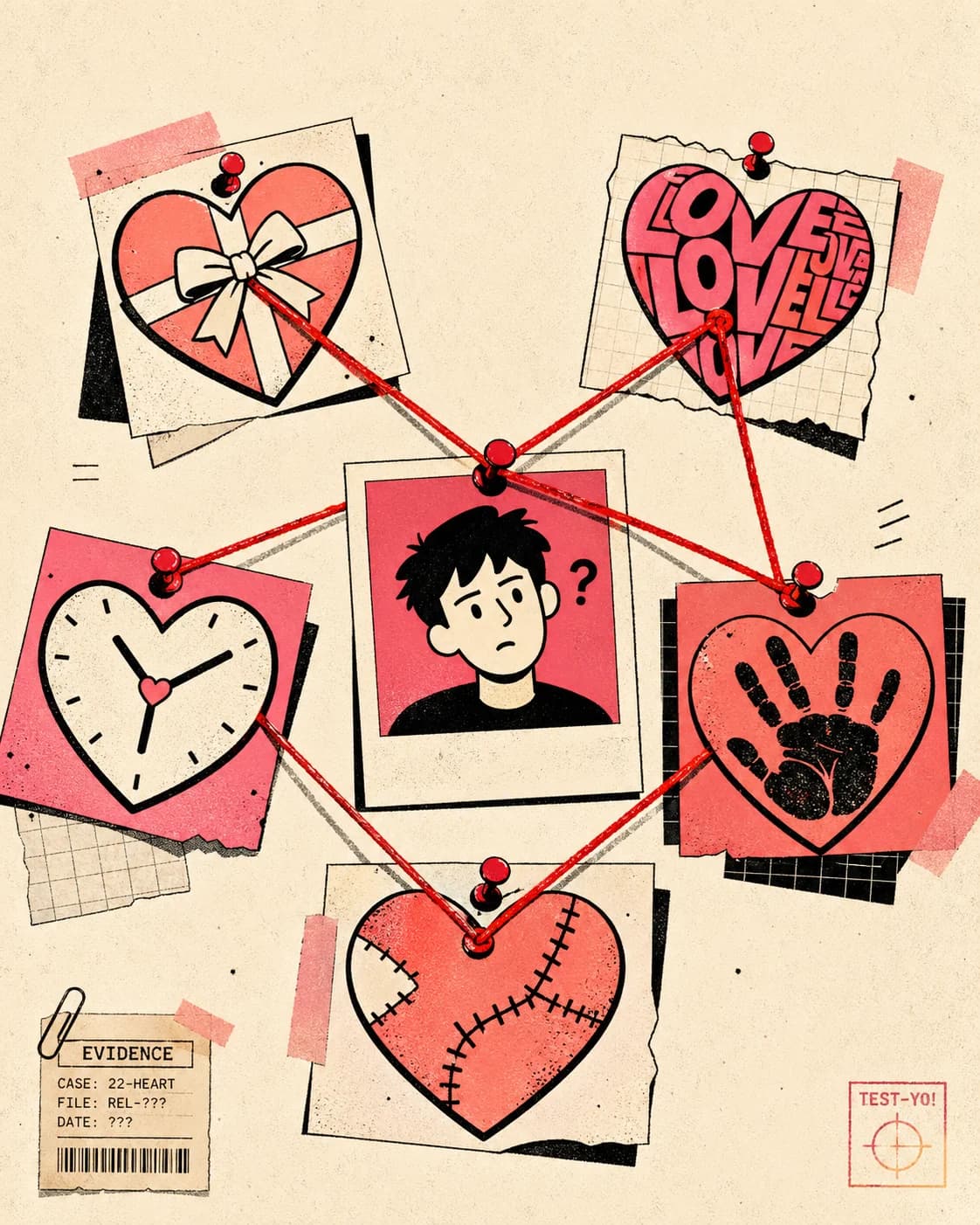
Your answers lead to one of 5 results: Words of Affirmation, Acts of Service, Receiving Gifts, Quality Time, or Physical Touch.
- 25 questions · ~2 min
- Cost: free · no signup
About this test
This independent 25-question self-reflection quiz explores the five love languages popularised by Gary Chapman: words of affirmation, quality time, acts of service, gifts and physical touch. You rate five statements per language on a five-point scale. The free result shows your highest-scoring language and each language’s score as a percentage of its own maximum, rather than five shares adding to 100. The evidence for the framework’s core claims is mixed. Use your result to discuss welcome gestures and changing needs, not as a diagnosis, a compatibility measurement or a scientific verdict.
Methodology
25 original self-report statements, five per love language, rated on a five-point scale. Scores compare each language with its own maximum; the top score selects your result. The framework was popularised by Gary Chapman. This independent quiz is not the official assessment, and research support for the framework’s core claims is mixed.
The 5 love languages
Love languages are five ways of expressing and receiving affection, popularised by Gary Chapman. This list gives you words for preferences, not five fixed types of person. You can appreciate every language, and your partner may value different gestures.
- Words of affirmation
- Showing care through sincere words of appreciation, encouragement and affection. Thank your partner for listening after a difficult day. Leave a note naming something you admire about them.
- Quality time
- Giving someone your attention while spending time together. Put your phones away for a conversation over dinner. Take a walk together and ask how their day really went.
- Acts of service
- Showing care by doing something helpful that the other person welcomes. Cook dinner when your partner has a busy evening. Take an agreed household task off their list without waiting to be reminded.
- Gifts
- Choosing a thoughtful token that says you remembered someone; its meaning matters more than its price. Bring home their favourite snack. Make a small photo card to mark a shared memory.
- Physical touch
- Sharing physical affection that both people want and feel comfortable with. Hold hands on a walk if you both enjoy it. Offer a hug after a hard day and respect the answer, including no.
Independent quiz, not affiliated with Gary Chapman or Northfield Publishing. The 5 Love Languages is their trademark.
How to use your result with your partner
Compare all five scores rather than only your top label. Each percentage is your score out of that language’s maximum, so the five numbers do not have to add up to 100. Take turns saying “I feel cared for when…” and give one specific example. Each choose a small, welcome gesture to try this week, then ask how it felt. Different top languages are not a compatibility verdict. A preference never creates an obligation to spend money, provide touch or ignore your own boundaries.
Love languages for kids and family
Use the five ideas as prompts for noticing what each family member enjoys, rather than assigning children a permanent label. Praise a child’s effort, read together, help with a difficult task, make a drawing for them or offer a hug they can decline. Ask what felt good and offer different kinds of care. This quiz is written for self-reflection about relationships, not validated as an assessment for children; parents should not answer it to diagnose a child’s needs.
Possible archetypes
- Words of Affirmation · Tell me I look good
- Call me pretty or this whole relationship collapses. We both know it.
About: Words of Affirmation
Your top language is Words of Affirmation. Verbal and written expressions of love land deepest with you — sincere compliments, "I love you", a thoughtful text, public praise. The flip side is that careless or harsh words can wound you for a long time. Tell partners directly: "When you put it into words, I feel it."
- Acts of Service · Just do the dishes
- Tell me you love me by emptying the dishwasher. That's it. That's the post.
About: Acts of Service
Your top language is Acts of Service. The dishwasher unloaded, the form filled in, the errand quietly handled — those are how you read love. You believe actions are louder than words. The flip side: broken promises and unfinished commitments hit you especially hard, even if your partner says all the right things.
- Receiving Gifts · It's the thought
- You don't want it to be expensive. You want it to be proof.
About: Receiving Gifts
Your top language is Receiving Gifts. A small object that says "I was thinking of you" can carry enormous emotional weight for you. It is rarely about cost — it is about the proof of attention behind the gesture. Forgetting an anniversary or showing up empty-handed when it matters can sting more than your partner realises.
- Quality Time · Phone down or leave
- Scroll TikTok while I'm talking and I will plot your downfall. Calmly.
About: Quality Time
Your top language is Quality Time. Full attention — phone away, eyes meeting, real conversation — is what tells you that you matter. You'd rather have a quiet evening on the sofa than an expensive surprise. The flip side is that distracted, half-present interactions can feel almost like rejection, even when your partner has the best intentions.
- Physical Touch · Touch-starved mode
- Three days without a hand on your back and you start unraveling.
About: Physical Touch
Your top language is Physical Touch. A hug at the door, a hand on the back, sitting close on the sofa — these tactile signals soothe and reassure you in a way that words alone cannot. Long stretches without physical affection can leave you feeling disconnected even from a loving partner.
Related tests
Related reading
What you unlock
EUR 4.99 · One payment · no subscription
- Love Wheel and private deep matches — unlimited for 30 days
- A seven-day plan and messages to start a conversation
- Full readings on all four “Do they like me?” quizzes
- Secret Crush links — feelings revealed only when mutual
FAQ + disclaimer
What are the five love languages?
Words of affirmation, quality time, acts of service, gifts and physical touch. These are categories of affectionate gestures, not an exhaustive list of human needs. The definitions and everyday examples above can help you name what matters to you.
Can you have two love languages?
Yes. You can value two, several or all five. Similar scores are a useful reason to discuss more than one preference. The quiz selects a top result for convenience; a close score or tie does not mean one of your preferences is less real.
Can your love language change?
Yes. What feels caring can shift with your circumstances, relationship and current needs. Use your answers as a snapshot and ask each other again rather than treating the result as a lifelong identity.
Are love languages scientific?
The evidence for the framework’s core claims is mixed. It is not established that everyone has exactly one primary language or that matching languages guarantees a better relationship. This independent self-reflection quiz is not a validated clinical assessment or a substitute for relationship counselling.
What if my partner has a different love language?
Ask which specific gestures they welcome and explain your own preferences. Try a small action each and check in afterwards. Different results do not measure compatibility, and no result overrides consent, boundaries or the need for respectful communication.
Is the love language test free, and how long does it take?
The 25-question quiz and all five result scores are free, with no signup or purchase needed. Allow about 2 minutes, or take longer to reflect. Each score is a percentage of its own maximum; the scores are not shares of a single total.