 TEST-YO!· Love Block
What Belief About Love Is Holding You Back?
This love limiting belief quiz explores recurring assumptions about closeness, abandonment, deserving care and feeling safe alone. It is for anyone reflecting on relationship self-talk who wants words for concerns, without predicting a partner’s feelings or diagnosing an attachment style.
- 3 min
- 24 questions
- No signup
- Free
Full result at the end — no email needed
Possible results · which one are you?
- "I'll Be Left"
- "I'm Too Much"
- "Love Is For Others"
- "I Have To Earn It"
- "Anyone Good Leaves"
- "I'm Safer Alone"
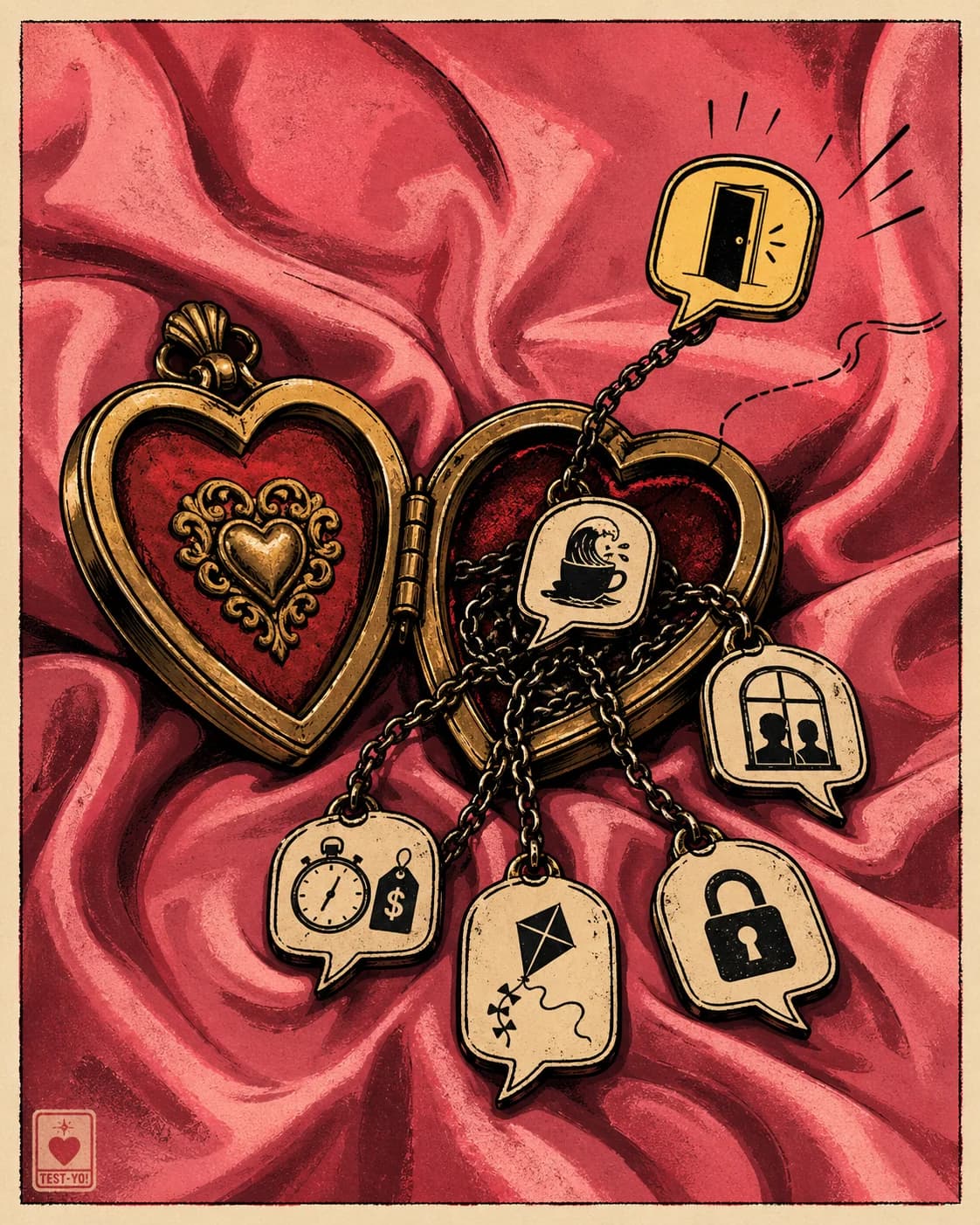
Quick answer
Your answers lead to one of 6 results: "I'll Be Left", "I'm Too Much", "Love Is For Others", "I Have To Earn It", "Anyone Good Leaves", or "I'm Safer Alone".
- 24 questions · ~3 min
- Cost: free · no signup
About this test
The sentence about love you've been operating under, often inherited. 24 honest items, one verdict on the script costing you connection.
Methodology
24 items, 4 per belief, 5-point Likert. Dominant-belief scoring across six classic love limiting beliefs.
What the results mean
These quoted beliefs are patterns in your answers, not predictions about love. Another person’s actions and your safety need attention independently of any quiz label.
- "I'll Be Left"
- Your answers suggest expecting closeness to end in being left. Notice whether a current event supports that expectation or whether uncertainty is filling the gap. The label cannot predict abandonment and does not mean you should ignore actual signs of an unreliable relationship.
- "I'm Too Much"
- Your answers suggest editing your needs or expression because you worry they are excessive. Consider what you want to communicate and whether the relationship allows respectful differences. The result does not tell you that every request must be accepted or that your needs are wrong.
- "Love Is For Others"
- Your answers suggest treating love as something available to others rather than to you. Notice what that story leaves out about your own hopes and choices. The quiz cannot promise a future relationship, and being single does not make the belief true.
- "I Have To Earn It"
- Your answers suggest connecting being loved with providing help, effort or reassurance. Consider whether receiving care feels possible without immediately repaying it. The label does not determine what you owe someone or require you to give more to keep a relationship.
- "Anyone Good Leaves"
- Your answers suggest expecting warmth or kindness to disappear. Caution may have a context worth respecting, while a new person's behaviour needs its own evidence. This result cannot identify deception or establish that someone kind will stay or leave.
- "I'm Safer Alone"
- Your answers suggest that independence feels safer than closeness. You can value being alone without needing to change it. If you also want connection, consider what pace and boundaries would feel acceptable rather than treating intimacy as an obligation or a cure.
If these feelings persist, cause distress or affect daily life, consider speaking with a qualified mental health professional.
How to use your result
Choose a step that fits your circumstances:
- Choose one thought and distinguish a current event from an expected outcome.
- Name a need or boundary you would want respected in a relationship.
- Discuss a small concern with someone trustworthy only if it feels safe and useful.
Possible archetypes
- "I'll Be Left" · One foot out, always
- You break up in your head every Tuesday so the real one won't sting.
About: "I'll Be Left"
You expect love to end, so you stay ready for the exit. The good part is that you are not naive. The hard part is that preparing to be left can make your partner feel half-chosen. What helps is noticing when you are protecting yourself from a breakup that is not actually happening.
- "I'm Too Much" · Pre-shrinking myself
- You feel a lot, then immediately apologize for it. We've all watched this.
About: "I'm Too Much"
You tone yourself down so love feels safer. The good part is that you are considerate and aware of others. The hard part is that a relationship built around the edited version of you can never fully hold the real one. What helps is letting someone see more of you in small, honest steps.
- "Love Is For Others" · Outside, looking in
- You see a happy couple, smile, mutter 'must be nice', cry into a bowl of pasta.
About: "Love Is For Others"
You act like love is something other people get. The good part is that you can handle being on your own. The hard part is that you may reject yourself before anyone else has the chance to choose you. What helps is treating love as possible for you too, even if it starts slowly.
- "I Have To Earn It" · Overfunctioning
- You give 110%, they tip 4%. And you wonder why you're tired.
About: "I Have To Earn It"
You feel you have to earn love by doing more. The good part is real generosity and care. The hard part is that you may not know how to be loved when you are tired, quiet or empty-handed. What helps is practicing being received without immediately paying it back.
- "Anyone Good Leaves" · Trust no nice ones
- Someone treats you well and your first thought is 'okay, what's the catch'.
About: "Anyone Good Leaves"
You do not fully trust kindness at the start. The good part is that you can spot fake intensity and love-bombing. The hard part is that warm, honest people may get filtered out too. What helps is slowing down without shutting down.
- "I'm Safer Alone" · Safer on my own
- You'd rather eat alone in peace than text someone back. And you mean it.
About: "I'm Safer Alone"
You feel safer alone because relationships can disturb your peace. The good part is real independence and self-knowledge. The hard part is that peace can become a wall against intimacy that might actually be worth the risk. What helps is choosing slower, safer closeness instead of all-or-nothing distance.
Related tests
FAQ + disclaimer
How accurate is this quiz?
This is a self-reflection quiz, not a prediction. It summarises the answers you give here, without establishing a fixed trait or guaranteeing an outcome. It is not a diagnosis or clinical assessment.
Can my result change?
Yes. Different answers, circumstances or interpretations can produce a different result. If you retake it, compare the individual answers and context as well as the label.
Does this tell me whether my partner will leave?
No. It cannot read feelings or predict behaviour. Look at actual communication, actions and safety rather than the label.
Is this an attachment-style diagnosis?
No. The beliefs are informal reflection prompts. They do not establish an attachment style, condition or cause.
Do I need a relationship to change a belief?
No. Reflection can happen while single or partnered. Being alone is a valid preference and does not need correcting.