 TEST-YO!· What Blocks You
What's the Belief That's Holding You Back?
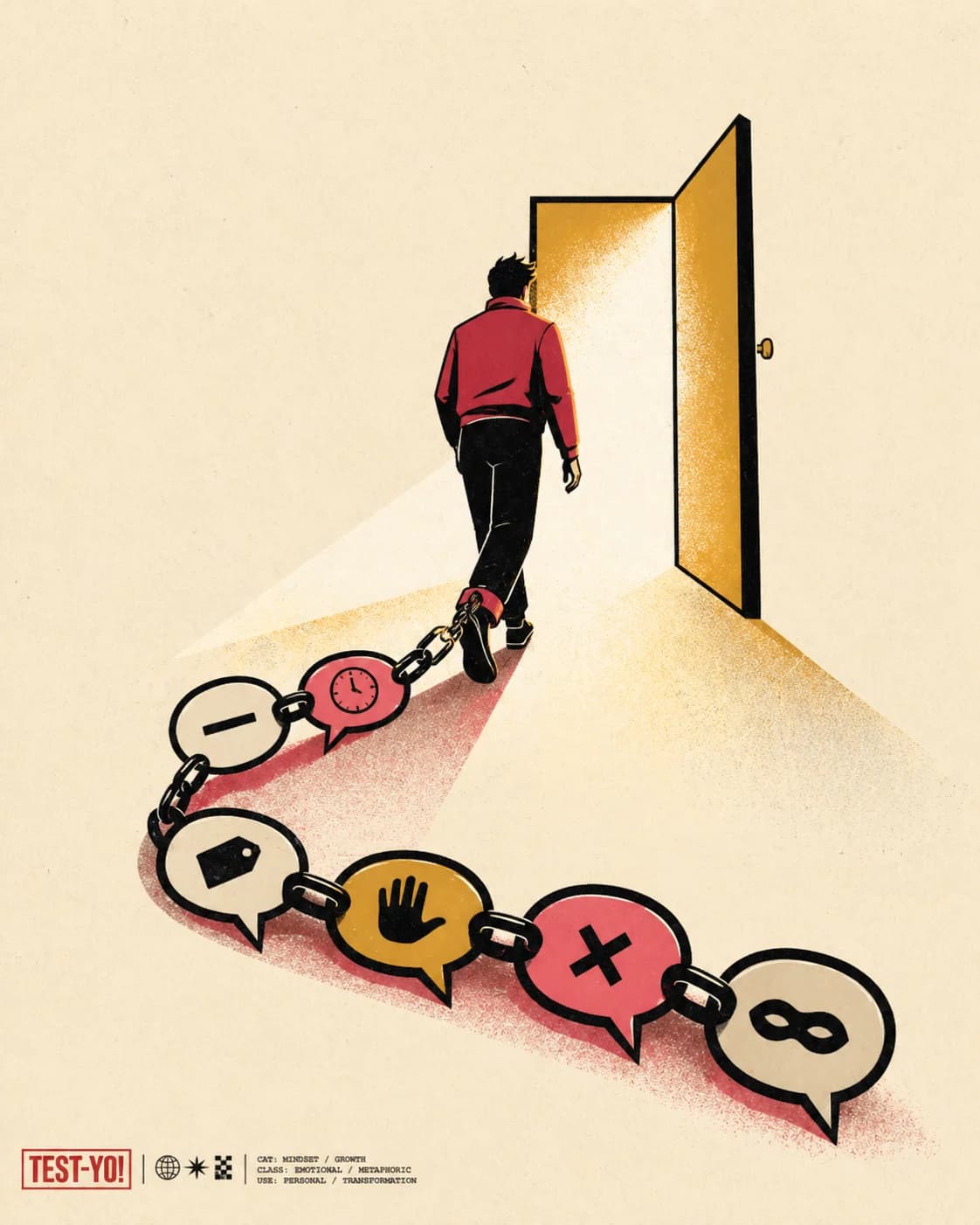
This limiting belief quiz explores recurring assumptions about worth, timing, deservingness and what might happen if you try. It is for anyone reflecting on self-talk who wants gentle prompts for examining a belief, without a diagnosis or promise of change.
- 3 min
- 24 questions
- No signup
- Free
Full result at the end — no email needed
Possible results · which one are you?
- "I'm Not Enough"
- "It's Too Late"
- "I Don't Deserve It"
- "I'd Be Selfish"
- "It Won't Work Anyway"
- "I'll Be Found Out"
Quick answer
Your answers lead to one of 6 results: "I'm Not Enough", "It's Too Late", "I Don't Deserve It", "I'd Be Selfish", "It Won't Work Anyway", or "I'll Be Found Out".
- 24 questions · ~3 min
- Cost: free · no signup
About this test
The belief running quietly in the background of your life. 24 honest items, one verdict on the script you've been working against.
Methodology
24 items, 4 per belief, 5-point Likert. Dominant-belief scoring across six classic self-limiting beliefs.
What the results mean
The quoted labels name thoughts you endorsed, not truths about you. They do not identify a disorder, reveal a hidden cause or explain your whole life.
- "I'm Not Enough"
- Your answers suggest a recurring sense that effort or achievement still leaves you short of enough. Notice how the standard moves and whether you would apply it to someone else. The quoted label describes a thought, not a measure of your worth.
- "It's Too Late"
- Your answers suggest treating an opportunity as already past. Some constraints may be real, while others may deserve a closer look. Separate the practical limits of one situation from a conclusion that every possible version of something important is closed.
- "I Don't Deserve It"
- Your answers suggest discomfort with receiving good things or feeling deserving of them. Notice what you expect might happen after praise or support. The result does not establish why you feel this way or imply that you caused difficult experiences.
- "I'd Be Selfish"
- Your answers suggest equating having needs with being selfish. Consider a specific request and how it differs from demanding agreement. Other people's limits still matter, and naming your own needs does not require deciding that everyone must meet them.
- "It Won't Work Anyway"
- Your answers suggest expecting failure before an attempt has enough room to develop. Notice which conclusion comes from evidence and which comes from anticipation. A small, low-pressure experiment can provide information without requiring you to promise yourself a successful outcome.
- "I'll Be Found Out"
- Your answers suggest worrying that others have overestimated you or will discover you do not belong. Consider what you actually know and what you are still learning. This result is a reflection prompt, not a diagnosis of imposter syndrome or proof of inadequacy.
If these feelings persist, cause distress or affect daily life, consider speaking with a qualified mental health professional.
How to use your result
Choose a step that fits your circumstances:
- Write the thought as something you are noticing rather than a fact about yourself.
- Recall a specific example that fits and one that complicates the belief.
- Choose one small, safe action that lets you gather information without demanding a transformation.
Possible archetypes
- "I'm Not Enough" · Allergic to enough
- You work twice as hard as everyone else. And it still doesn't feel like enough.
About: "I'm Not Enough"
You often feel like you are close, but still not quite enough. That can push you to work hard, improve and keep proving yourself. The good part is real discipline and high output. The hard part is that proof never seems to finish the job. Once you reach one bar, another appears. What helps is noticing when you are trying to earn worth instead of simply doing good work. You do not need endless evidence to deserve rest or care.
- "It's Too Late" · Pure "ya veré" mode
- You use your age like a hall pass to skip your own life. We both know it.
About: "It's Too Late"
This belief says the chance has already passed. Sometimes that feels safer than trying and feeling exposed. The good part is that you may have a clear sense of what you wanted. The hard part is that doors can stay closed for years even when part of you still wants to walk through them. What helps is naming the real fear: being a beginner, being seen trying, or grieving lost time. The clock may matter, but it may not be the whole story.
- "I Don't Deserve It" · Waiting for the bill
- Something good happens and you're already scanning for the catch. Lo sabemos.
About: "I Don't Deserve It"
Good things can make you uneasy, as if a cost is coming. You may struggle to receive praise, success or love without looking for the catch. The good part is humility and care about fairness. The hard part is that you may sabotage good things before they can settle. What helps is practicing letting small good things be good. Accept the compliment. Enjoy the win. Notice that nothing bad has to happen just because something went well.
- "I'd Be Selfish" · Allergic to wanting
- You ask for less on purpose, then wonder why you got less. We both know it.
About: "I'd Be Selfish"
You may treat asking for what you want as if it makes you selfish. So you ask for less: less money, less help, less time, less care. The good part is that you consider other people. The hard part is that people cannot give what you never ask for. Over time, unmet needs can turn into quiet resentment. What helps is remembering that asking is not the same as demanding. People who care about you usually prefer clarity.
- "It Won't Work Anyway" · Pre-decided to lose
- You write "fail" on the test before reading the question. We both know it.
About: "It Won't Work Anyway"
You may decide something will fail before you fully try. That protects you from disappointment, but it also lowers your effort and makes failure more likely. The good part is that you are not naive. You have learned from real disappointment. The hard part is that this belief blocks the wins that could change your mind. What helps is testing small actions instead of judging the whole future at once. Let one small result give you new information.
- "I'll Be Found Out" · Pure imposter mode
- You're convinced your wins are clerical errors. Lo sabemos.
About: "I'll Be Found Out"
You may feel like people have overestimated you and will eventually find out. Compliments can make you suspicious instead of proud. The good part is humility and a strong work ethic. The hard part is that wins do not become evidence if you keep explaining them away as luck. What helps is practicing honesty with safe people: admit what you know, what you do not know and where you are still learning. Being ordinary in front of someone trustworthy can loosen the fear.
Related tests
FAQ + disclaimer
How accurate is this quiz?
This is a self-reflection quiz, not a prediction. It summarises the answers you give here, without establishing a fixed trait or guaranteeing an outcome. It is not a diagnosis or clinical assessment.
Can my result change?
Yes. Different answers, circumstances or interpretations can produce a different result. If you retake it, compare the individual answers and context as well as the label.
Are these beliefs facts about me?
No. The result names a pattern in your answers. A recurring thought can feel convincing without being a complete or accurate account of you.
Does this diagnose imposter syndrome or another condition?
No. It cannot identify a diagnosis, a cause or a treatment. The labels are informal prompts for reflection.
Do I need to replace every negative thought with a positive one?
No. Try describing the situation more specifically and acknowledging uncertainty. You do not need forced optimism or perfect confidence to reflect.