 TEST-YO!· Money Block
What Belief About Money Is Holding You Back?
This money limiting belief quiz explores assumptions about money, fairness, deservingness and asking for what you need. It is for anyone reflecting on money-related self-talk who wants conversation prompts, without a diagnosis, financial assessment or advice about earning or investing.
- 3 min
- 24 questions
- No signup
- Free
Full result at the end — no email needed
Possible results · which one are you?
- "I'm Bad With Money"
- "Money Is Dirty"
- "I Don't Deserve Wealth"
- "More Money = More Problems"
- "Asking Is Tacky"
- "It's Out of My Hands"
Quick answer
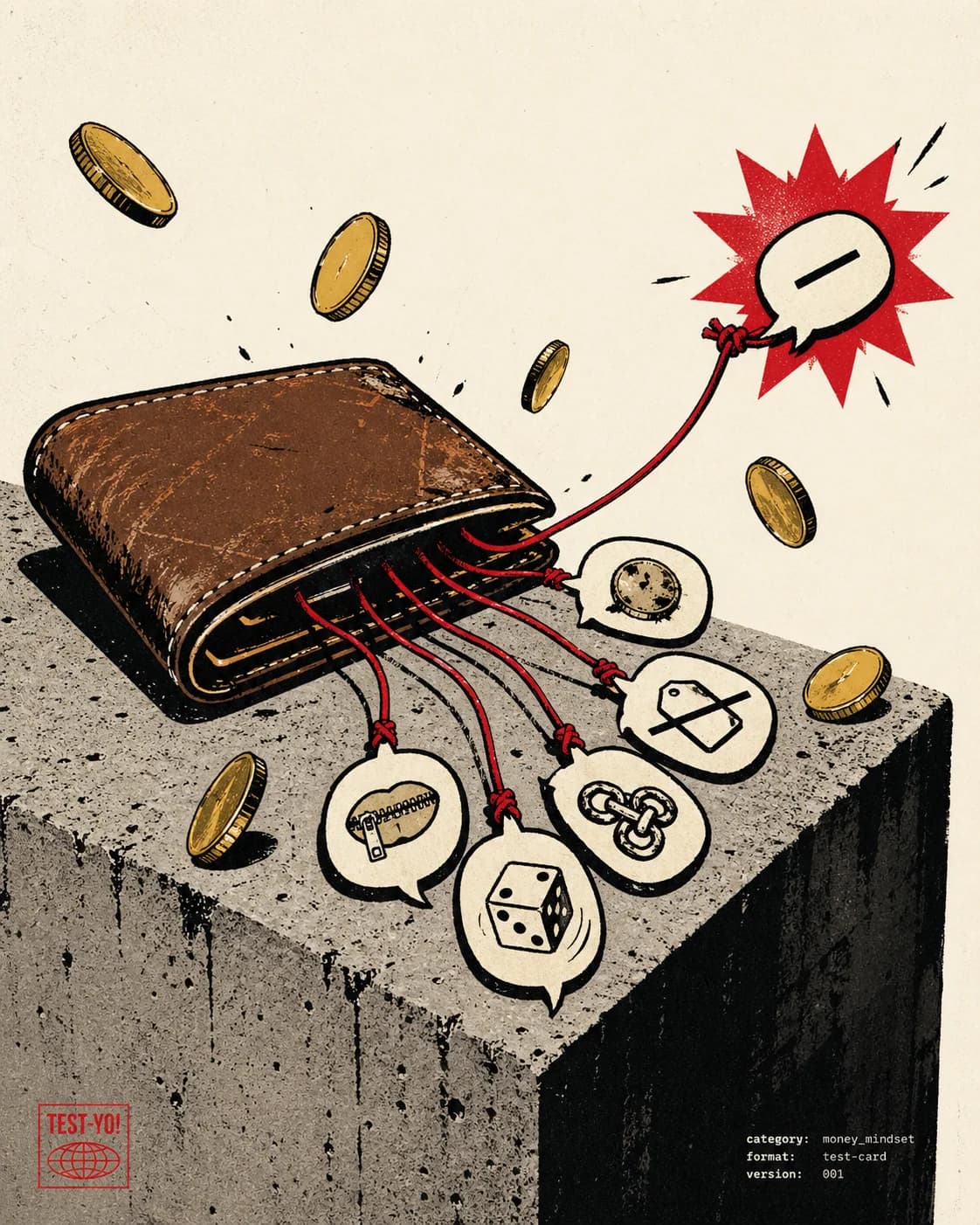
Your answers lead to one of 6 results: "I'm Bad With Money", "Money Is Dirty", "I Don't Deserve Wealth", "More Money = More Problems", "Asking Is Tacky", or "It's Out of My Hands".
- 24 questions · ~3 min
- Cost: free · no signup
About this test
The sentence about money you've been operating under, often inherited. 24 honest items, one verdict on the script costing you.
Methodology
24 items, 4 per belief, 5-point Likert. Dominant-belief scoring across six classic money limiting beliefs.
What the results mean
These are thoughts reflected in your answers, not financial facts or instructions. The guide gives no advice on prices, income, spending, borrowing or investments.
- "I'm Bad With Money"
- Your answers suggest turning difficulty with money into an identity label. Describe the specific task or uncertainty instead of judging your whole character. The quiz cannot assess financial knowledge or recommend a habit, product or decision that fits your circumstances.
- "Money Is Dirty"
- Your answers suggest associating money with harmful or unethical behaviour. Consider the particular actions you object to rather than treating the association as a universal rule. This reflection does not establish a moral judgement about wealth or recommend pursuing more of it.
- "I Don't Deserve Wealth"
- Your answers suggest connecting access to wealth with whether you deserve it. Notice the thought without taking it as a fact about your worth or future. This result provides no assessment of what you should earn, charge, receive or be able to afford.
- "More Money = More Problems"
- Your answers suggest expecting money to bring difficult responsibilities or changes in relationships. Those concerns can be examined individually rather than dismissed. The quiz cannot weigh financial trade-offs for you or determine whether pursuing a change would improve your circumstances.
- "Asking Is Tacky"
- Your answers suggest discomfort with raising money questions or making requests. Notice what you fear the conversation would communicate about you. Practising a respectful question is a communication exercise, not advice about negotiation, pricing or what another person should pay.
- "It's Out of My Hands"
- Your answers suggest feeling that financial outcomes mostly sit beyond your influence. Real systems and circumstances can constrain choices. Separate the feeling from any specific practical question, without using the label to blame yourself or assuming the quiz can identify an appropriate next financial step.
If these feelings persist, cause distress or affect daily life, consider speaking with a qualified mental health professional.
How to use your result
Choose a step that fits your circumstances:
- Write one money-related assumption and the situation in which it appears.
- Distinguish a judgement about yourself from a practical question requiring information.
- Use the result for conversation; seek qualified advice for decisions about your actual finances.
Possible archetypes
- "I'm Bad With Money" · Excel-allergic
- You haven't opened your banking app on purpose. We both know it.
About: "I'm Bad With Money"
You have started treating "bad with money" like a fact about you. The good part is that you are open to learning. The hard part is that the label can become an excuse to avoid the simple admin that would help. What helps is dropping the identity and starting with one small money habit you can repeat.
- "Money Is Dirty" · Suspicious-of-rich
- You side-eye your own raise like it owes you an explanation. Lo sabemos.
About: "Money Is Dirty"
You connect money with corruption or selfishness. The good part is that you have a strong ethical compass. The hard part is that you may block your own success just to prove you are not greedy. What helps is separating honest wealth from harmful behavior.
- "I Don't Deserve Wealth" · Pre-emptive shrink
- You undercharged again last week and called it humility. We both know it.
About: "I Don't Deserve Wealth"
You quietly assume wealth is not for people like you. The good part is that you are fair and not entitled. The hard part is that you may undercharge, under-ask and make other people richer while keeping yourself small. What helps is pricing your work by value, not by how worthy you feel.
- "More Money = More Problems" · Self-sabotage @ win
- When things go well, you mysteriously start dropping the ball. Lo sabemos.
About: "More Money = More Problems"
You believe more money will bring more stress. The good part is that you understand money can change relationships. The hard part is that you may stop at "comfortable" and never let yourself build further. What helps is planning for the problems instead of using them as a reason not to grow.
- "Asking Is Tacky" · Negotiation allergy
- You said yes to a first offer and felt classy about it. We see it.
About: "Asking Is Tacky"
You learned that talking about money is rude or awkward. The good part is that you have real social grace. The hard part is that people who simply ask may out-earn you for years. What helps is practicing money conversations as clear, respectful facts instead of personal drama.
- "It's Out of My Hands" · Fully fatalist mode
- You're waiting for a windfall like it's a bus. Lo sabemos.
About: "It's Out of My Hands"
You feel money is mostly out of your hands. The good part is that you do not blame yourself for every unfair outcome. The hard part is that the choices you do have can go unused. What helps is focusing on the next action you can control, even if the whole system is not fair.
Related tests
FAQ + disclaimer
How accurate is this quiz?
This is a self-reflection quiz, not a prediction. It summarises the answers you give here, without establishing a fixed trait or guaranteeing an outcome. It is not a diagnosis or clinical assessment.
Can my result change?
Yes. Different answers, circumstances or interpretations can produce a different result. If you retake it, compare the individual answers and context as well as the label.
Does this tell me how to improve my finances?
No. It explores self-talk and provides no financial advice, financial assessment or recommendation about products, prices, saving or investing.
Are money beliefs the cause of my financial circumstances?
The quiz cannot establish causes. Resources, opportunities, obligations and wider systems matter; financial difficulty is not proof of a harmful mindset.
Should I force myself to want more money?
No. The result does not set your values or goals. Consider what the thought means to you without treating wealth as a measure of personal progress.