 TEST-YO!· Color Personality
Color Personality — What color is your personality?
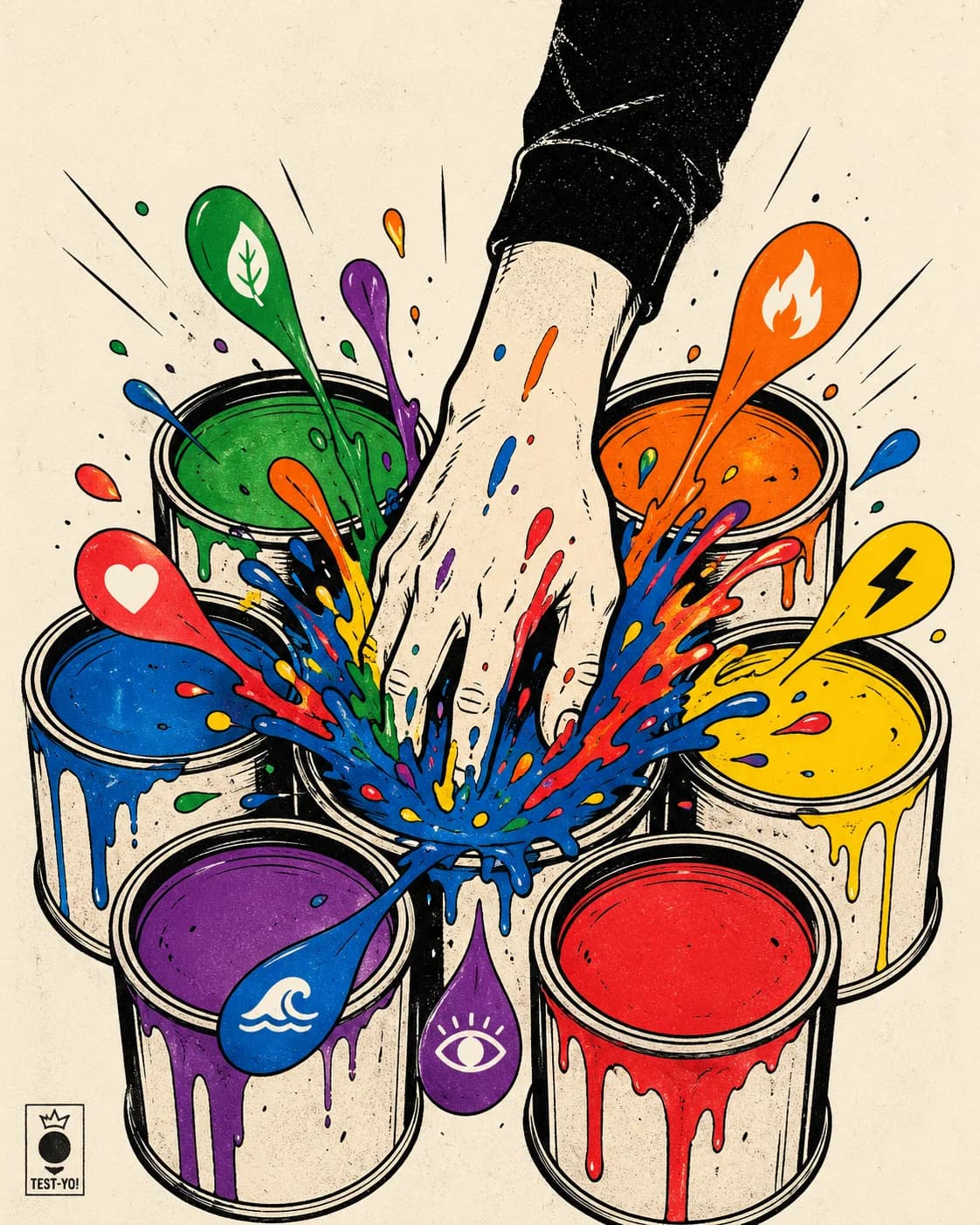
This color personality quiz explores how you describe decisions, details, social energy, support and ideas through five playful labels. It is for friends, teams or curious individuals wanting conversation prompts about preferences, without treating a colour as a fixed identity.
- 4 min
- 20 questions
- No signup
- Free
Full result at the end — no email needed
Possible results · which one are you?
- Red
- Blue
- Green
- Yellow
- Purple
Quick answer
Your answers lead to one of 5 results: Red, Blue, Green, Yellow, or Purple.
- 20 questions · ~4 min
- Cost: free · no signup
About this test
A 20-item self-report quiz that maps you to one of five color personality archetypes: red, blue, green, yellow and purple. It follows the popular four-color personality frameworks used in team workshops and school programs (Insights Discovery, True Colors and similar), where each of four personality types is given a color, and adds purple for the visionary pattern the four-type versions leave out. Each color is measured by 4 items on a 5-point Likert scale. This is a playful identity quiz — not a psychometric instrument — and a great conversation starter for teams, friends and partners.
Methodology
20 self-report items (4 per color archetype) on a 5-point Likert scale, with the highest-scoring color reported as the result. Inspired by the structure of common four-color and four-quadrant personality frameworks used in workplace training (such as Insights Discovery and True Colors), with an added fifth (purple) archetype. This is an entertainment-grade self-report quiz, not a validated psychometric instrument, and is not affiliated with or a reproduction of any commercial color-personality product.
What the results mean
Colors are shorthand for this quiz’s patterns, not measured personality categories. This version includes purple alongside red, blue, green and yellow; other systems use different meanings.
- Red
- Your answers favour direct action, pace and making decisions. That preference can help move a conversation forward, while others may need time to contribute. Consider when acting quickly is useful and when checking understanding would improve the next step.
- Blue
- Your answers favour precision, evidence and understanding details before deciding. Notice when checking adds something useful and when it postpones a choice already clear enough. In this quiz blue means analytical; another color system may use the word differently.
- Green
- Your answers emphasise patience, support and attention to relationships. Those preferences can help others feel heard, but your own needs still need a voice. Try naming what you want instead of assuming care requires always agreeing or absorbing extra work.
- Yellow
- Your answers favour social expression, enthusiasm and getting people interested in possibilities. Consider which ideas you want to follow through and where help with details would be welcome. Being expressive does not mean you must entertain everyone or stay upbeat constantly.
- Purple
- Your answers favour imagination, meaning and exploring possibilities beyond the immediate task. Read this as a preference for ideas rather than a claim of unusual ability. Consider one practical way to express an idea without needing to settle every possibility first.
How to use your result
Choose a step that fits your circumstances:
- Recall a situation where your result fits and one where you behaved differently.
- Ask a willing friend how your decision or communication preferences show up together.
- Use the colors to discuss needs, not to assign jobs or judge compatibility.
Possible archetypes
- Red · Red firestarter
- You hit send before the second read. Ten minutes later the room is moving at your pace and nobody remembers agreeing to it.
About: Red
Red is the one color that means roughly the same thing wherever it turns up. The four-color workshop models popular in team training — Insights Discovery and its relatives — call it fiery red and give it drive, pace and directness, and DISC files the same behavior under Dominance. True Colors is the odd one out with no red at all: its gold carries the finish-what-you-start half and its orange the appetite for action. What this quiz changes is the neighborhood. Four-type sets tend to park the visionary streak in red as well, because there is nowhere else to put it; here purple takes that job, so red comes out narrower and more literal — pace, decisions, momentum, and a willingness to be the person who says the uncomfortable thing first. At work that reads as the meeting-closer. The red statements scored high for taking charge unasked, deciding quickly, and acting on seventy percent of the information rather than waiting for the last thirty. Stuck projects tend to like this; careful ones tend to flinch at it. With friends it shows up as the group's logistics engine, because the plan that survives six people's calendars is usually the one somebody booked before the debate had finished. Under pressure the model expects the same instinct to overshoot: speed turns into impatience, deciding turns into deciding for other people, and the objection nobody managed to voice arrives three weeks later as a problem. In love the red pattern is direct rather than subtle — say the thing, fix the thing, and be genuinely puzzled when the other person wanted it witnessed instead of solved. Pair a red with a blue for depth or a green for the emotional weather report; both read a room on a delay that red simply does not have.
- Blue · Blue scholar
- Fourteen tabs open, two of them comparison charts, and the original question was whether you wanted pizza.
About: Blue
Blue is the color word most likely to start an argument, because two popular systems use it for opposite things. In the four-color workshop models it is cool blue: precision, evidence, and a quiet refusal to accept a conclusion whose mechanism is still unexplained — near enough to Conscientiousness on DISC. True Colors gives blue to the warm, empathetic type instead and files the analyst under green, so two people who both introduce themselves as blues may be describing opposite habits. This quiz uses the first meaning, and narrows it further: because purple exists here to absorb abstraction and speculation, blue is left with the concrete half of thinking — checking, sourcing, and noticing the number that does not add up. At work this is the person who reads the appendix. The blue statements scored high for wanting the mechanism before the conclusion, preferring evidence to intuition, and catching the inconsistency six other people skimmed past. Decisions made this way are usually better and reliably later. With friends the same care arrives as research disguised as enthusiasm: nobody asked for a comparison table of four hotels, and everybody used it. Under pressure the model expects the loop to close on itself — more reading instead of a decision, more caveats instead of an answer, and a deadline passing while the analysis is still quietly improving. In love blues tend to show care through accuracy, remembering the specifics and checking the detail, which is lovely right up to the evening a feeling gets answered with a correction. None of that is a flaw in the reading; it is the same habit that produced the good decisions, run several hours past the point where it still pays. The useful question for a blue is rarely whether the analysis is right, because it usually is, but whether anybody is still waiting on it. Pair a blue with a red to get the conclusion out of the document and into the world, and expect to be irritated by how well that works.
- Green · Green comfort
- Three group chats treat you as the unpaid group therapist, and you have never once left one of them on read.
About: Green
Green is the second half of the color world's most confusing swap. The four-color workshop models call it earth green and give it care, patience and harmony, which is the territory DISC labels Steadiness. True Colors hands that same description to blue and keeps green for the analyst, which is how two color quizzes can return opposite labels for identical answers. This version follows the workshop convention, and keeps green deliberately narrow: the organized, dutiful, plan-first streak that True Colors files under gold sits closer to blue in this quiz, so green here is about people rather than procedure. At work this is the person the team actually tells the truth to. The green statements scored high for being sought out for support, listening rather than answering fast, and valuing the temperature of the room above winning the point — which is why greens often know about a problem two weeks before the manager does. With friends the pattern is constancy. Turning up on ordinary days is the entire trick, and it is rarer than the dramatic gestures that collect more credit. Under pressure the model expects the bend to run inward: instead of stating a need, the extra work gets absorbed, described as fine, and logged in a private ledger nobody else knows exists. In love greens tend to be steady and low-drama, and the risk runs the same direction, because a relationship can be genuinely comfortable and still be running on one person's unspoken accounting. Green is also the color most often thanked last and relied on first, which is a flattering sentence and an expensive habit. The workshop models frame that as a strength with a cost attached rather than as a weakness, and the framing is worth keeping, because the listening and the patience and the steadiness are genuinely the point. The only part worth changing is the bit where whoever does all of it never gets a turn. Pair a green with a red for the sentence you have been not-saying for about a month.
- Yellow · Yellow sunbeam
- Seven projects started this week, and you are still, genuinely, hyping all seven of them to anyone who stands still.
About: Yellow
Yellow is where the two systems agree on the behavior and disagree on the label. The four-color workshop models call it sunshine yellow — sociable, expressive, quick to enthuse and quicker to enlist — and DISC calls the same pattern Influence. True Colors has no yellow at all and files this type under orange: spontaneous, hands-on, allergic to a long agenda. Anyone who has taken both quizzes and come out yellow once and orange once has simply met the same description twice. This quiz's version is smaller than the usual one on purpose. Because purple is here to hold the ideas-ahead-of-their-time strand, yellow is not asked to stand in for every creative person; it covers energy, expression and the social half of momentum. At work this is the person who makes a project sound worth doing. The yellow statements scored high for getting others excited about new ideas, thinking out loud, and preferring ten experiments to one carefully argued plan. Kickoff goes beautifully. Week six is the interesting part. With friends yellow is the reason plans exist at all, because a group chat dormant for a month wakes up the moment somebody posts a photo of a rented van. Under pressure the pattern scatters rather than freezes: new tabs, new ideas, a sudden conviction that the real problem is a different project entirely, and nine open loops on a list built for three. In love yellows tend to run warm and expressive, and the friction is usually about follow-through rather than feeling, since enthusiasm arrives reliably and the boring logistics of a Tuesday arrive rather less so. The color models are unusually generous to yellow and unusually vague about the second half of a project, which happens to be where most of the interesting negotiation with yourself takes place. Very little here needs fixing so much as finishing, because the ideas were never the scarce resource and were never going to be. Pair a yellow with a blue and the ten started things drop to two finished ones.
- Purple · Purple oracle
- Still turning over a thing from 2014 and what it says about the species. Right now. At a party. Holding a drink.
About: Purple
Purple is the one archetype here with no counterpart in the popular systems. The four-color workshop models run red, blue, green and yellow; True Colors runs orange, gold, blue and green; neither carries a purple, so the pattern this page describes normally gets split in two — abstraction filed under the analytical color, appetite for novelty filed under the sociable one. Neither half survives that split intact, which is precisely why this quiz carries a fifth color. For anyone who lands here, the closest research-backed relative is Openness in the Big Five: a measured trait in a real model, and the honest place to look next. At work purple is the long horizon. The purple statements scored high for thinking about meaning and the bigger picture, being drawn to ideas slightly ahead of their time, and preferring possibility to present reality. That is worth a great deal in a strategy conversation and rather less on a Thursday afternoon with a shipping list. With friends purple tends to be a one-on-one proposition, since a crowded room costs energy and two hours on something genuinely unresolved refunds it. Under pressure the pattern retreats to the drawing board — a deadline becomes a reason to reopen the premise, and work that was nearly done gets rebuilt because a better frame turned up at midnight. In love purple runs deep and slightly abstract, and the care is real even when it arrives as a theory of the relationship rather than as the thing the other person actually asked for. Popular color systems tend to treat this pattern as a bonus feature bolted onto some other type, which is why people who recognize themselves in it so often report that no color quite fitted. Having a page of its own is most of the value here: the strengths and the costs below belong together, and they stop making sense the moment they get shared out between two other colors. Pair a purple with a red or a yellow, because a vision needs at least one person whose native tense is the present.
Related tests
Related reading
FAQ + disclaimer
How accurate is this quiz?
This is a self-reflection quiz, not a prediction. It summarises the answers you give here, without establishing a fixed trait or guaranteeing an outcome.
Can my result change?
Yes. Different answers, circumstances or interpretations can produce a different result. If you retake it, compare the individual answers and context as well as the label.
What are the 4 personality types and their colors?
The familiar four-color shorthand uses red for directness, blue for analysis, green for support and yellow for expression. This quiz adds purple for imaginative, big-picture preferences.
Is this a four colour personality test or True Colors?
This quiz uses five colors. True Colors uses orange, gold, blue and green with different meanings, so matching color words do not establish matching results.
Can I have more than one color?
Yes. Your answers can reflect several preferences. The displayed color is the strongest match here, not an exclusive category or a claim about the rarest type.