 TEST-YO!· Revenge Style
How Do You Actually Get Even?
Explore your first impulses when someone wrongs you, including withdrawal, public confrontation, small retaliations or moving on. This quiz is for anyone reflecting on hurt and boundaries, helping you recognise reactions without recommending revenge or excusing behaviour that harms others.
- 3 min
- 24 questions
- No signup
- Free
Full result at the end — no email needed
Possible results · which one are you?
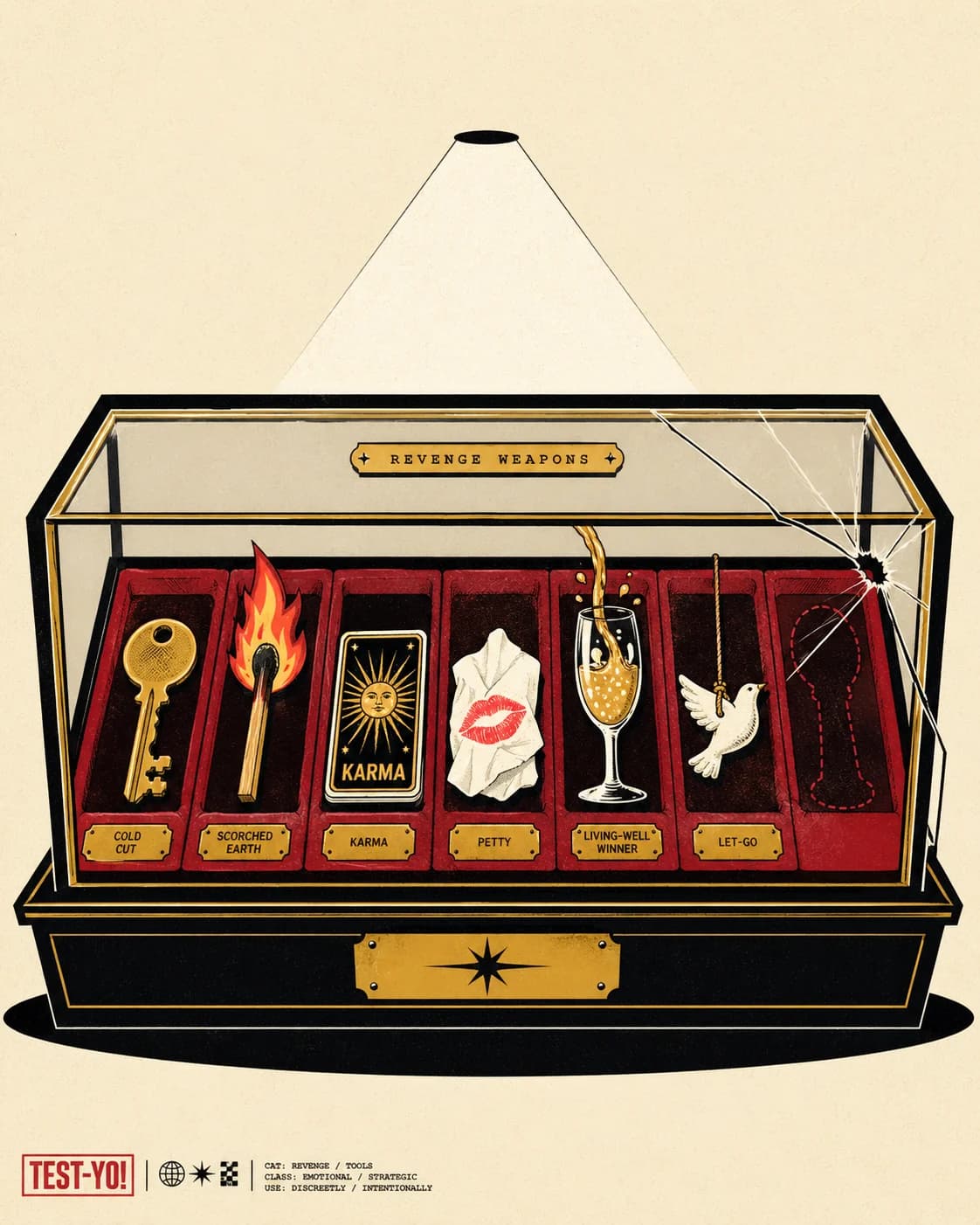
- Cold Cut
- Scorched Earth
- Karma Watcher
- Petty Operator
- Living-Well Winner
- Let-Go-er
Quick answer
Your answers lead to one of 6 results: Cold Cut, Scorched Earth, Karma Watcher, Petty Operator, Living-Well Winner, or Let-Go-er.
- 24 questions · ~3 min
- Cost: free · no signup
About this test
Everyone has one. 24 honest items, one verdict on what you actually do when you've been wronged.
Methodology
24 items, 4 per style, 5-point Likert. Dominant-style scoring across six revenge tactics.
What the result types mean
The six labels describe reactions to being hurt, not recommended tactics. A strong impulse does not require action, and none of these results justifies retaliation.
- Cold Cut
- You tend to remove contact when someone hurts you. Distance may express a boundary, while in some situations it can also avoid a conversation you would value. Consider what level of contact you want without assuming that reconciliation is required.
- Scorched Earth
- You may want others to know what happened and feel a strong urge to confront publicly. Before acting, consider privacy, possible escalation and the outcome you actually need. The label is a prompt to pause, not encouragement to expose or humiliate someone.
- Karma Watcher
- You prefer waiting for consequences rather than retaliating directly. Notice whether that distance helps you move on or keeps you watching for proof that justice arrived. Think about what closure could look like without depending on another person’s downfall.
- Petty Operator
- Your answers suggest small retaliatory gestures or indirect messages when you feel wronged. Those actions can keep attention fixed on the conflict. Try naming the boundary or feeling underneath the impulse before deciding whether any response would help.
- Living-Well Winner
- You tend to turn hurt into effort towards personal goals. Consider which goals matter to you even if the other person never sees them. Progress can be satisfying without becoming a performance intended to provoke regret.
- Let-Go-er
- You lean towards releasing the conflict and moving forward. Check whether you have also given yourself room to acknowledge the hurt and set boundaries. Moving on does not require forgiving, reconnecting or pretending that what happened was acceptable.
How to use your result
Start with a situation you recognise, then choose one useful step:
- Pause before posting, messaging or making a decision while upset.
- Write down the outcome you want: distance, repair, accountability or closure.
- Choose a boundary or a private conversation that serves that outcome without retaliation.
- If the situation feels unsafe, prioritise support and distance over confronting the person.
Possible archetypes
- Cold Cut · Block-delete-disap
- Block, delete, disappear. They get nothing — not even a goodbye text.
About: Cold Cut
When someone hurts you, you remove access. No long fight, no big speech, just gone. The good part is a clean boundary. The hard part is that people who might have repaired things never get the chance. What helps is pausing long enough to know whether you are choosing a boundary or avoiding a hard conversation.
- Scorched Earth · Receipts everywhere
- You bring proof to the group chat. Then to Twitter. Then to LinkedIn. Damn.
About: Scorched Earth
When someone crosses you, you want the truth out in the open. The good part is that harm does not get hidden. The hard part is that public damage is hard to undo, even when the feeling passes. What helps is asking what outcome you want before you burn the whole bridge.
- Karma Watcher · Popcorn-and-wait
- You don't lift a finger. You just sit, sip, and watch the universe collect.
About: Karma Watcher
You prefer to wait and let life answer for you. The good part is that you do not waste energy becoming cruel. The hard part is that sometimes no clear justice arrives, and resentment can sit there for years. What helps is deciding what closure you can create without waiting for the universe to do it.
- Petty Operator · Microaggression art
- You unfollow, mute, screenshot, and leave messages seen on purpose.
About: Petty Operator
You do not always go big; you go small, subtle and hard to prove. The good part is that you notice details and know where it will sting. The hard part is that petty revenge keeps them living in your head. What helps is asking whether the tiny win is worth the space it takes from you.
- Living-Well Winner · Glow-up = receipt
- Your glow-up is the receipt. The post is the closing argument. Iconic.
About: Living-Well Winner
You turn hurt into fuel. You want to become better, brighter or more successful where they can see it. The good part is that you build instead of destroy. The hard part is that your progress can stay tied to the person you say you moved past. What helps is choosing goals that still matter when they are not watching.
- Let-Go-er · No rent-free tenants
- They don't live in your head rent-free. They were evicted, with kindness. Rare.
About: Let-Go-er
You try not to carry people who hurt you. The good part is real emotional freedom. The hard part is that letting go too fast can skip the part where you actually feel what happened. What helps is making sure peace is not just another way to avoid pain.
Related tests
FAQ + disclaimer
How accurate is my revenge style result?
It reflects the reactions you report, not an observation of what you will do in a future conflict. Different situations can produce different impulses.
Is this a scientific test?
No. This is a self-reflection quiz using informal response styles, not a validated assessment of aggression, character or mental health.
Can my revenge style change?
Yes. Experience, boundaries and a pause before acting can change how you respond. You are not required to act on an impulse because a quiz named it.
Does the quiz recommend getting revenge?
No. The labels are ways to discuss reactions to hurt. Use them to consider consequences and choose boundaries, support or repair without harassment or retaliation.