 TEST-YO!· Family Role
What Family Role Were You Cast In?
Answer 24 statements about how you actually grew up — not the family's public version of it. Go with your first honest reaction. There are no good or bad roles here: each one was a way of coping with the family you had.
- 3 min
- 24 questions
- No signup
- Free
Full result at the end — no email needed
Possible results · which one are you?
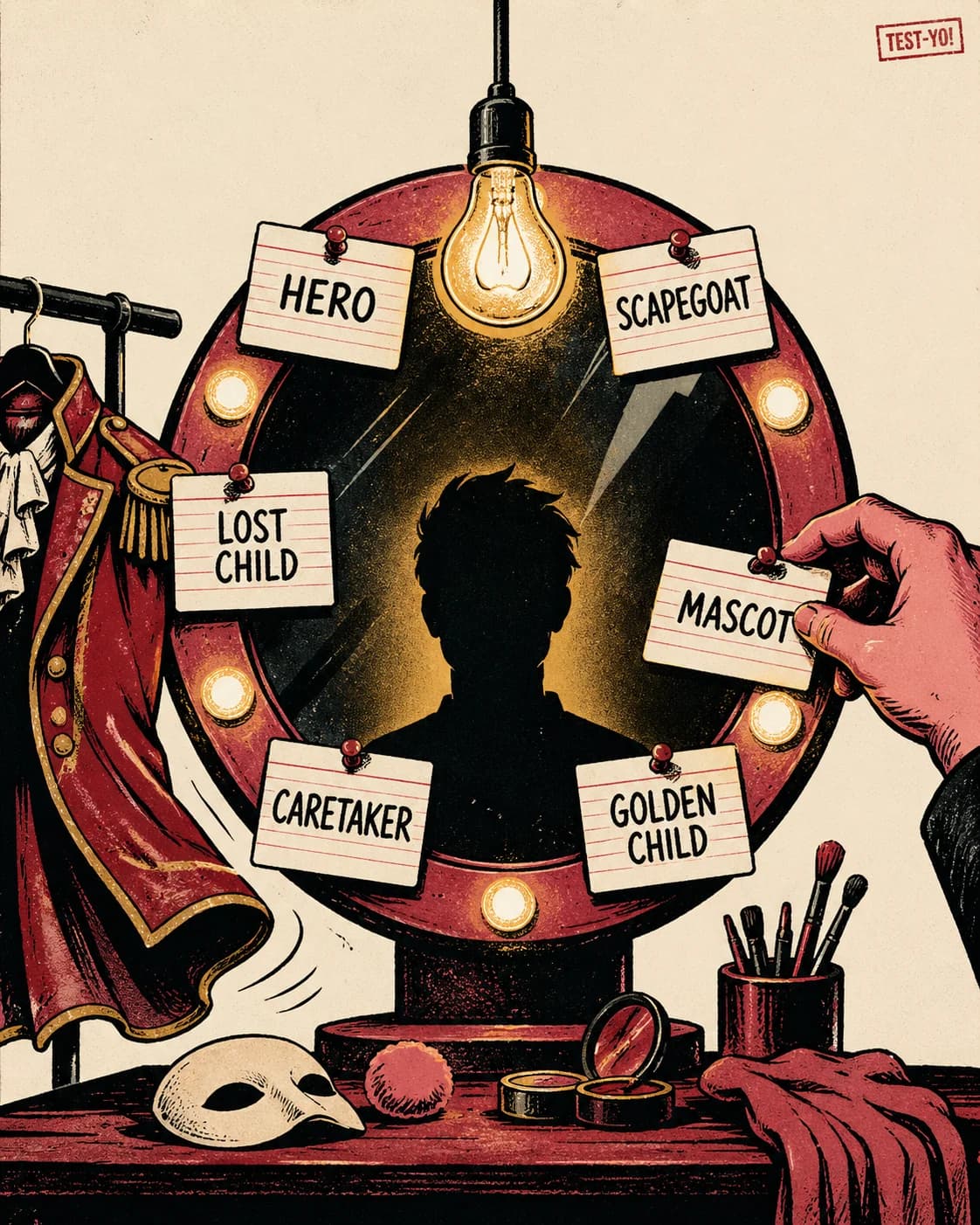
- The Hero
- The Scapegoat
- The Lost Child
- The Mascot
- The Caretaker
- The Golden Child
Quick answer
Your answers lead to one of 6 results: The Hero, The Scapegoat, The Lost Child, The Mascot, The Caretaker, or The Golden Child.
- 24 questions · ~3 min
- Cost: free · no signup
About this test
Many families under stress — addiction, conflict, illness, favoritism — quietly hand each child a part to play. This quiz uses 24 statements to show which of six family roles you lean toward: the four childhood roles described by family therapist Sharon Wegscheider-Cruse (Hero, Scapegoat, Lost Child, Mascot), plus the Caretaker and the Golden Child, two roles widely used in later writing on dysfunctional and narcissistic family dynamics. You get your dominant role, what it gave you, and what it may still cost you in adult relationships.
Methodology
24 statements, 4 per role, each rated on a 5-point agree/disagree scale. Scores are totalled per role and your highest-scoring role is reported as your dominant role. The Hero, Scapegoat, Lost Child and Mascot roles follow the family roles framework developed by therapist Sharon Wegscheider-Cruse; the Caretaker and Golden Child are drawn from later family-dynamics writing. A self-reflection tool, not a validated clinical instrument.
What does my family role result mean for me now?
Family role names can bring familiar scenes to mind without capturing everything about growing up. Read this card as popular shorthand for answers about expectations and your responses to them. The same person may recognise several roles across different relatives, occasions and stages of life.
- The Hero
- You reported feeling responsible for bringing achievements or dependable solutions into family life. Perhaps a visit turns into an update on your achievements. Try mentioning an unfinished hobby simply because you enjoy it, without needing a successful outcome to make the story worth sharing at the table.
- The Scapegoat
- This card gathers answers about feeling singled out when something goes wrong. A disagreement over a misplaced key might become a discussion about your reliability. Write down the particular remembered event and your part, keeping broader assumptions separate from the detail you can account for.
- The Lost Child
- Your responses describe keeping requests small or staying outside conversation. You might quietly accept the spare room everyone has allocated without saying another arrangement would suit you. Practise expressing a modest preference while plans are still open, allowing yourself to participate without having to dominate discussion.
- The Mascot
- You described using playfulness during strained family exchanges. Perhaps you turn a difficult question into an entertaining impression before anyone hears your answer. On a low-pressure occasion, finish a sincere sentence before making the joke, giving the people listening a chance to respond to what you meant.
- The Caretaker
- Your answers centre on noticing what relatives need and making arrangements around them. You might spend a visit fetching drinks while missing an interesting conversation. Choose a brief part of the gathering when you will sit down, and ask someone to handle requests during it.
- The Golden Child
- This result reflects answers about approval and the expectations attached to receiving it. A relative might celebrate a choice you made as though it represents the whole family. Try describing what suited your own circumstances, leaving room for a different choice to make sense for somebody else.
You can recognise an old expectation without making it your permanent part in every family gathering.
How to use your result
Keep the reflection close to your experience:
- Choose a remembered scene rather than judging an entire childhood.
- Notice a response you still use and where it differs today.
- Experiment with a small request you would like to express more openly.
What this quiz is and is not
Popular names support self-reflection; this is not a diagnosis or family history. You can talk with a trusted person or a professional if these reflections concern you.
Possible archetypes
- The Hero · Family human trophy
- You were the family's PR campaign. They got the brag, you got the ulcer.
About: The Hero
You learned to be the proof that the family was okay. Doing well, achieving and staying capable became your role. The good part is real discipline and competence. You can build a strong adult life with that. The hard part is that achievement can start to feel like the only reason you are valuable. Rest may feel wrong, and wins may never feel like enough. What helps is practicing being loved when you are not producing, fixing or proving anything.
- The Scapegoat · Family villain
- Whatever the real problem was, it ended up wearing your name.
About: The Scapegoat
You may have been treated like the problem when the family had problems it did not want to face. The good part is that you often saw the truth more clearly than others. You knew something was wrong. The hard part is carrying the feeling that maybe you really were the problem. That belief can follow you into adult relationships. What helps is remembering that being blamed is not the same as being accurately seen. You do not have to win the old family argument to build a better life now.
- The Lost Child · Family ghost
- You disappeared into your bedroom for a decade. It worked too well.
About: The Lost Child
You learned to need very little. Staying quiet, easy and out of the way may have felt safer than asking. The good part is a rich inner world and real self-sufficiency. The hard part is that close people may not know how to reach you, because you rarely show what you want. What helps is practicing small asks in safe relationships. Start with simple wants, not huge needs. The first ask is usually the hardest.
- The Mascot · Comedian-on-duty
- You learned to read a room before you could read words. Charm clocks in.
About: The Mascot
You learned to lower tension by being funny, charming or light. The good part is real social skill: you can change the mood in a room. The hard part is feeling unsure who you are when you are not entertaining anyone. What helps is letting trusted people see you when you are sad, angry, tired or simply quiet. Humor can be part of you, not your whole job.
- The Caretaker · Parented my parents
- You were a tiny adult before twelve. You spot a mood shift across rooms.
About: The Caretaker
You learned to watch the adults and manage their feelings. The good part is a strong emotional radar. You can read a room quickly and support people well. The hard part is that your identity may be built around taking care of others. When nobody is in crisis, you may not know what you want. What helps is choosing at least one relationship where you let yourself be noticed and supported too. You are allowed to be cared for, not only useful.
- The Golden Child · Family's open fave
- You were the family's favorite. Your siblings noticed. You pretended you didn't.
About: The Golden Child
You may have been the child the family praised most or used as proof that things were fine. The good part is confidence and capability. The hard part is that ordinary moments can feel like failure, and sibling relationships may carry guilt or resentment. What helps is separating your worth from being exceptional and listening to siblings who had a different experience.
Related tests
Related reading
FAQ + disclaimer
What are the family roles in dysfunctional families?
In the family roles framework developed by therapist Sharon Wegscheider-Cruse, children in a stressed or addicted family tend to adopt roles that keep the system stable: the Hero (achieves to make the family look okay), the Scapegoat (acts out and absorbs the blame), the Lost Child (stays invisible to avoid adding pressure) and the Mascot (uses humor to ease tension). Her model also describes the Enabler, usually a partner who covers for the person with the problem. This quiz adds the Caretaker and the Golden Child, two roles common in later writing on family dynamics.
Who created the family roles framework?
Sharon Wegscheider-Cruse, a family therapist who worked with families affected by alcoholism, described these roles in her 1981 book Another Chance: Hope and Health for the Alcoholic Family, building on the family systems work of Virginia Satir. The Golden Child label comes from later writing on narcissistic family dynamics, not from her original model.
Am I the golden child or the scapegoat?
The two often come as a pair. The Golden Child is the one the family praises and holds up as proof things are fine; the Scapegoat is the one blamed for problems, often for noticing or naming them. If you were consistently favored, you likely score higher on Golden Child; if you were consistently blamed, Scapegoat. Some people swap between the two over time — this quiz shows which pattern dominates for you.
Were these roles assigned on purpose?
Almost never. They emerge from family dynamics — children fall into the slots the system needs filled, usually without anyone deciding it.
Can I have more than one family role?
Yes. Most people recognize themselves in more than one. The result names your dominant role; a secondary role often shows up too, and roles can shift when siblings leave home or circumstances change.
Is this only for families with addiction or abuse?
No. The model was developed from work with alcoholic families, but many people from families shaped by chronic conflict, illness, divorce or favoritism recognize these patterns. Healthy families have roles too — they are just more flexible and less rigid.
Do family roles continue into adulthood?
They often do. The habits that helped you cope as a child — overachieving, keeping quiet, making jokes, looking after everyone — can carry into work, friendships and family gatherings long after you have left home. Noticing the pattern is the first step to choosing when to use it.
How do family roles show up in adult relationships?
A Hero may struggle to rest or ask for help; a Scapegoat may expect blame or push back hard against criticism; a Lost Child may avoid conflict and hide their needs; a Mascot may deflect serious conversations with humor; a Caretaker may attract partners who need rescuing; a Golden Child may tie their worth to performing well.
Is this family role quiz a diagnosis?
No. Family roles are a self-reflection framework, not a clinical diagnosis, and they have little formal research support as fixed categories. Use your result as a starting point for reflection. If your family history still causes you distress, a licensed therapist can help.