 TEST-YO!· How You Cope
How Do You Actually Cope?
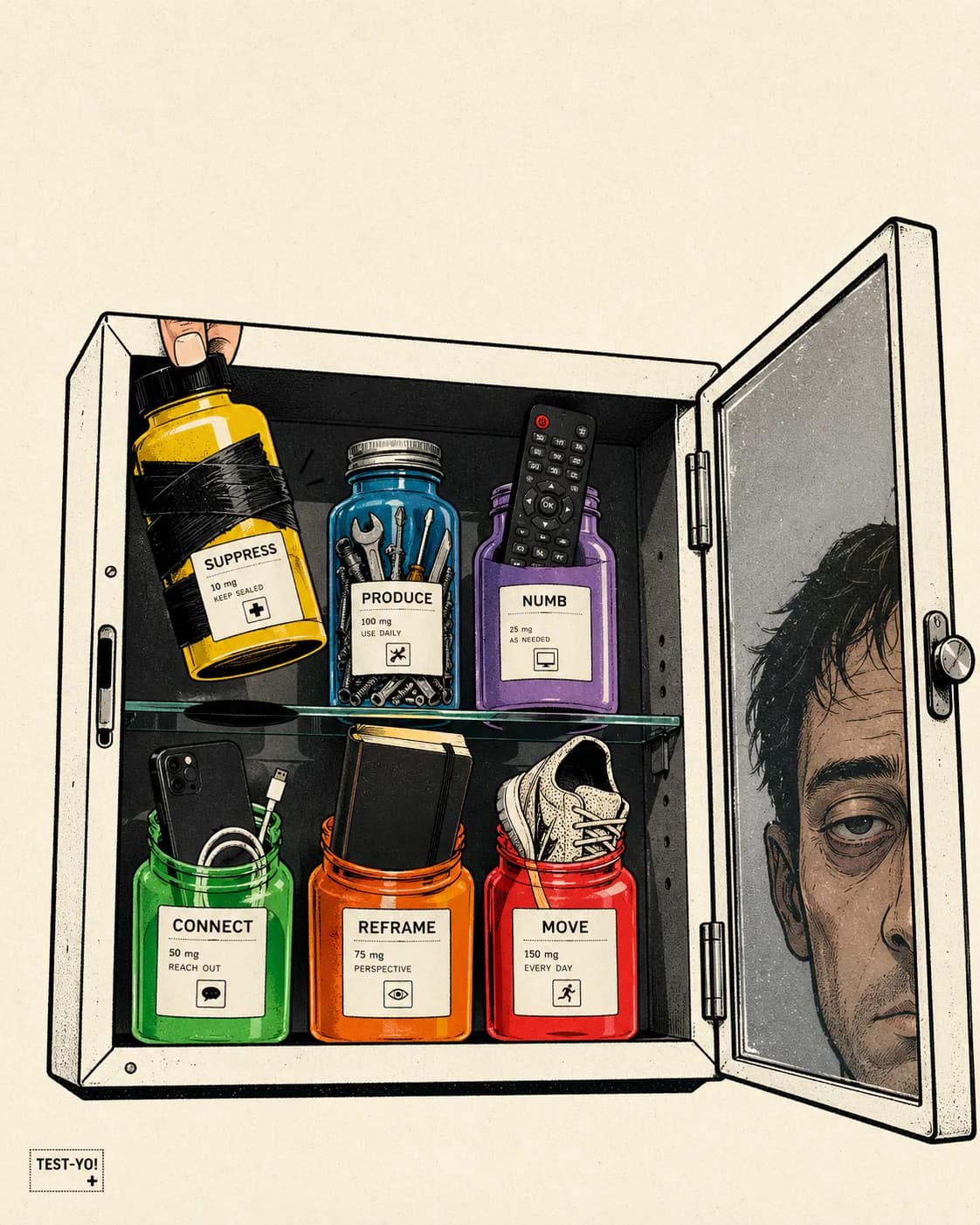
This coping mechanism quiz explores how you describe responding to difficult feelings, including staying busy, seeking company, reframing and movement. It is for anyone reflecting on everyday coping who wants a vocabulary for patterns, without diagnosis or a treatment plan.
- 3 min
- 24 questions
- No signup
- Free
Full result at the end — no email needed
Possible results · which one are you?
- Suppressor
- Productiviser
- Numb-er
- Connector
- Reframer
- Body Mover
Quick answer
Your answers lead to one of 6 results: Suppressor, Productiviser, Numb-er, Connector, Reframer, or Body Mover.
- 24 questions · ~3 min
- Cost: free · no signup
About this test
Everyone says they have "healthy coping" until something breaks. 24 honest items, one verdict on what you actually do when it hurts.
Methodology
24 items, 4 per style, 5-point Likert. Dominant-style scoring across six coping types.
What the results mean
These six labels describe tendencies in your answers, not clinical categories. A response may help in one situation and be less useful in another.
- Suppressor
- Your answers suggest setting feelings aside to keep functioning. That may feel useful in the moment, while you might still want time to acknowledge what happened later. The quiz cannot tell you what unexpressed feelings do to your body or health.
- Productiviser
- Your answers suggest turning towards tasks, cleaning or organising when feelings are difficult. Notice whether activity supports you or leaves no space to recognise what you need. Productivity can be one response without becoming a requirement for deserving care or rest.
- Numb-er
- Your answers suggest seeking distance from uncomfortable feelings through distraction or disengagement. Notice the effect on your day without judging yourself by the label. If a coping habit feels unsafe or difficult to control, consider discussing it with a qualified professional.
- Connector
- Your answers suggest processing feelings through conversation and connection. Think about who feels safe to approach and whether they have space to listen. Support can include other people alongside private ways of settling yourself; it need not depend on constant availability.
- Reframer
- Your answers suggest looking for meaning, perspective or another interpretation when something hurts. Notice whether a new explanation helps you or rushes past a feeling you still want acknowledged. You do not have to find a lesson in every difficult experience.
- Body Mover
- Your answers suggest turning to movement when dealing with difficult feelings. Consider the forms that feel accessible and comfortable for you, without treating activity as treatment. It may also help to identify a quiet option for times when movement is unavailable.
If these feelings persist, cause distress or affect daily life, consider speaking with a qualified mental health professional.
How to use your result
Choose a step that fits your circumstances:
- Recall a difficult moment and describe what you did before judging whether it helped.
- Identify one safe response you could choose in a similar situation.
- Ask a trusted person about support while respecting their availability and your privacy.
Possible archetypes
- Suppressor · Emo. constipated
- You file feelings under "deal with later" and "later" never arrives. Brave.
About: Suppressor
Your first move is to box hard feelings up and keep functioning. The good part is reliable composure when everyone else is melting; the hard part is that what you don't feel doesn't leave — it just relocates to your body or your sleep.
- Productiviser · Trauma: spreadsheet
- Sad? Reorganize the closet. Heartbroken? Inbox zero. Cleanest fridge.
About: Productiviser
When it hurts, you build, clean, organise, finish. The good part is functional output even at your worst; the hard part is that "useful" can quietly substitute for "felt" until the body forces a stop.
- Numb-er · Doomscroll mode
- You numb the volume with the algorithm and a glass of something. We see you.
About: Numb-er
Your strategy is a small distance from yourself until the wave passes. The good part is real survival in seasons when feeling fully would have flattened you; the hard part is that the things that quiet you also quietly run your life.
- Connector · 47-min voice-notes
- A feeling isn't real until you've sent the 47-minute voice memo. Iconic.
About: Connector
You understand your feelings best when you can say them out loud to someone safe. The good part is that talking helps pain move instead of staying stuck. The hard part is that you can start needing another person before you can calm yourself at all. What helps is using people for support while also building one private way to settle yourself.
- Reframer · Main-character lesn
- Every breakdown becomes a lesson. Every ex becomes a chapter.
About: Reframer
You cope by finding the meaning in what happened. The good part is that a clear story can help you carry hard things over time. The hard part is that you may explain the pain before you have actually felt it. What helps is letting the feeling exist before turning it into a lesson.
- Body Mover · Rage-run feelings
- You can't think it through, you have to sweat it out. Your therapist agrees.
About: Body Mover
You cope best when your body gets to move. Walking, running, lifting or crying can help the stress leave. The good part is that movement gives you a clear reset. The hard part is that when you cannot move, you can feel stuck. What helps is also learning one quiet tool for moments when movement is not possible.
Related tests
FAQ + disclaimer
How accurate is this quiz?
This is a self-reflection quiz, not a prediction. It summarises the answers you give here, without establishing a fixed trait or guaranteeing an outcome. It is not a diagnosis or clinical assessment.
Can my result change?
Yes. Different answers, circumstances or interpretations can produce a different result. If you retake it, compare the individual answers and context as well as the label.
Does this diagnose my coping or mental health?
No. These informal patterns cannot identify a condition, its cause or the treatment you need. A professional can discuss concerns in their full context.
Is one coping mechanism always best?
No. Context, safety and the effect on your life matter. The quiz does not rank people or prescribe a single response.
Can I use several coping mechanisms?
Yes. Different situations can bring different responses. The displayed result is the strongest match in these answers, not a complete account of how you cope.