 TEST-YO!· Financial Fear
What Are You Actually Afraid Of About Money?
This financial fear quiz explores the worries you associate with money, including security, judgement, comparison and independence. It is for anyone wanting words for uncomfortable feelings or conversation starters, without diagnosing anxiety, assessing finances or recommending what to do next.
- 3 min
- 24 questions
- No signup
- Free
Full result at the end — no email needed
Possible results · which one are you?
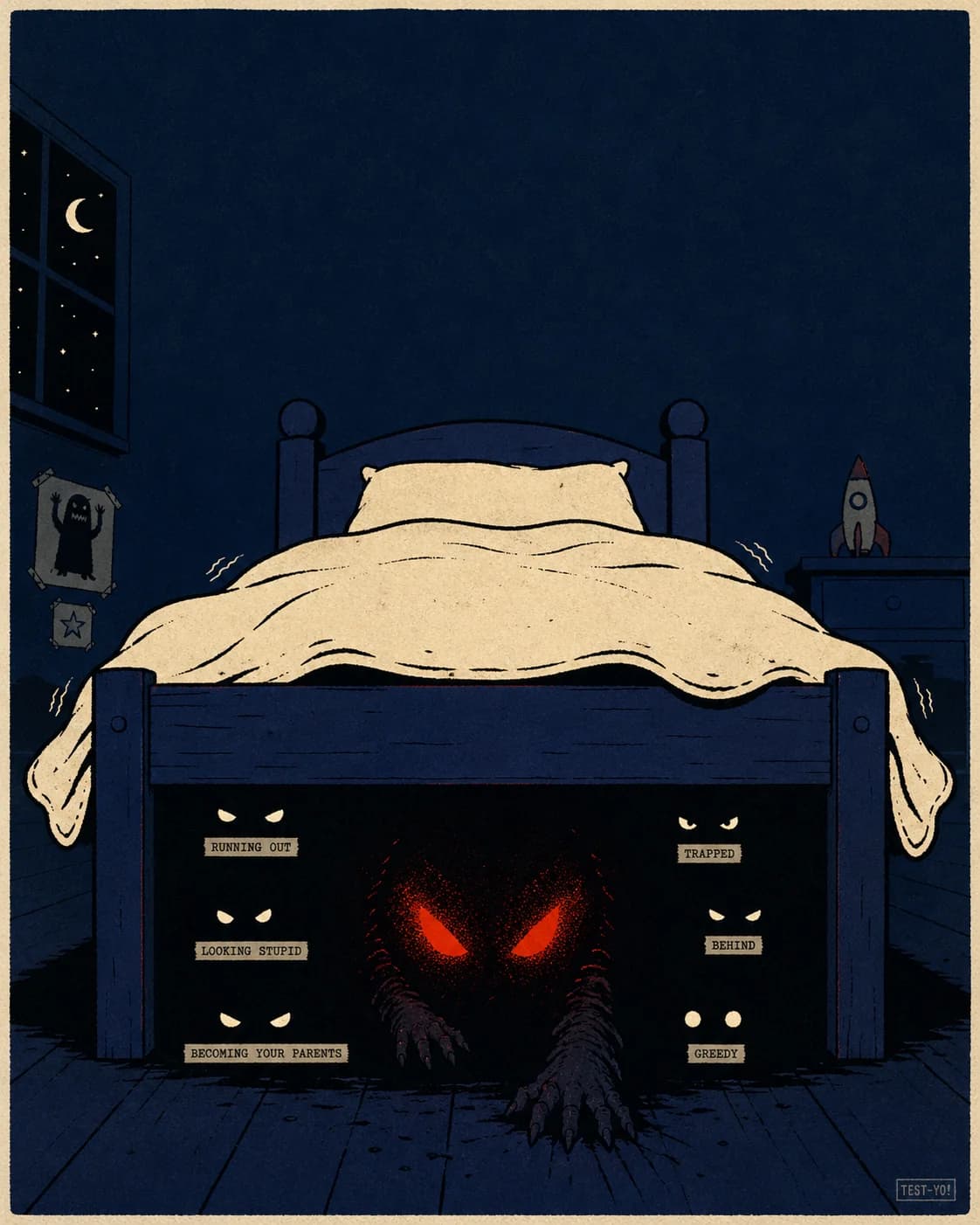
- Running Out
- Looking Stupid
- Becoming Your Parents
- Being Trapped
- Being Behind
- Being Greedy
Quick answer
Your answers lead to one of 6 results: Running Out, Looking Stupid, Becoming Your Parents, Being Trapped, Being Behind, or Being Greedy.
- 24 questions · ~3 min
- Cost: free · no signup
About this test
The number is rarely the real fear. 24 honest items, one verdict on what your money behaviour is actually trying to avoid.
Methodology
24 items, 4 per fear, 5-point Likert. Dominant-fear scoring across six financial-fear types.
What the results mean
These six labels describe concerns in your answers, not your financial position or how justified a worry is. This guide offers emotional reflection, not financial advice.
- Running Out
- Your answers emphasise worrying that money may not be available when needed. Acknowledge both the feeling and any real uncertainty without assuming the quiz can distinguish them. It cannot assess whether you have enough or recommend spending, saving or borrowing.
- Looking Stupid
- Your answers emphasise fear of making a mistake that could feel embarrassing. Notice whether judgement from yourself or others is part of the worry. Caution does not establish financial expertise, and the quiz cannot decide what level of risk is appropriate for you.
- Becoming Your Parents
- Your answers emphasise concern about repeating money patterns you associate with your family. Consider which experiences you are reacting to and which values are your own. The label does not establish family history or recommend choosing the opposite financial behaviour.
- Being Trapped
- Your answers emphasise independence and concern about losing options through money. Name the kind of freedom you value without assuming every shared commitment threatens it. This quiz cannot assess your ability to leave a situation or prescribe a financial arrangement.
- Being Behind
- Your answers emphasise comparison with other people's apparent progress or possessions. Consider whose milestones you are using and what they mean to you. The quiz cannot establish that you are behind, assess anyone else's circumstances or set appropriate financial goals.
- Being Greedy
- Your answers emphasise concern that wanting money could conflict with being fair or caring. Examine what you mean by greed without deciding the label proves anything about your character. It does not tell you what to earn, charge, give or keep.
If these feelings persist, cause distress or affect daily life, consider speaking with a qualified mental health professional.
How to use your result
Choose a step that fits your circumstances:
- Write the worry in ordinary words and distinguish feelings from facts you have verified.
- Notice when comparison or memories intensify the worry.
- Discuss emotional distress with appropriate support and take practical financial questions to a qualified adviser.
Possible archetypes
- Running Out · Bunker mode
- You save like the apocalypse is on a calendar invite. We both know it.
About: Running Out
Your biggest money fear is not having enough when you need it. The good part is that you build real security and plan ahead. The hard part is that the fear may stay even when the numbers say you are okay. What helps is deciding what "enough" means in advance, then practicing small, safe spending on comfort and joy.
- Looking Stupid · Allergic to L-takes
- You'd skip a great deal just to never feel scammed. Lo sabemos.
About: Looking Stupid
Your biggest fear is making a money mistake you feel you should have avoided. That makes you careful, well-researched and hard to scam. The good part is that you do not rush into hype. The hard part is that fear of embarrassment can make every risk feel too dangerous. You may pass on reasonable chances because being wrong would feel unbearable. What helps is separating smart caution from shame. A careful risk is not the same as being careless.
- Becoming Your Parents · Pattern-break mode
- You catch yourself doing exactly what they did. We both know it.
About: Becoming Your Parents
You learned a lot from watching what money did in your family. Now you may choose the opposite so you do not repeat the same pattern. The good part is awareness. You can break habits that many people never question. The hard part is that “opposite of my parents” is still shaped by your parents. What helps is asking what you actually value: security, freedom, generosity, comfort, growth. Build from those values, not only from what you are trying to avoid.
- Being Trapped · Always-an-exit mode
- You keep a "leave fund" you have never told anyone about. Lo sabemos.
About: Being Trapped
You want money to keep doors open. You do not want to stay in a job, place or relationship only because you cannot afford to leave. The good part is real independence. You are unlikely to get stuck by accident. The hard part is that shared plans can feel risky, especially when they involve pooled money or long-term commitment. Watch for the point where independence stops protecting you and starts keeping people at a distance.
- Being Behind · Pure comparison mode
- You Google 'average net worth at my age' more than is healthy. We both know it.
About: Being Behind
Your money fear is tied to comparison. You notice who bought a home, who earns more, who seems further ahead. The good part is ambition: comparison can push you to act. The hard part is that the goal keeps moving. Someone will always be ahead on one scoreboard. What helps is choosing which comparisons actually matter to your life, and letting the rest be noise. You need goals that fit you, not just goals that make you look caught up.
- Being Greedy · Pre-emptive guilt
- You apologised for asking for what your work was actually worth. Lo sabemos.
About: Being Greedy
You worry that wanting more money says something bad about you. Because of that, you may ask for less, charge less or deny yourself things you can afford. The good part is that you care about fairness and do not want to exploit people. The hard part is that under-asking can hurt you and the people you want to help. Wanting more is not the same as taking from others. What helps is learning the difference between greed and healthy self-support.
Related tests
FAQ + disclaimer
How accurate is this quiz?
This is a self-reflection quiz, not a prediction. It summarises the answers you give here, without establishing a fixed trait or guaranteeing an outcome. It is not a diagnosis or clinical assessment.
Can my result change?
Yes. Different answers, circumstances or interpretations can produce a different result. If you retake it, compare the individual answers and context as well as the label.
Does this tell me whether my finances are safe?
No. It reflects feelings in your answers and cannot assess income, debt, resources or financial risk. It gives no financial advice.
Does a financial fear result diagnose anxiety?
No. Worry about money can arise in many circumstances. If distress persists or affects daily life, consider a qualified mental health professional.
Can more than one fear fit?
Yes. Security, comparison and independence may overlap. The displayed result names the strongest match here, not the only concern you can have.