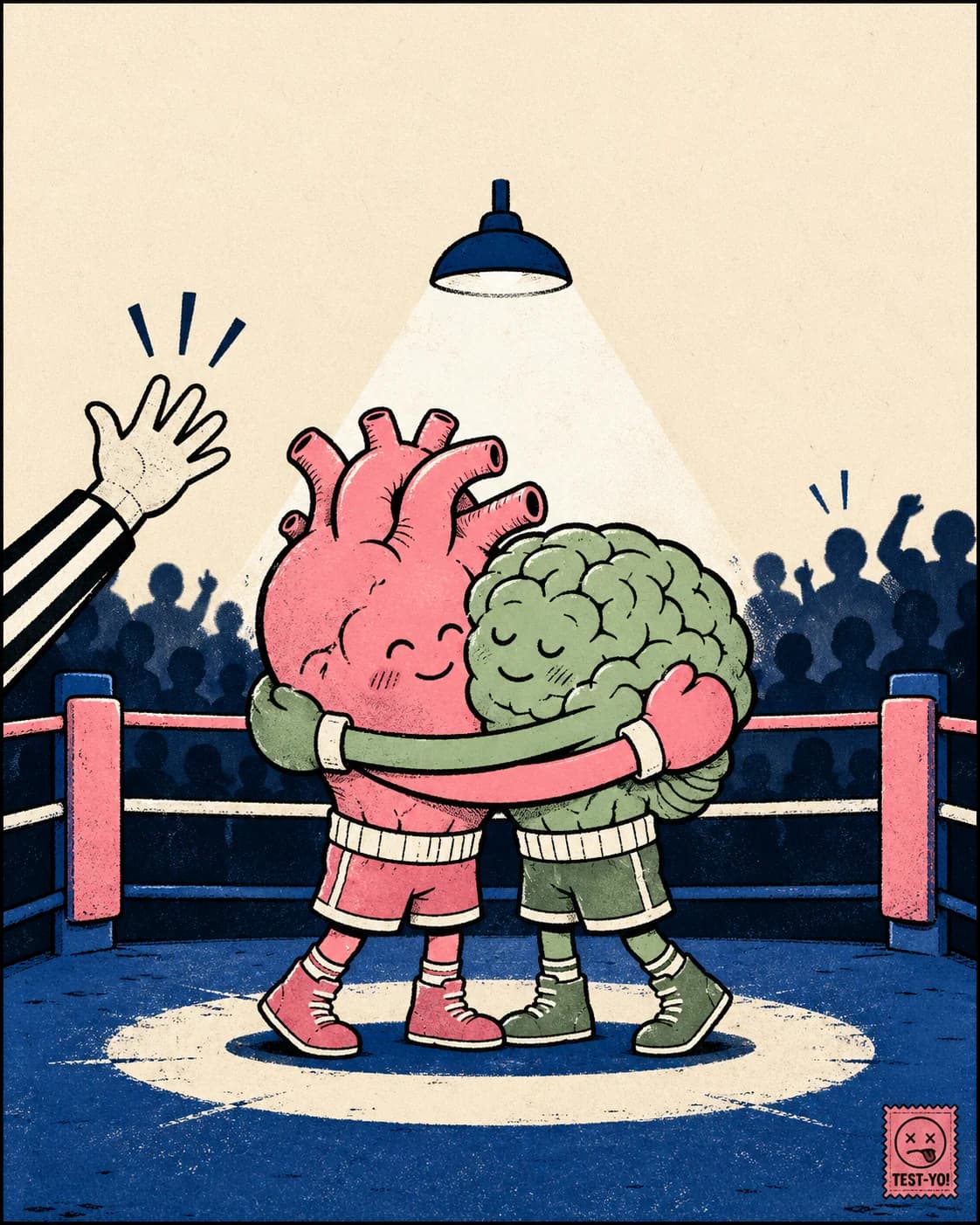
Daniel Goleman's 1995 book Emotional Intelligence popularised the idea that EQ might matter more than IQ for most life outcomes. The popular version is oversimplified; the underlying model is more careful. Goleman describes emotional intelligence through four domains. This article arranges them as a practical grid so you can compare what each domain is about.
Why four domains
Goleman's model pairs awareness with action, and self with others:
| Self | Others | |
|---|---|---|
| Awareness | Self-Awareness | Social Awareness |
| Action | Self-Management | Relationship Management |
The grid crosses awareness with action, and your own emotions with other people's. It is a way to orient yourself among the four domains, not evidence that everyone must learn them in a fixed order or that one domain is a prerequisite for every other.
Self-Awareness
The ability to accurately name your emotions in real time and notice how they colour your decisions. Sounds easy. Isn't. Self-report confidence and independently observed skill can diverge, so a quiz answer is a reflection prompt rather than a direct measure of self-awareness.
High Self-Awareness shows up as: - Naming the specific emotion rather than the umbrella ("I'm frustrated because I felt dismissed" rather than "I'm angry") - Knowing your triggers - Reading your own strengths and weaknesses without flinching
Some people use journaling or deliberate emotion-labelling as reflection exercises. This article does not establish that any one practice works for everyone.
Self-Management
What you do with emotions once you've noticed them. Impulse control, stress recovery, delayed gratification. The calm person under pressure.
High Self-Management shows up as: - Staying composed when things go sideways - Bouncing back from setbacks within days, not weeks - Not saying things you regret when stressed
At its edges, high Self-Management can tip into suppression — which looks like regulation from outside but builds pressure inside. Real self-management acknowledges the emotion, then chooses a response.
Social Awareness
Empathy. Reading mood, non-verbal cues, what a person is experiencing even when you disagree with them.
High Social Awareness shows up as: - Sensing the mood of a room as you walk in - Noticing when a friend is pretending to be fine - Understanding why someone feels what they feel, even when you'd feel differently in the same situation
This is where training slows down. You can learn to observe more, but natural empathy varies and isn't fully teachable. Strong Social Awareness also has a cost: people high on this absorb others' emotions and need deliberate recovery time.
Relationship Management
The outward-facing domain. Turning the previous three skills into real-world influence, conflict resolution, trust-building.
High Relationship Management shows up as: - Handling disagreements without damaging the relationship - Giving hard feedback with care - Rallying people around a shared goal
This domain is the most visible in interactions with other people. A result in this area is a prompt to examine specific behaviours, not a prediction about leadership, career advancement, or relationship outcomes.
How to use the grid in practice
Pick one recent interaction and write down four details: what you felt, what you did with that feeling, what you noticed about the other person, and how you handled the interaction. That comparison can suggest a useful reflection question without treating the grid as a required training sequence.
Which domain is yours?
Most people are asymmetric. Someone can be brilliant at Self-Management and poor at Social Awareness (reliable and composed but misses cues). Someone else can be an Empath with weak Self-Management (picks up everything, regulates poorly). Our 24-item Goleman test measures all four domains in 4 minutes and tells you which is your strongest.
If you want a next step, choose one detail from that reflection and describe a small response you would like to try next time. This exercise does not show that training will improve a particular domain or predict how you will act in every situation.