 TEST-YO!· Power Style
Konten utama halaman ini saat ini hanya tersedia dalam bahasa Inggris.
Inspired by research
Power Style — What drives how you show up?
What drives how you actually show up at work? 24 honest questions.
IPIP DISC · Goldberg 1999. This adapted quiz is not a validated instrument.
6 min · 24 questions · Free · No signup
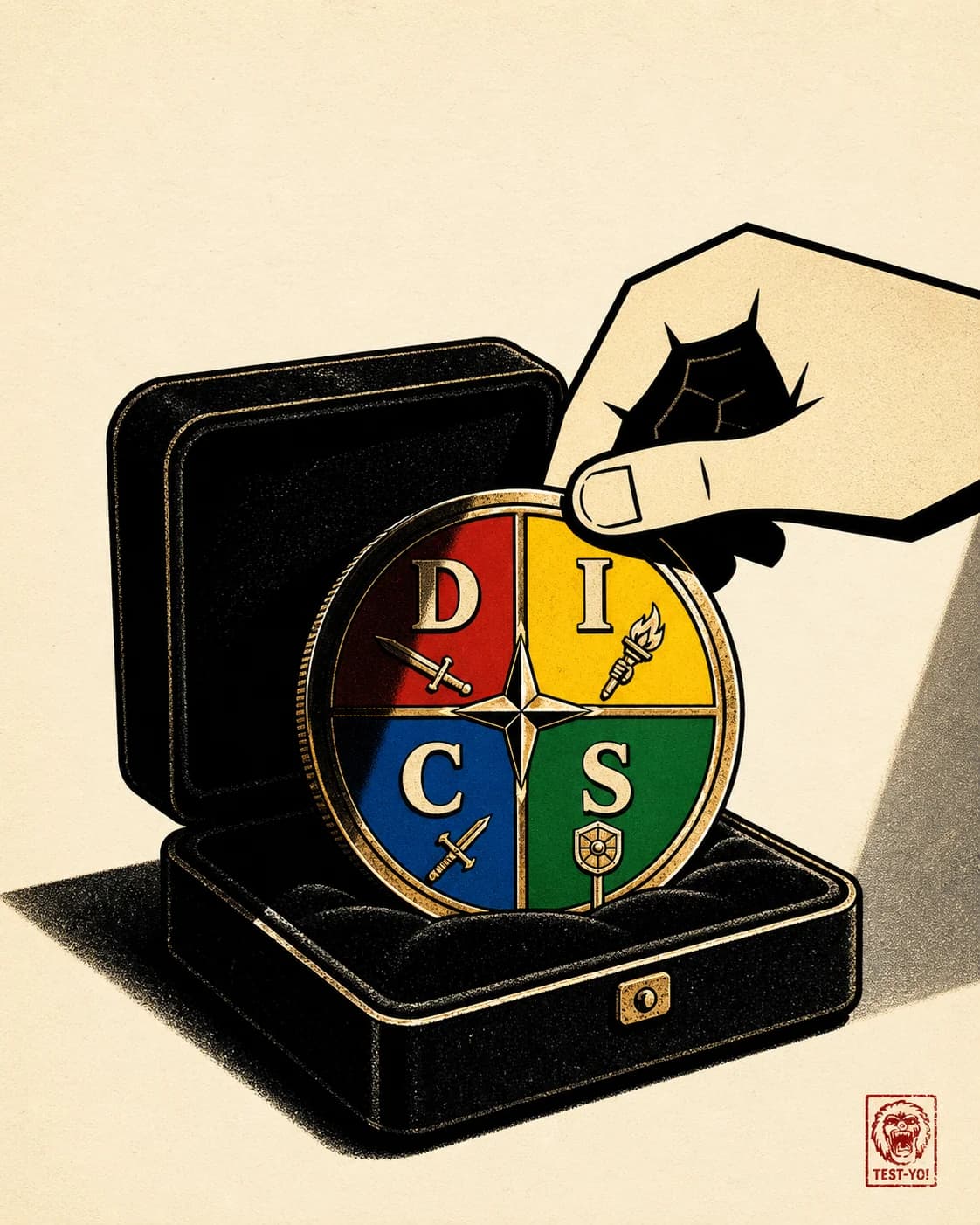
Possible archetypes
What drives how you actually show up at work? 24 honest questions.
How it works
- Answer 24 short questions, honestly
- Your answers add up to 4 patterns
- Read your result and, if you like, compare it with someone
This 24-item self-report quiz uses items from the International Personality Item Pool (IPIP), which is explicitly in the public domain, to estimate your relative standing on four behavioral tendencies: Dominance, Influence, Steadiness, and Conscientiousness.
This adapted quiz is not a validated instrument. How we build it
Baca selengkapnya · Tentang tes iniRead less
About this test
It is not affiliated with, and does not reproduce items from, any commercial DISC product (Wiley Everything DiSC, TTI, or 123test).
Methodology
Items drawn from the International Personality Item Pool (IPIP; Goldberg et al. 2006, public-domain scientific collaboration). The DISC four-factor model traces to W.M. Marston (1928). Not affiliated with Wiley Everything DiSC or TTI products.
Keep exploring
Sources & references
- Goldberg, L. R. (1999). IPIP scales constructed to measure constructs similar to those in the DISC model.
FAQ
Is this the official DISC assessment?
No. This is an independent self-report quiz that uses public-domain IPIP items and the general four-factor DISC framework first described by W.M. Marston in 1928. It is not affiliated with Wiley Everything DiSC, TTI, or any commercial DISC product.
Where do the items come from?
All 24 items are drawn from the International Personality Item Pool (IPIP; ipip.ori.org), a public-domain scientific item collaboration led by L. R. Goldberg.
Is this suitable for hiring or clinical decisions?
No. Treat this as self-reflection. It is not a validated instrument for selection, clinical assessment, or diagnosis.