 TEST-YO!· Temperament Test
Konten utama halaman ini saat ini hanya tersedia dalam bahasa Inggris.
Which of the four temperaments are you?
Sanguine, choleric, melancholic or phlegmatic? A free 22-question test based on the classical four temperaments, mapped onto extraversion and emotional stability.
5 min · 22 questions · Free · No signup
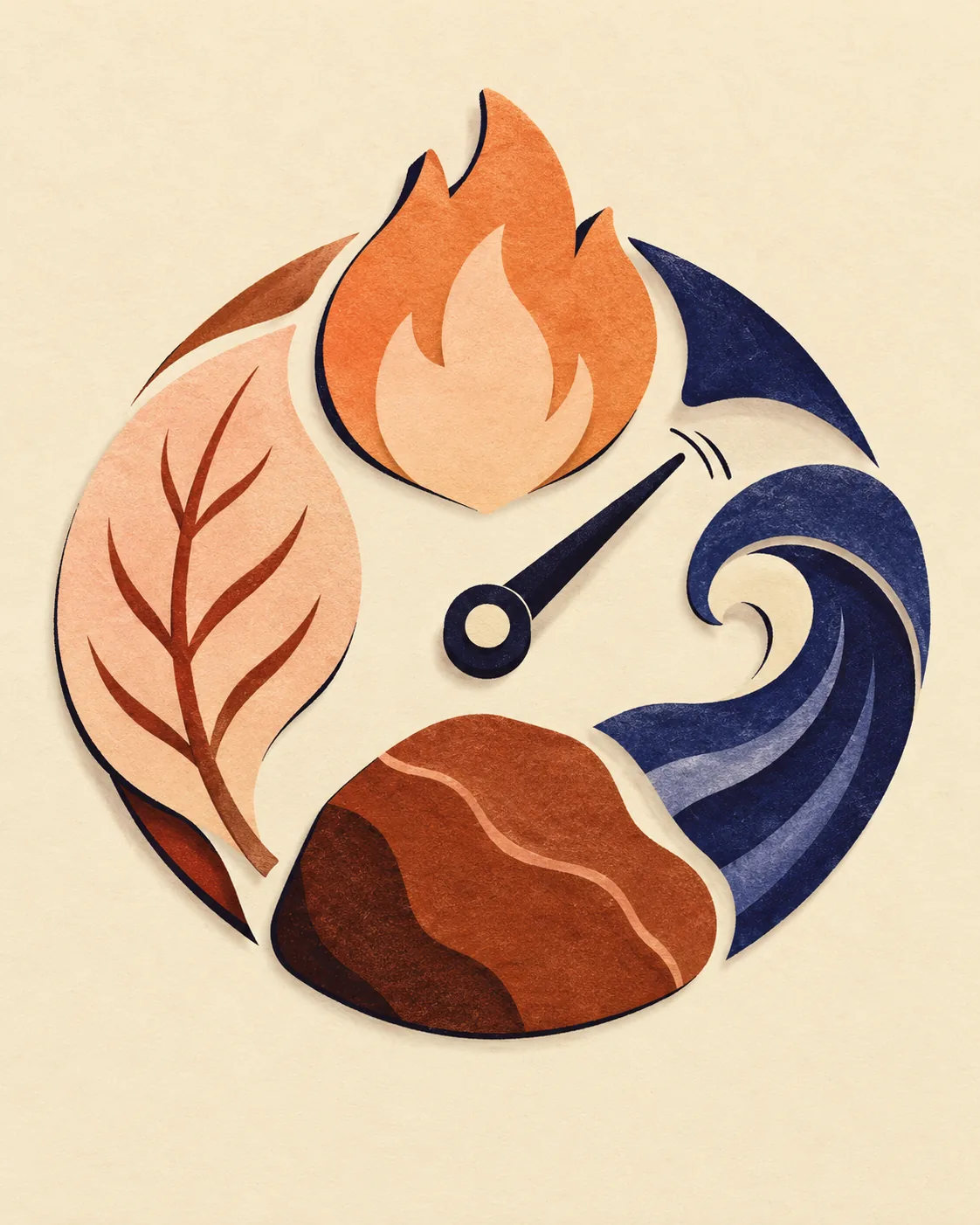
What sanguine, choleric, melancholic and phlegmatic actually mean
Baca selengkapnya · Tentang tes iniRead less
The four temperaments are one of the oldest personality frameworks still in everyday use — nearly two thousand years old in its systematised form. Here is where each label came from and what it is said to describe.
- Sanguine — stable extravert
- Sociable, optimistic, quick to recover from setbacks. Named for blood in the original humoral scheme. On Eysenck's later map, sanguine sits at extraverted and emotionally stable.
- Choleric — unstable extravert
- Driven, decisive, quick to react and quick to cool down. Named for yellow bile. On Eysenck's map, choleric sits at extraverted and less emotionally stable.
- Melancholic — unstable introvert
- Reflective, detail-focused, more affected by setbacks than shown outwardly. Named for black bile. On Eysenck's map, melancholic sits at introverted and less emotionally stable.
- Phlegmatic — stable introvert
- Calm, easy-going, slow to be provoked and slow to be unsettled. Named for phlegm. On Eysenck's map, phlegmatic sits at introverted and emotionally stable.
- From Hippocrates to Galen
- Ancient Greek medicine linked personality and health to the balance of four bodily fluids. The physician Galen, writing in the 2nd century CE, turned that idea into the fixed four-temperament scheme that survived long after the underlying medical theory was abandoned.
- Kant, Wundt and Eysenck
- The philosopher Immanuel Kant wrote about the four temperaments as a description of feeling and activity. The psychologist Wilhelm Wundt later argued two dimensions — roughly, emotional strength and changeability — explained the four types better than four separate boxes. In the twentieth century, Hans Eysenck showed those two dimensions could be measured directly as extraversion and neuroticism, and that crossing them reproduces the four ancient temperaments almost exactly.
This is a historically grounded framework used as descriptive vocabulary, not a validated psychometric instrument, and nothing here is a health or clinical claim. For a modern, extensively validated model of the same territory, the Big Five personality test measures five continuous traits instead of assigning one of four ancient types.
Possible archetypes
Sanguine, choleric, melancholic or phlegmatic? A free 22-question test based on the classical four temperaments, mapped onto extraversion and emotional stability.
- SanguineThe warm extrovertYou walked in knowing one person and left with three new group chats.
- CholericThe driven leaderYou have already restructured the plan before the meeting officially started.
- MelancholicThe reflective perfectionistYou are still thinking about the thing you noticed, three days later.
- PhlegmaticThe steady peacemakerThe group argued for twenty minutes and you were fine with whatever they picked.
How it works
- Answer 22 short questions, honestly
- Your answers add up to 4 patterns
- Read your result and, if you like, compare it with someone
A 22-item forced-choice quiz that places you in one of the four classical temperaments: sanguine (sociable, optimistic), choleric (driven, decisive), melancholic (reflective, detail-focused) and phlegmatic (calm, easy-going).
This adapted quiz is not a validated instrument. How we build it
Baca selengkapnya · Tentang tes iniRead less
About this test
The theory traces back to Hippocratic humoral medicine and was systematised into a fixed four-part scheme by the physician Galen roughly 1,800 years ago. It stayed in circulation as philosophy and folk psychology — Kant wrote about it, and Wilhelm Wundt proposed organizing the four types along two dimensions instead of four unconnected labels. In the twentieth century, Hans Eysenck showed that the same four types fall out naturally when you cross two measurable personality dimensions, extraversion and emotional stability (low neuroticism), into a simple grid. This quiz uses that grid: each question scores you toward one of the four temperaments, and your most-chosen pattern is reported as your result. It is a historically grounded self-reflection tool, not a validated diagnostic instrument — for a modern, evidence-based alternative that measures traits independently instead of assigning a type, see the Big Five personality test.
Methodology
22 forced-choice self-report items, four options each, one per temperament; the highest-scoring temperament is reported. The theory traces to Hippocratic humoral medicine, systematised by Galen (2nd century CE), discussed later by Kant and Wundt, and mapped onto extraversion and emotional stability by Hans Eysenck in the twentieth century. This quiz is an original instrument inspired by that two-dimensional mapping; it is not the EPQ, the Big Five, or any other published questionnaire, and it makes no clinical or diagnostic claims. This questionnaire and its result bands are not a validated instrument.
Keep exploring

FAQ
What are the four temperaments in a temperament test?
The four temperaments are sanguine, choleric, melancholic and phlegmatic: historical sketches associated with sociability, drive, reflection and steadiness. This temperament test compares the preferences in your own answers. It is a self-reflection quiz, not a validated instrument, and its results are not diagnoses. You may recognize parts of several sketches, depending on the setting.
What are the four temperaments?
Sanguine (sociable and optimistic), choleric (driven and decisive), melancholic (reflective and detail-focused) and phlegmatic (calm and easy-going). They originate in ancient Greek medicine, which linked personality to four bodily fluids, and were later organized by the physician Galen into the fixed four-type scheme still referenced today.
Is the four temperaments model scientific?
No — not in its original form. It began as Hippocratic humoral medicine, the idea that personality and health were governed by the balance of four bodily fluids (blood, yellow bile, black bile and phlegm), a theory modern medicine has fully abandoned. What survived is the descriptive four-way pattern itself, which the psychologist Hans Eysenck later showed maps onto two real, measurable personality dimensions: extraversion and emotional stability. So the four labels are a useful historical shorthand for a real pattern, but the four-temperaments test itself is not a validated psychometric instrument the way the Big Five or Eysenck's own PEN model are.
How does this connect to Eysenck and the Big Five?
Eysenck plotted extraversion on one axis and emotional stability (the inverse of neuroticism) on the other, and noticed that the four resulting quadrants matched the ancient temperaments closely: stable extravert (sanguine), unstable extravert (choleric), unstable introvert (melancholic) and stable introvert (phlegmatic). The Big Five model, developed later and validated far more extensively, keeps extraversion and neuroticism as two of its five separate, continuous traits, so it never combines them into four discrete types — so it describes the same territory with more precision and no ancient bile theory attached.
Can you be a mix of two temperaments?
Yes, and most people are. This quiz reports your strongest pattern across 22 situations, but the other three temperaments still describe parts of how you operate — it is common to lean sanguine in social settings and melancholic when working alone, for example.
Who invented the four temperaments theory?
The underlying idea comes from Hippocratic medicine in ancient Greece. The Roman physician Galen, writing in the second century CE, systematised it into the fixed four-temperament scheme people still reference. Centuries later, the philosopher Immanuel Kant and the psychologist Wilhelm Wundt both wrote about the four types, with Wundt proposing that two underlying dimensions — not four separate boxes — explained the pattern better.
Is this test free?
Yes — the full test and full result are free, with no sign-up and no email. All 22 questions and all four temperament descriptions are available to everyone.
How long does it take?
About 5 minutes — 22 forced-choice questions with four options each. There is no timer, and your progress is kept in your browser if you need to stop and come back.
Is it accurate?
It accurately reports which of the four described patterns your answers match most closely, based on a coherent psychological model of extraversion and emotional stability. It is not a clinical or diagnostic instrument, and the ancient temperament labels themselves are historical vocabulary, not a measured trait system. For a research-backed, continuous-trait alternative, try the Big Five personality test.