 TEST-YO!· Personality
Konten utama halaman ini saat ini hanya tersedia dalam bahasa Inggris.
Inspired by research
Who Are You, Really?
Take a free personality test in about 5 minutes. Explore five Big Five traits with 30 questions, instant results and everyday examples. No signup.
Inspired by the Big Five (IPIP). This adapted quiz is not a validated instrument.
5 min · 30 questions · Free · No signup
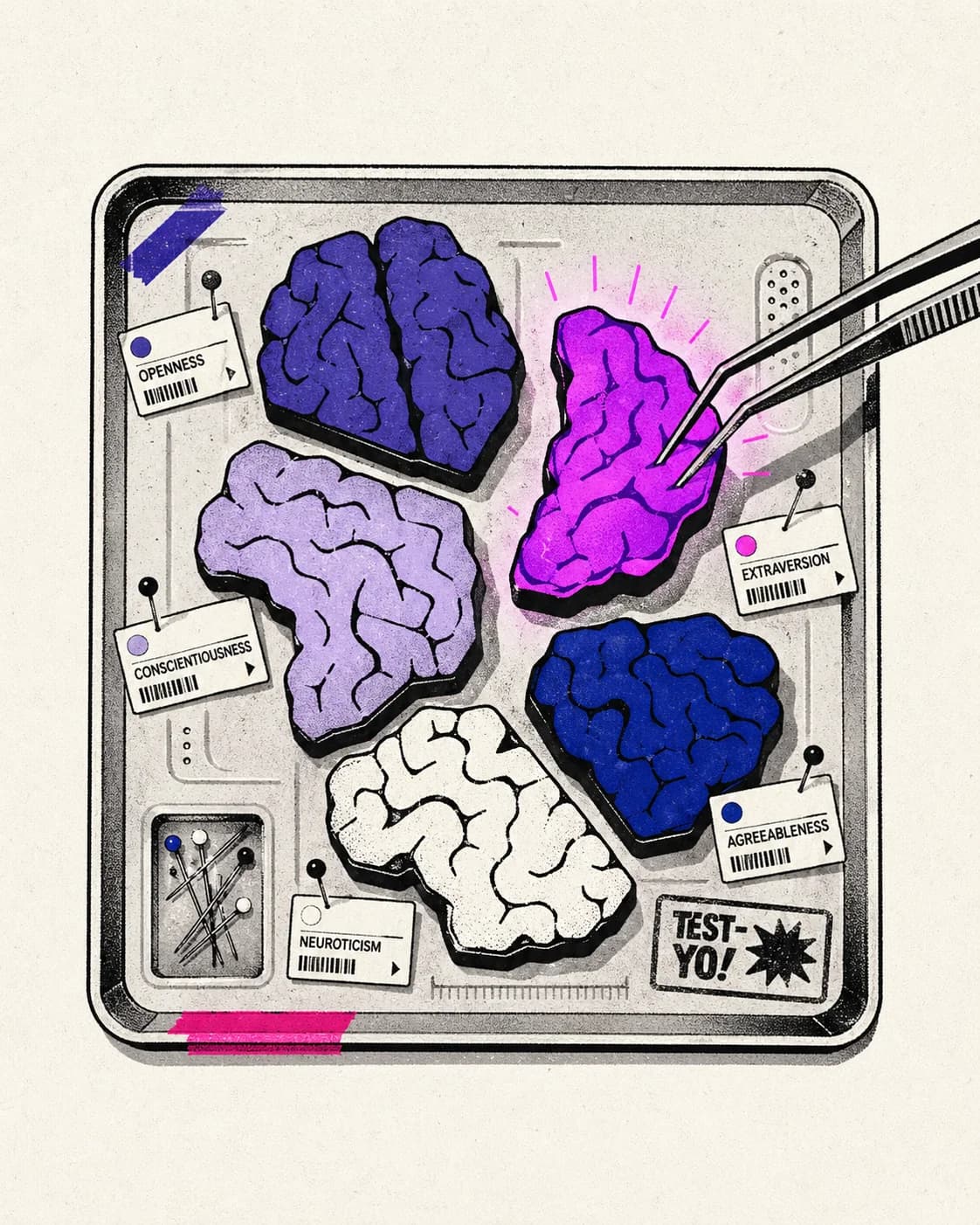
The five traits
Baca selengkapnya · Tentang tes iniRead less
Big Five describes tendencies on continuous scales, not five exclusive types. OCEAN stands for openness, conscientiousness, extraversion, agreeableness and neuroticism. Everyone has a pattern across all five; these everyday examples show tendencies, and none of them is a rule.
- Openness
- Curiosity about unfamiliar ideas, experiences and creative possibilities. You might try a recipe from a cuisine you do not know. You might explore a different interpretation of a favorite film.
- Conscientiousness
- A tendency toward organization, responsibility and following through. You might plan your week before Monday. You might check the details of a task before handing it over.
- Extraversion
- A tendency toward sociability, assertiveness and outward activity. You might start a conversation at a gathering. You might volunteer to speak during a group discussion.
- Agreeableness
- A tendency toward cooperation, consideration and trust. You might listen to both sides of a disagreement. You might offer a colleague help when they are overloaded.
- Neuroticism
- A tendency to experience stress and difficult emotions more readily, also called emotional reactivity. You might worry about a delayed reply. You might feel unsettled after a small change of plans. This is a trait description, not a diagnosis.
Independent Big Five quiz, not an MBTI assessment and not affiliated with its publisher. Myers-Briggs Type Indicator and MBTI are trademarks of their respective owners.
How to read your result
Your archetype names the trait with the highest total across your answers, not your whole personality. Some statements are scored in reverse. If totals tie, the quiz uses O, C, E, A, N order, so a close result deserves caution. The profile bars run from the lowest possible total at 0% to the highest at 100%; neutral answers sit at 50%. These are not population percentiles, and the five percentages do not need to add up to 100. Compare the descriptions with real situations, including examples that do not fit. A higher score is not a better person, and a lower one is not a flaw.
Big Five vs MBTI
Big Five describes five continuous traits. The Myers-Briggs Type Indicator (MBTI) describes preferences through four pairs and reports a type combination. Both use self-report, but they organize the answers differently; there is no direct conversion from an OCEAN score to a four-letter type. Big Five is more widely used in academic personality research. That research does not establish the validity of this original quiz. Choose a validated instrument when you need a formal assessment, and do not treat a shareable label as a verdict.
Possible archetypes
Take a free personality test in about 5 minutes. Explore five Big Five traits with 30 questions, instant results and everyday examples. No signup.
- OpennessCuriosity and new ideasOpenness leads or ties in this run. Check the five bars before reading it as a strong preference.
- ConscientiousnessPlanning and follow-throughConscientiousness leads or ties in your answers. That does not establish organization or reliability.
- ExtraversionCompany and expressionExtraversion leads or ties in this run. A relative lead does not establish social confidence or skill.
- AgreeablenessCooperation and trustAgreeableness leads or ties in your answers. It does not measure kindness, ethics or how others experience you.
- NeuroticismStress and emotional reactionsNeuroticism leads or ties in this run. It describes answers about emotional reactivity, without assessing health.
How it works
- Answer 30 short questions, honestly
- Your answers add up to 5 patterns
- Read your result and, if you like, compare it with someone
This original 30-item quiz explores Openness, Conscientiousness, Extraversion, Agreeableness and Neuroticism (emotional reactivity).
This adapted quiz is not a validated instrument. How we build it
Baca selengkapnya · Tentang tes iniRead less
About this test
Six statements per trait use a five-point agreement scale, with some scored in reverse. It is inspired by the Big Five model, not a validated BFI or IPIP questionnaire, and has no population norms.
Methodology
30 original self-report items, 6 per Big Five trait, with forward- and reverse-keyed statements. Each answer contributes −2 to +2 to its trait. The highest total determines the result archetype; ties use O, C, E, A, N order. This independent quiz is not a validated BFI or IPIP questionnaire and has no population norms.
Keep exploring
Sources & references
- Goldberg, L. R. (1999). A broad-bandwidth, public domain, personality inventory measuring the lower-level facets of several five-factor models. Tilburg University Press.
- Costa, P. T., & McCrae, R. R. (1992). Revised NEO Personality Inventory (NEO-PI-R) and NEO Five-Factor Inventory (NEO-FFI) Professional Manual. Psychological Assessment Resources.
FAQ
Is this personality test free?
Yes. All 30 questions and the Big Five result are free, with no signup or email required.
How accurate is this Big Five personality test?
It is an original self-reflection quiz inspired by a research framework. This particular questionnaire has not been independently validated or normed, so we cannot give an accuracy percentage. Answers depend on how you see yourself and your current situation.
Can my personality test result change?
Yes. Habits and personality can develop over time, and mood, context and how you interpret a question can affect your answers. A different result does not by itself prove a lasting personality change.
Which is more scientific: Big Five or MBTI?
The Big Five is more widely used in academic personality research and describes continuous traits. MBTI describes type preferences. Evidence for a framework does not automatically validate every quiz based on it, including this one.
How is my Big Five result calculated?
Each statement contributes to one trait, with some answers scored in reverse. The trait with the highest total names your archetype. If totals tie, the order is openness, conscientiousness, extraversion, agreeableness, then neuroticism. Scores are not population percentiles.
Does a high neuroticism score mean a diagnosis?
No. Here neuroticism means a tendency to react to stress and difficult emotions. This quiz cannot diagnose a mental health condition or replace a professional assessment.