 TEST-YO!· Reasoning challenge
Konten utama halaman ini saat ini hanya tersedia dalam bahasa Inggris.
IQ Test: How Do You Solve These 40 Puzzles?
Forty free IQ-style questions across pattern, verbal, numerical and logical reasoning, scored into bands in about 8 minutes — with an example of each format.
8 min · 40 questions · Free · No signup
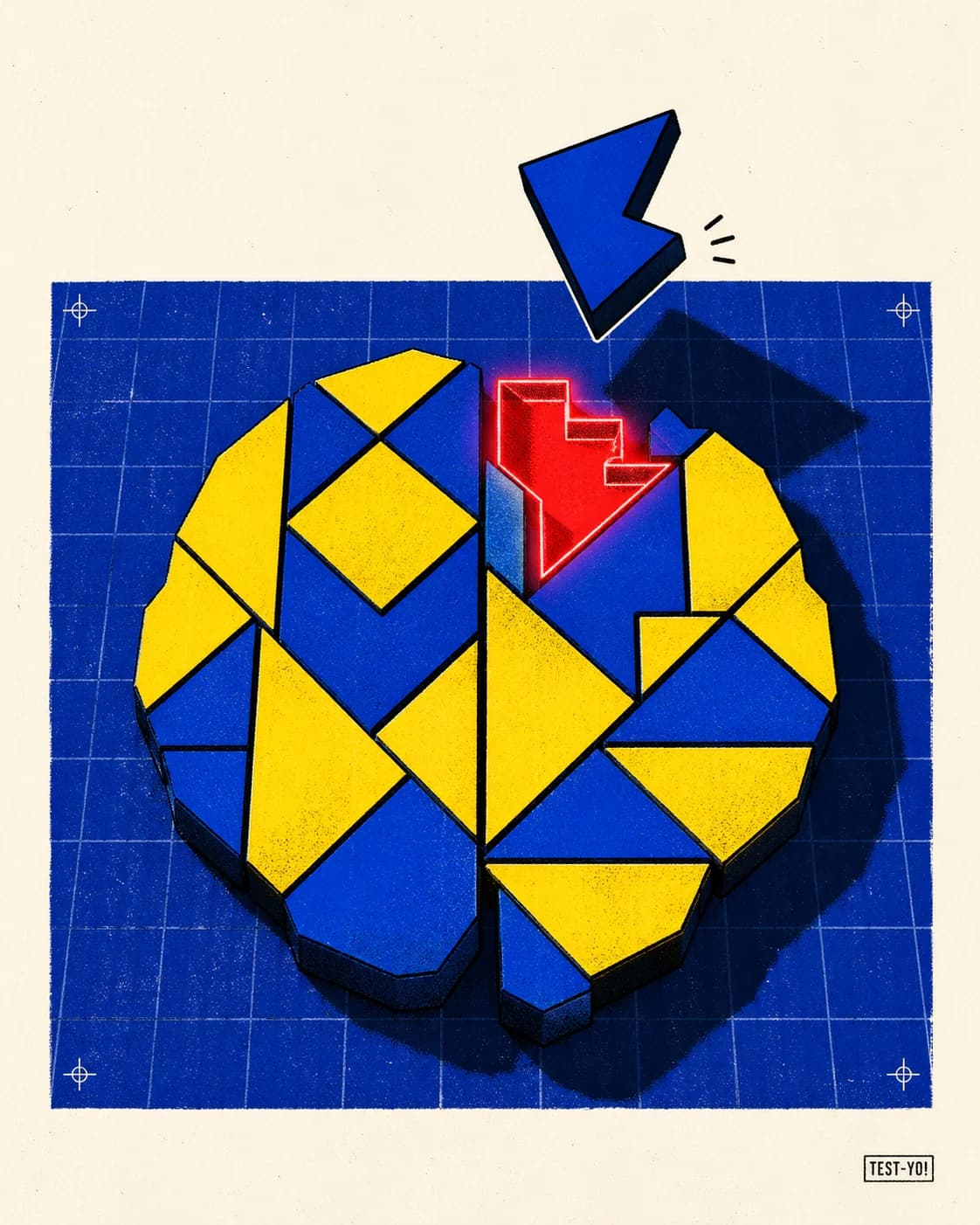
What kind of questions are on an IQ test?
Baca selengkapnya · Tentang tes iniRead less
An IQ test samples reasoning formats, not knowledge, and the same handful turn up whichever test you sit. This one runs four domains — pattern, verbal, numerical and logical — with ten items each. Here is what a real question from every format looks like, taken straight from the 40.
- Pattern and sequence questions
- Continue a run of numbers or letters by working out the rule. An easy one: 2, 4, 8, 16, ? — each term doubles, so 32. A hard one: 2, 6, 12, 20, 30, ? — the gaps grow by 2 each step (4, 6, 8, 10, 12), so the answer is 42.
- Shape and symbol puzzles
- Part of the pattern set, run with shapes instead of numbers: ◯ ◻ △ ◯ ◻ ? repeats every three, so a triangle closes it. Formal tests use grids of abstract figures for the same job; here the shapes are plain symbols you can read as text.
- Verbal reasoning
- Synonyms, antonyms, odd-one-out and analogies — "Doctor is to hospital as teacher is to…" (school). The harder items turn into vocabulary: "ephemeral" most nearly means short-lived.
- Numerical reasoning
- Arithmetic you have to work out, not remember: "A shirt costs €40 after a 20% discount — what was the original price?" It's €50, because €40 is 80% of it. The last few items reach into probability.
- Logical reasoning
- Syllogisms and ordering puzzles. "All mimes are quiet. Some quiet people are artists" supports only the weak conclusion — some mimes may be artists. Seating orders and truth-teller riddles sit at the top of the difficulty scale.
Ten items per domain, each rated 1 to 5 for difficulty, with the harder ones worth more points. This is a self-scored, entertainment-grade test: only a professional, norm-referenced assessment produces a valid IQ score.
Possible archetypes
Forty free IQ-style questions across pattern, verbal, numerical and logical reasoning, scored into bands in about 8 minutes — with an example of each format.
- Quiz band 1 of 4Quiz band 1 of 4Your weighted score is in the first band for these 40 questions.
- Quiz band 2 of 4Quiz band 2 of 4Your weighted score is in the second band for these 40 questions.
- Quiz band 3 of 4Quiz band 3 of 4Your weighted score is in the third band for these 40 questions.
- Quiz band 4 of 4Quiz band 4 of 4Your weighted score is in the highest band for these 40 questions.
How it works
- Answer 40 short questions, honestly
- Your answers add up to 4 patterns
- Read your result and, if you like, compare it with someone
Forty puzzles across patterns, words, numbers and logic — easy ones to warm you up, brutal ones to sort out the rest.
This adapted quiz is not a validated instrument. How we build it
Baca selengkapnya · Tentang tes iniRead less
About this test
Ten items per reasoning type, difficulty graded 1 to 5, all of it text and simple symbols with no picture matrices, so it reads the same on any screen. Your score is banded into ranges so you can see which range you land in, not just one suspicious number.
Methodology
40 items are distributed equally across four reasoning domains (10 each). Difficulty levels 1–5 carry 3, 4, 6, 8 and 10 points respectively. Total points are normalized to a 0–100 percentage and mapped to one of four result bands.
Keep exploring
FAQ
How long does an IQ test take?
This one takes about 8 minutes for 40 questions. A professionally administered battery such as the WAIS or Stanford-Binet takes far longer — usually an hour or more with a trained administrator — because it runs many more subtests and is scored against a norming sample.
Can you study for an IQ test?
You can get better at the formats. Practicing sequences, analogies and syllogisms makes you faster and less likely to misread an item, and scores usually rise a little the second time you sit the same style of test. What practice does not do is move the underlying reasoning the test is trying to sample — which is also why a practice score is no substitute for a proper assessment.
Are there picture or image questions on this test?
No images. The pattern items use numbers, letters and simple symbols (◯ ◻ △) that render as text, so the test works on any screen and with a screen reader. Formal assessments lean much more heavily on abstract picture matrices — Raven's Progressive Matrices is the best-known example.
Can I see examples of IQ test questions first?
Yes — the question-types section on this page walks through a worked example of each of the four formats used here, taken from the real 40 items.
Is this an official IQ test?
No. This is a free, informational IQ-style test — not a clinical or diagnostic assessment.
How is the score calculated?
Each correct answer earns points weighted by item difficulty (1–5 stars). The total is normalized to 0–100% and mapped to one of four bands.
Why 40 questions and not 80?
Forty questions keep this puzzle set short while including ten items in each of four reasoning areas. The length does not establish reliability, and this quiz has not been validated as an IQ assessment.
Can I compare this to a "real" IQ score?
No. These are score bands for this quiz’s difficulty-weighted points. They have no conversion to IQ or population percentiles. Only a suitable, professionally administered assessment can provide a norm-referenced IQ score.