You took the test. You got scores on five traits. Now what? Big Five results are more informative than MBTI types but take more interpretation. Here's how to read them without over-reading.
The five scores, quickly
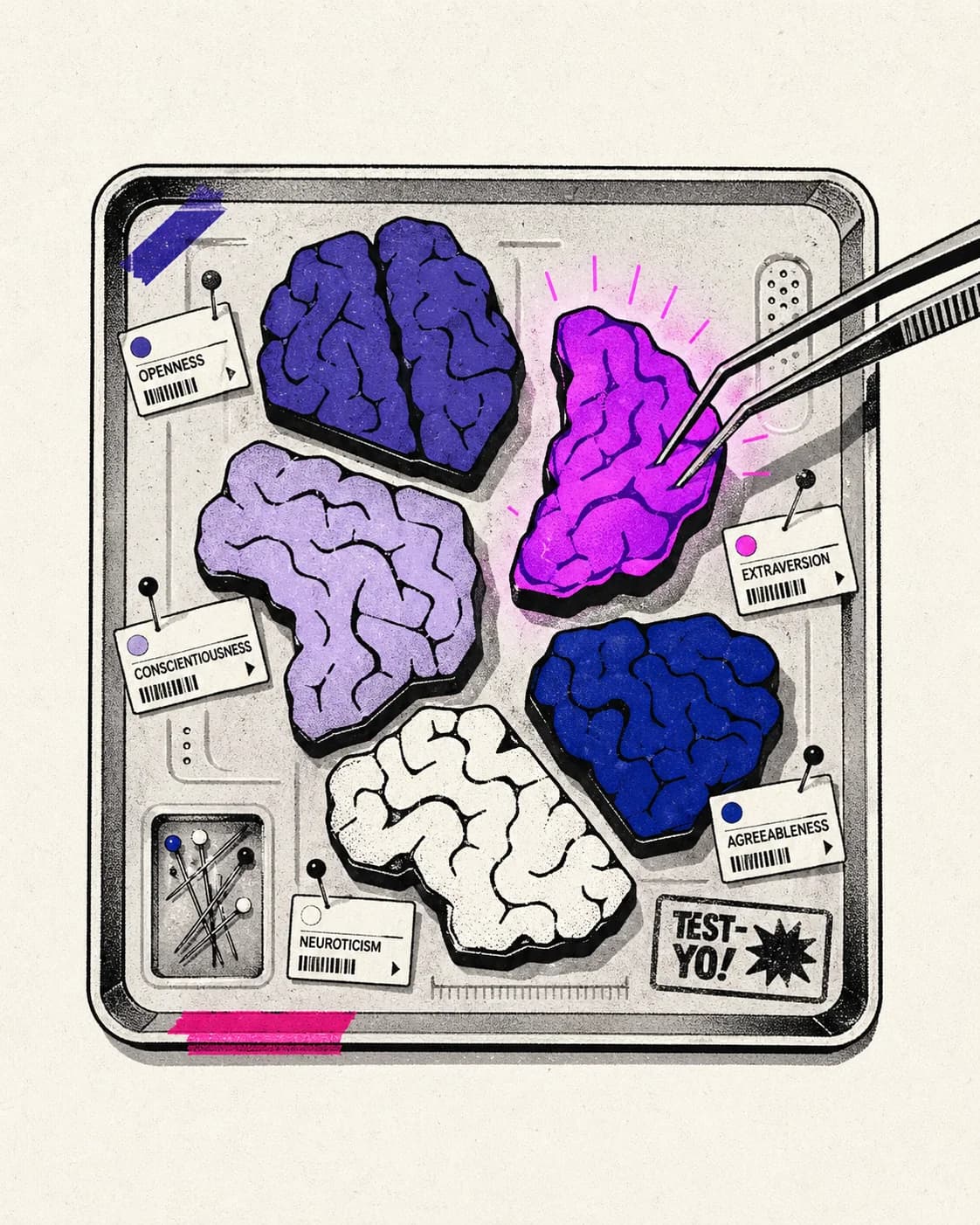
Our test (like most Big Five instruments) returns your standing on: - Openness — curiosity, art, abstraction - Conscientiousness — discipline, planning, follow-through - Extraversion — external energy, social drive - Agreeableness — warmth, cooperation, trust - Neuroticism — emotional reactivity to setbacks
The short-form we show tells you which trait is your dominant one. That's the clearest signal but only part of the picture.
Reading trait scores
A trait score is a percentile — where you sit compared to a reference population. A score in the 70th percentile doesn't mean you're "70% Open" — it means you're more Open than about 70% of people in the sample.
What the ranges typically mean: - Below 30th percentile: Strongly low. A defining feature of your profile. - 30th-70th: Typical range. Present but not a distinguishing feature. - Above 70th: Strongly high. A defining feature. - Above 90th: Distinctive. This is the trait you'd likely be described by.
Having "average" scores on several traits isn't bland — it's just the middle of a bell curve. The meaningful signal is which traits are clearly high or clearly low.
Trait combinations that actually matter
Individual traits are useful. Combinations are often more descriptive:
High Openness + High Conscientiousness — the productive creative. Generates ideas AND ships them. Rare and valuable.
High Openness + Low Conscientiousness — the idea person. Endless creativity but struggles with follow-through. Often needs a disciplined collaborator.
High Conscientiousness + Low Openness — the reliable operator. Excellent execution, less comfortable with ambiguity or innovation.
High Extraversion + Low Agreeableness — the dominant leader. Comfortable with conflict, builds momentum, harder on people.
High Extraversion + High Agreeableness — the connector. Warm, energising, harmony-seeking. Often ends up in HR, teaching, team leadership.
High Conscientiousness + High Neuroticism — the anxious achiever. High performer fuelled partly by fear of failure. Effective but at a personal cost.
Low Neuroticism + High Extraversion — the easy-going optimist. Often high life satisfaction, sometimes misses early warning signs in others.
Common misreadings
"I got Extraversion — I must be an extrovert": Your dominant trait is the one that stands out most in your profile, not necessarily the one you score highest on in absolute terms. If your Extraversion is 65th percentile and your Agreeableness is 62nd, Extraversion "won" but you're about equally describable by both.
"My Neuroticism is high — I must have mental health issues": No. Neuroticism measures a normal trait range. Clinical depression and anxiety are diagnosed via different criteria. A high Neuroticism score means you're more emotionally reactive than average, not that you're unwell.
"My scores changed from two years ago — the test is unreliable": Possibly — or your personality moved. Personality shifts over years of life events are real (see our personality-change article). Retest reliability for Big Five is high within weeks, lower over years.
"I'm low on Agreeableness so I'm a bad person": Agreeableness isn't ethics. People low in Agreeableness can be highly ethical; people high in Agreeableness can be unethical when the group rewards it. They're separate dimensions.
What your result doesn't tell you
- Your intelligence
- Your values
- Your ethics
- Your competence at any specific skill
- Whether you'd be happy in a specific job or relationship
Using your result productively
1. Look at your top and bottom traits. Those are your defining features. 2. Read the archetype page for your dominant trait — it expands on patterns you'll recognise. 3. Read the trait deep-dive for your weakest-scoring trait — that's where growth usually lives. 4. Retake in 6-12 months to see drift.
Read the whole profile before choosing a story
Consider an invented profile with higher Openness and Conscientiousness, lower Extraversion, middle Agreeableness and higher Neuroticism. Imagine someone who enjoys redesigning a community newsletter, finishes the layout carefully, prefers written discussion and worries about sending it. The combination gives you questions to ask about that scene. It does not establish creativity, competence or anxiety, and another person with similar answers could describe a different experience.
Now consider an invented profile with lower Openness, middle Conscientiousness, higher Extraversion and Agreeableness, and lower Neuroticism. Someone might recognise themselves in arranging a familiar group walk, chatting easily, changing the plan to accommodate a friend and feeling untroubled by a late start. That is an illustration, not a forecast. The profile would not tell you whether they remembered the route or treated everyone fairly.
Both examples describe all the traits without making the highest one the person's identity. Read the combinations above as possible conversation prompts rather than reliable roles or career advice. A dominant label can leave important parts out. If the quiz displays only that label, it has not supplied a complete numerical profile: do not invent the missing scores. Work with what is actually shown and add your own concrete examples.
A middle score gives you something to explore
A middle result is not an empty space between interesting extremes. Ask what answers contributed to it. Perhaps you welcome visitors you know but rarely introduce yourself at a crowded event. Perhaps you enjoy unfamiliar food but prefer familiar tools for a task with a deadline. These contrasting examples can make a broad middle description useful without turning it into a special personality type.
Do not assume a middle score proves flexibility or balance. You might behave similarly across settings, vary with the situation or have found several questions hard to answer. The number by itself cannot choose among those accounts. Nor should the middle be treated as a target everyone ought to reach; it is not a grade for how well you handle life.
Check what scale the result actually uses. Percentile language applies when an instrument compares answers with a reference group. This site's original quiz does not report population percentiles, so the ranges described earlier should not be applied to its result as though it did. That distinction matters at the middle as well as the extremes. A position within your displayed result and a position within a population are different comparisons.
Context helps explain apparently conflicting examples
Imagine you organise work tasks carefully because a shared schedule makes each deadline visible. At home, an unfinished cupboard remains open for days because nobody needs it completed yet. Both observations can belong to the same person. Before calling the profile inconsistent, describe the different demands, reminders and consequences around those actions.
The same applies to social situations. You might speak readily when explaining a familiar project and say little at a family gathering where you feel interrupted. That does not let you calculate separate true personalities for work and home. It does give you a reason to say which setting you had in mind when you answered a broad question about sociability.
Include exceptions without using context to excuse every difficulty. If your late reply inconvenienced someone, that effect still matters even when you can explain why it happened. A result does not settle responsibility for a particular action. Put the broad description beside the event: what was expected, what you did and what conditions were different. This keeps the profile connected to experience rather than using it as a complete explanation of behaviour or a prediction for the next situation.
Start a conversation with an example, not a label
Instead of telling a housemate, "You are low in Conscientiousness," describe the shared task: "When the cupboard is left unfinished, I cannot put the plates away. How can we agree when it will be done?" The request remains understandable without a test result. If both of you want to discuss profiles, use them to explore preferences after making the practical issue clear.
For your own result, try a tentative description: "I answered thinking about work, where I like plans. Does that fit what you see when we arrange weekends?" Leave the other person room to disagree. Their example is useful information, but it does not make them the final judge of your personality. Equally, your quiz label is not a reason to dismiss their experience.
Ask permission before sharing or interpreting someone else's result, and allow them to keep it private. Avoid turning the conversation into a competition about whose traits are better. End with something specific you both understand, such as an agreed way to arrange plans, or an open question where your accounts differ. A profile can support that discussion without becoming a rule about who each person must be.
Results are descriptive, not prescriptive. They tell you where you currently are — not where you have to stay.