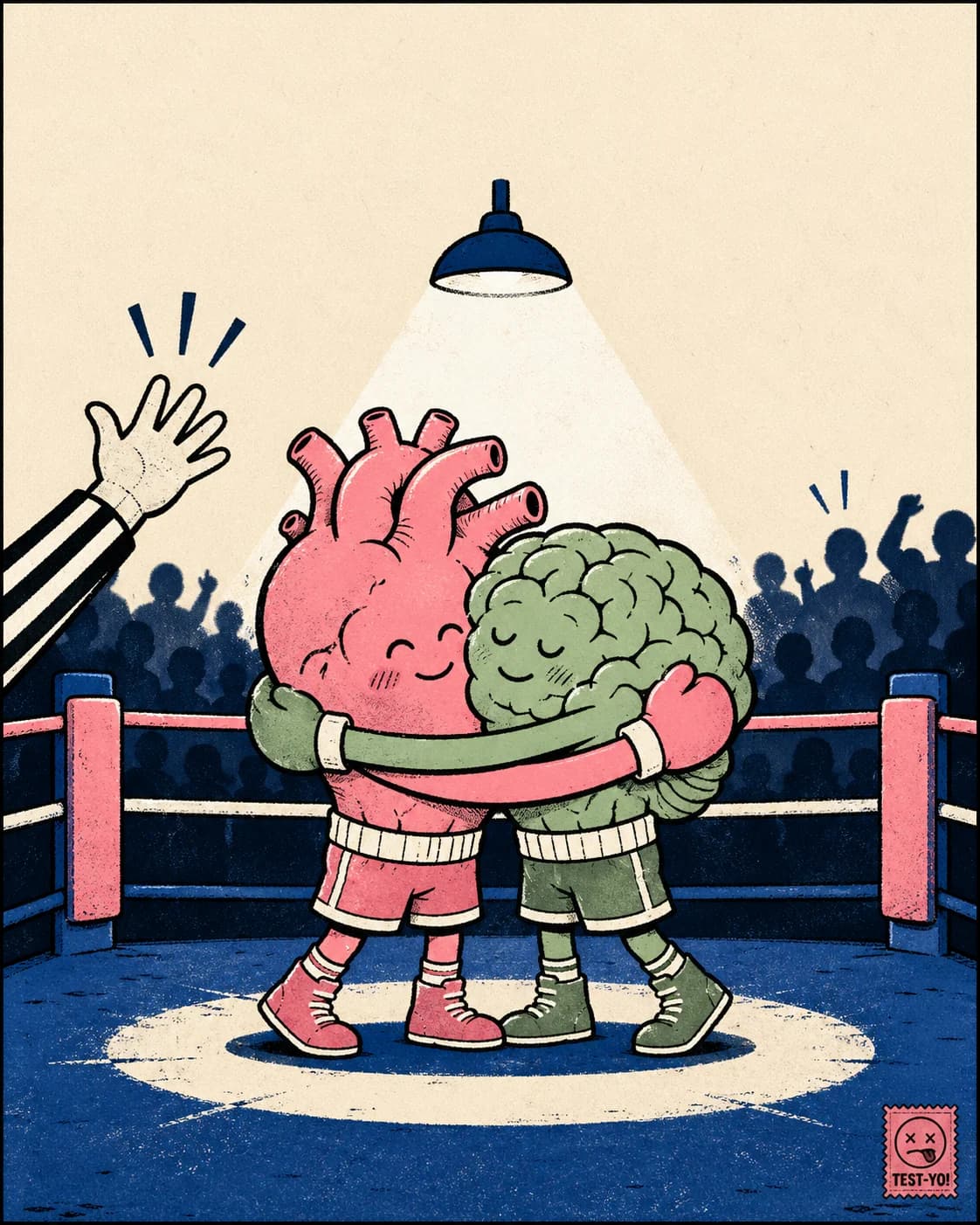
Daniel Goleman's 1995 book Emotional Intelligence popularised the idea that EQ might matter more than IQ for most life outcomes. The popular version is oversimplified; the underlying model is more careful. Goleman describes emotional intelligence through four domains. This article arranges them as a practical grid so you can compare what each domain is about.
Why four domains
Goleman's model pairs awareness with action, and self with others:
| Self | Others | |
|---|---|---|
| Awareness | Self-Awareness | Social Awareness |
| Action | Self-Management | Relationship Management |
The grid crosses awareness with action, and your own emotions with other people's. It is a way to orient yourself among the four domains, not evidence that everyone must learn them in a fixed order or that one domain is a prerequisite for every other.
Self-Awareness
The ability to accurately name your emotions in real time and notice how they colour your decisions. Sounds easy. Isn't. Self-report confidence and independently observed skill can diverge, so a quiz answer is a reflection prompt rather than a direct measure of self-awareness.
High Self-Awareness shows up as: - Naming the specific emotion rather than the umbrella ("I'm frustrated because I felt dismissed" rather than "I'm angry") - Knowing your triggers - Reading your own strengths and weaknesses without flinching
Some people use journaling or deliberate emotion-labelling as reflection exercises. This article does not establish that any one practice works for everyone.
Self-Management
What you do with emotions once you've noticed them. Impulse control, stress recovery, delayed gratification. The calm person under pressure.
High Self-Management shows up as: - Staying composed when things go sideways - Bouncing back from setbacks within days, not weeks - Not saying things you regret when stressed
At its edges, high Self-Management can tip into suppression — which looks like regulation from outside but builds pressure inside. Real self-management acknowledges the emotion, then chooses a response.
Social Awareness
Empathy. Reading mood, non-verbal cues, what a person is experiencing even when you disagree with them.
High Social Awareness shows up as: - Sensing the mood of a room as you walk in - Noticing when a friend is pretending to be fine - Understanding why someone feels what they feel, even when you'd feel differently in the same situation
This is where training slows down. You can learn to observe more, but natural empathy varies and isn't fully teachable. Strong Social Awareness also has a cost: people high on this absorb others' emotions and need deliberate recovery time.
Relationship Management
The outward-facing domain. Turning the previous three skills into real-world influence, conflict resolution, trust-building.
High Relationship Management shows up as: - Handling disagreements without damaging the relationship - Giving hard feedback with care - Rallying people around a shared goal
This domain is the most visible in interactions with other people. A result in this area is a prompt to examine specific behaviours, not a prediction about leadership, career advancement, or relationship outcomes.
How to use the grid in practice
Pick one recent interaction and write down four details: what you felt, what you did with that feeling, what you noticed about the other person, and how you handled the interaction. That comparison can suggest a useful reflection question without treating the grid as a required training sequence.
Which domain is yours?
Most people are asymmetric. Someone can be brilliant at Self-Management and poor at Social Awareness (reliable and composed but misses cues). Someone else can be an Empath with weak Self-Management (picks up everything, regulates poorly).
If you want a next step, choose one detail from that reflection and describe a small response you would like to try next time. This exercise does not show that training will improve a particular domain or predict how you will act in every situation.
The domains across an ordinary workday
Imagine a workday that starts with a tense meeting. Someone questions your proposal, and you notice that embarrassment is mixed with irritation. Naming that mixture belongs to self-awareness. Choosing to explain your reasoning without making the disagreement personal belongs to self-management. Neither action tells you whether your proposal is good; the practical question remains open.
Later, a delayed train threatens your next appointment. You feel impatient and decide to send an honest update rather than promise an arrival time you cannot know. The delay has not disappeared, and you are still annoyed. That makes the scene useful: managing a response does not require removing the feeling or controlling the situation.
Back at work, a colleague shares bad news. You notice their unusually short answers, but ask what they need rather than deciding you know. During a team decision that afternoon, you make space for their concerns while explaining the deadline. These are imagined examples of social awareness and relationship management, not a test of anyone's character. Several domains can be involved in the same sentence: understanding the colleague, noticing your own discomfort and agreeing what can reasonably happen next.
How the domains support and limit each other
The grid separates questions that can otherwise blur together. Knowing that you are upset is different from knowing what another person feels. Being able to describe both is different again from reaching an agreement. In the meeting example, you might recognise your embarrassment accurately but still dismiss the other person's practical objection. A clear account of your own feelings does not settle theirs.
The domains can inform each other without forming a compulsory ladder. A colleague's explanation might help you realise that your irritation came from feeling left out, rather than from the decision itself. An attempt to repair the conversation might reveal that you misunderstood their silence. Awareness can shape action, and the response to an action can change what you notice.
This also explains an uneven profile. Someone may keep a discussion orderly yet miss a person's hesitation. Someone else may understand that hesitation but struggle to state their own boundary. Ask which part of the interaction needs closer attention, rather than declaring that a whole domain is missing. The framework gives you different angles on the same event; it does not provide access to anyone's private thoughts or make a successful outcome certain.
Emotional intelligence is not constant niceness
Suppose the team wants you to accept an extra task that would displace work already agreed. A pleasant yes could leave the conflict hidden. A respectful refusal could make it visible: you explain what you can take on, what would need to move and who should decide. In this example, friendliness and relationship management are not interchangeable. The conversation can be uncomfortable while remaining clear and considerate.
Anger deserves the same distinction. Feeling angry about being interrupted does not, by itself, show poor emotional intelligence. Examine what happened next: did you name the issue, check whether it was deliberate and say what you needed, or did you attack the person? You can object firmly without claiming that the feeling has vanished.
Nor does empathy require agreement. You may understand why a colleague is disappointed and still oppose their suggestion. Reading a possible feeling is a reason to ask, not permission to insist that you know them better than they know themselves. The model should help describe choices within a relationship, including boundaries and disagreement, rather than reward whoever seems most agreeable from the outside.
What a self-report result can actually show
A self-report questionnaire records how you describe yourself in response to its wording. You might answer a question about conflict with yesterday's meeting in mind; another person might think about disagreements at home. The resulting domain label can organise reflection, but those different frames matter. It is not a recording of either person's behaviour across all their relationships.
Use the result to pose a narrower question. If relationship management stands out, can you recall a conversation where you clarified a disagreement, and another where you left it unresolved? Both examples belong in your account. A strongest-domain result does not establish your weakest domain, certify empathy or show that another person felt understood. It also cannot decide whether you should lead a team or whether a relationship will work.
Compare your self-description with concrete events and, where appropriate, what the other person is willing to share. Their account is another perspective, not an automatic verdict. If the accounts differ, keep the difference visible instead of forcing agreement with the label. The useful endpoint is a more precise question about an interaction, not a ranking of whose emotions are handled best.
Our 24-item Goleman test measures all four domains in 4 minutes and tells you which is your strongest.