 TEST-YO!· Personality
IPIP-50 · Goldberg 1999
Who Are You, Really?
A free personality type test built on the Big Five: 30 questions, five character archetypes, and how it compares with MBTI, DISC and four-type models.
- 5 min
- 30 questions
- No signup
- Free
Full result at the end — no email needed
Possible results · which one are you?
- Explorer
- Organiser
- Energiser
- Harmoniser
- Sensitive
Quick answer
A free personality type test built on the Big Five: 30 questions, five character archetypes, and how it compares with MBTI, DISC and four-type models.
- 30 questions · ~5 min
- Framework: Big Five personality traits
- Based on: Goldberg, L. R. (1999)
- Cost: free · no signup
About this test
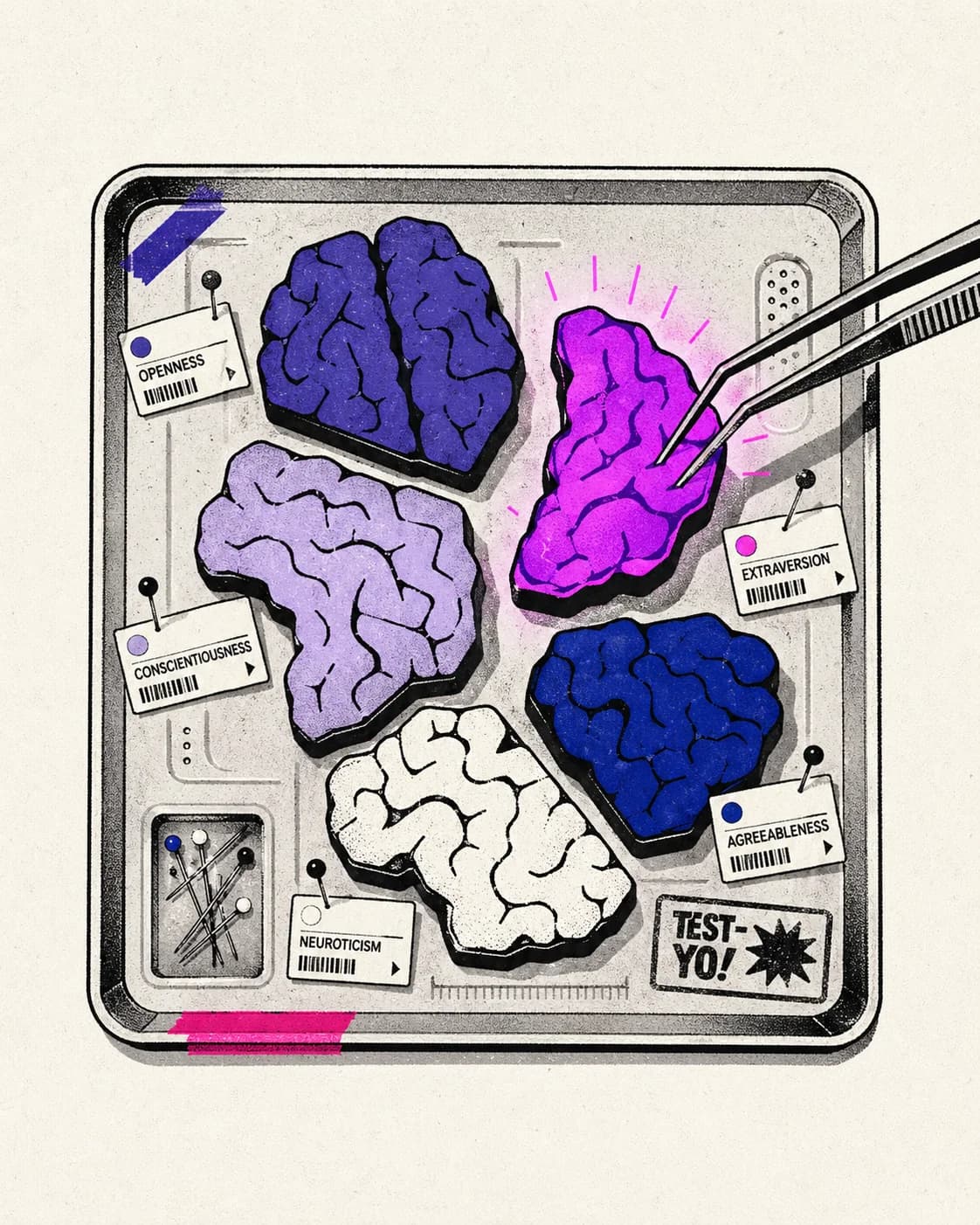
This 30-item Big Five personality test measures Openness, Conscientiousness, Extraversion, Agreeableness and Neuroticism (emotional reactivity). Each trait is probed with 6 items (3 forward-keyed, 3 reverse-keyed) on a 5-point Likert scale, following the structure of the widely used IPIP-NEO short forms.
Methodology
30 self-report items, 6 per Big Five trait, balanced between forward- and reverse-keyed. Each answer on a 5-point Likert scale contributes –2 to +2 to the target trait. The trait with the highest total determines the result archetype. Short Big Five forms such as BFI-10 or IPIP-30 follow the same structure with professionally validated wordings; this is a free, shorter indicator.
What a personality test measures — and how the popular models differ
A personality test is a set of self-report questions that estimates where you sit on a handful of traits: how you take in the world, how you organise it, and how you react when it pushes back. The disagreement between the popular personality test types is not really about people — it is about how many boxes to use, and whether you get a position on a scale or a label. Here is what each model claims to measure, and what this quiz is built on.
- Big Five (OCEAN) — five traits, measured by degree
- Openness, Conscientiousness, Extraversion, Agreeableness and Neuroticism (emotional reactivity). This is the model academic research settled on, because the same five dimensions keep reappearing across languages and samples. It gives you a position on each scale rather than a type code, which is why two people with the same top trait can still be quite different.
- MBTI — sixteen types from four letters
- Sorts people into one of 16 four-letter types (INFP, ESTJ and so on) by forcing four either/or choices. It is the most popular framework in the world, especially in workplaces. Researchers criticise the forced split: most people sit near the middle of each letter, so a retake weeks later can hand you a different type.
- DISC — four behaviour styles at work
- Dominance, Influence, Steadiness and Conscientiousness. Built for teams rather than for research, it describes how you behave in a working context instead of who you are in general, and it is what most corporate four-style workshops are ultimately based on.
- Enneagram — nine motivations
- Nine types defined by what drives you and what you fear — the Helper, the Achiever, the Loyalist and so on — usually with a "wing" borrowed from a neighbouring type. It comes from a spiritual and self-development tradition rather than from psychometrics, and it is the model that speaks most directly about motive.
- Four temperaments and the colour models
- The oldest split of all — sanguine, choleric, melancholic and phlegmatic — survives today as the red, blue, green and yellow colour systems and as the type A/B/C/D family. Both are four-box models, both have their own quiz on this site, and both trade precision for something you can remember and share.
- This quiz — five Big Five archetypes
- Thirty statements, six per trait, and the trait scoring highest names your archetype: Explorer (Openness), Organiser (Conscientiousness), Energiser (Extraversion), Harmoniser (Agreeableness) or Sensitive (emotional reactivity). It reports your strongest trait, not a full type code — and never a diagnosis.
- Why Korea keeps turning up in personality search
- In South Korea, MBTI became everyday small talk during the 2020s: four-letter types get traded on first dates, printed in dating-app bios, joked about on variety shows and occasionally asked about in hiring. That is a cultural phenomenon rather than a separate instrument — the questionnaire is the same one used everywhere else. The older regional habit of reading character from blood type has the same status: convention, not measurement.
Every framework named here is a popular model rather than a validated clinical instrument, and this quiz is no exception — it is built for self-reflection and entertainment. For how the research-backed model and the most popular one actually differ, read Big Five (OCEAN) vs MBTI in the related reading below.
Possible archetypes
- Explorer · Brain on 47 tabs
- Your "what if?" tab count is a public health concern.
- Organiser · Organised at heart
- You have a Notion page for your Notion pages. We see you.
- Energiser · Walking serotonin
- You came out of the womb introducing yourself. Still doing it.
- Harmoniser · Soft peacekeeper
- You apologize when other people bump into YOU. Your therapist agrees.
- Sensitive · Feels everything
- A song from 2009 just ruined your week. We both saw it happen.
Related tests
Related reading
The Big Five Personality Traits Explained
What Openness, Conscientiousness, Extraversion, Agreeableness and Neuroticism actually measure — and why researchers trust this model.
How to Interpret Your Big Five Results
A practical guide to reading your OCEAN scores — what percentiles mean, which combinations matter, and common misreadings.
Big Five (OCEAN) vs MBTI: Which Is More Accurate?
A careful comparison of the two most popular personality models — and why researchers largely abandoned MBTI decades ago.
Sources & references
- Goldberg, L. R. (1999). A broad-bandwidth, public domain, personality inventory measuring the lower-level facets of several five-factor models. Tilburg University Press.
- Costa, P. T., & McCrae, R. R. (1992). Revised NEO Personality Inventory (NEO-PI-R) and NEO Five-Factor Inventory (NEO-FFI) Professional Manual. Psychological Assessment Resources.
FAQ + disclaimer
Is this a character personality test?
Yes, in the everyday sense of the words. "Character" and "personality" are used interchangeably outside psychology, and this quiz does what people mean by both: 30 statements about how you think, work and react, then the trait that scores highest, named as one of five character archetypes. Academic psychology does separate the two — personality for stable dispositions, character for the moral and value-laden side — but no quiz on this site draws that line.
Is there a 4 personality types test?
Several, and this is not one of them: this quiz reports five archetypes built on the Big Five traits. The classic four-way splits are type A/B/C/D and the red, blue, green and yellow colour systems, each with its own quiz here. Four boxes are easier to remember and easier to share, at the cost of packing very different people into the same box.
What is the Korean personality test?
There is no separate Korean test. The phrase almost always means MBTI, which became ordinary small talk in South Korea during the 2020s — four-letter types turn up on first dates, in dating-app bios and on variety shows. The questionnaire is the same one used everywhere else; what is Korean is the conversation around it. The older regional habit of reading character from blood type sits in the same category.
Is there an antisocial personality test?
Not a valid one online, and this quiz is not it. Antisocial Personality Disorder is a clinical diagnosis, made by qualified professionals through interview and personal history. No online quiz, including this one, can screen for it, and a score on any web questionnaire means nothing diagnostically. If the question is about yourself or about someone close to you, talk to a doctor or a licensed mental health professional.
Does blood type predict personality?
No. The idea that A, B, O and AB map onto personality profiles is a popular belief in Japan and Korea, where it shapes small talk and sometimes even matchmaking, but studies looking for the link have not found one. Treat a blood type personality test the way you would a horoscope: entertainment, not measurement.
Can a personality test tell if two people are compatible?
No. A personality compatibility test compares two sets of answers and describes where they line up and where they clash, which can be a good conversation starter — but it does not predict whether a relationship lasts. What research finds matters is how a couple handles conflict, not how their traits pair on paper. Take the result as entertainment.