 TEST-YO!· Personality
IPIP-50 · Goldberg 1999
Who Are You, Really?
Take a free personality test in about 5 minutes. Explore five Big Five traits with 30 questions, instant results and everyday examples. No signup.
- 5 min
- 30 pytań
- Bez konta
- Bezpłatnie
Pełny wynik na końcu · bez podawania e-maila
Możliwe wyniki · który pasuje do ciebie?
- Explorer
- Organiser
- Energiser
- Harmoniser
- Sensitive
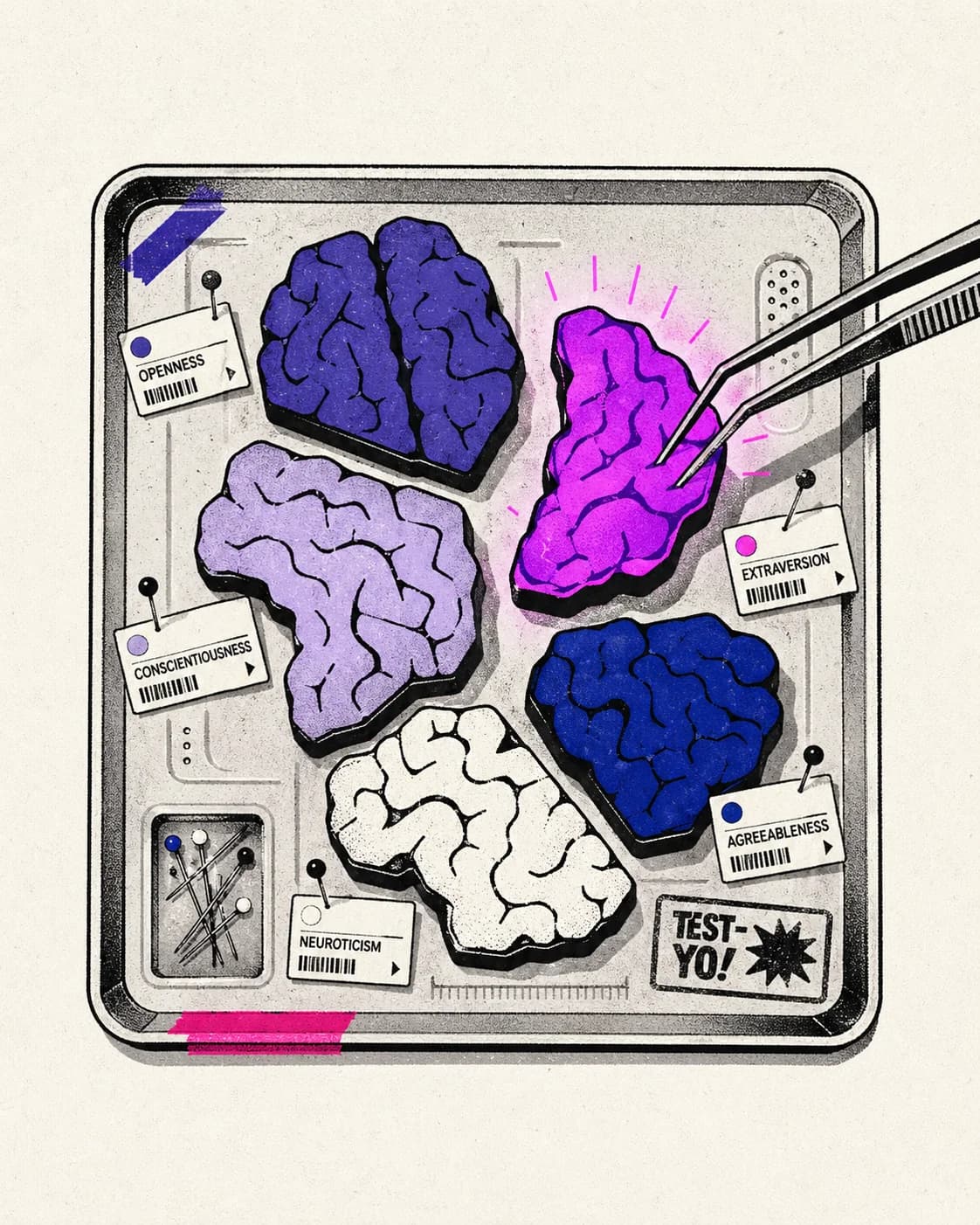
W skrócie
Take a free personality test in about 5 minutes. Explore five Big Five traits with 30 questions, instant results and everyday examples. No signup.
- 30 pytań · ~5 min
- Podejście: Big Five personality traits
- Podstawa: Goldberg, L. R. (1999)
- Koszt: bezpłatnie · bez konta
O tym teście
This original 30-item quiz explores Openness, Conscientiousness, Extraversion, Agreeableness and Neuroticism (emotional reactivity). Six statements per trait use a five-point agreement scale, with some scored in reverse. It is inspired by the Big Five model, not a validated BFI or IPIP questionnaire, and has no population norms.
Jak liczymy wynik
30 original self-report items, 6 per Big Five trait, with forward- and reverse-keyed statements. Each answer contributes −2 to +2 to its trait. The highest total determines the result archetype; ties use O, C, E, A, N order. This independent quiz is not a validated BFI or IPIP questionnaire and has no population norms.
The five traits
Big Five describes tendencies on continuous scales, not five exclusive types. OCEAN stands for openness, conscientiousness, extraversion, agreeableness and neuroticism. Everyone has a pattern across all five; these everyday examples illustrate tendencies rather than rules.
- Openness
- Curiosity about unfamiliar ideas, experiences and creative possibilities. You might try a recipe from a cuisine you do not know. You might explore a different interpretation of a favourite film.
- Conscientiousness
- A tendency towards organisation, responsibility and following through. You might plan your week before Monday. You might check the details of a task before handing it over.
- Extraversion
- A tendency towards sociability, assertiveness and outward activity. You might start a conversation at a gathering. You might volunteer to speak during a group discussion.
- Agreeableness
- A tendency towards cooperation, consideration and trust. You might listen to both sides of a disagreement. You might offer a colleague help when they are overloaded.
- Neuroticism
- A tendency to experience stress and difficult emotions more readily, also called emotional reactivity. You might worry about a delayed reply. You might feel unsettled after a small change of plans. This is a trait description, not a diagnosis.
Independent Big Five quiz, not an MBTI assessment and not affiliated with its publisher. Myers-Briggs Type Indicator and MBTI are trademarks of their respective owners.
How to read your result
Your archetype names the trait with the highest total across your answers, not your whole personality. Some statements are scored in reverse. If totals tie, the quiz uses O, C, E, A, N order, so a close result deserves caution. The profile bars show each total relative to that trait’s possible positive maximum; negative totals display as zero. These are not population percentiles, and the five percentages do not need to add up to 100. Compare the descriptions with real situations, including examples that do not fit. A higher score is not a better person, and a lower one is not a flaw.
Big Five vs MBTI
Big Five describes five continuous traits. The Myers-Briggs Type Indicator (MBTI) describes preferences through four pairs and reports a type combination. Both use self-report, but they organise the answers differently; there is no direct conversion from an OCEAN score to a four-letter type. Big Five is more widely used in academic personality research. That research does not establish the validity of this original quiz. Choose a validated instrument when you need a formal assessment, rather than treating a shareable label as a verdict.
Możliwe typy wyników
- Explorer · Brain on 47 tabs
- Six half-read books, one abandoned language app, and a genuinely good idea you had in the shower and never wrote down.
- Organiser · Organised at heart
- The calendar is colour-coded, the spare charger has a designated pocket, and you know which of your friends is always late.
- Energiser · Walking serotonin
- You made a friend in the queue, heard about their divorce, and offered them a place to stay in a city you do not live in.
- Harmoniser · Soft peacekeeper
- You have said no worries and meant it, right up until the third time, and nobody has any idea there was a third time.
- Sensitive · Feels everything
- A song from 2009 came on in a supermarket and took eleven minutes of your afternoon. Also, that text from Tuesday.
Powiązane testy
Źródła i literatura
- Goldberg, L. R. (1999). A broad-bandwidth, public domain, personality inventory measuring the lower-level facets of several five-factor models. Tilburg University Press.
- Costa, P. T., & McCrae, R. R. (1992). Revised NEO Personality Inventory (NEO-PI-R) and NEO Five-Factor Inventory (NEO-FFI) Professional Manual. Psychological Assessment Resources.
Najczęstsze pytania + informacja
Is this personality test free?
Yes. All 30 questions and the Big Five result are free, with no signup or email required.
How accurate is this Big Five personality test?
It is an original self-reflection quiz inspired by a research framework. This particular questionnaire has not been independently validated or normed, so we cannot give an accuracy percentage. Answers depend on how you see yourself and your current situation.
Can my personality test result change?
Yes. Habits and personality can develop over time, and mood, context and how you interpret a question can affect your answers. A different result does not by itself prove a lasting personality change.
Which is more scientific: Big Five or MBTI?
The Big Five is more widely used in academic personality research and describes continuous traits. MBTI describes type preferences. Evidence for a framework does not automatically validate every quiz based on it, including this one.
How is my Big Five result calculated?
Each statement contributes to one trait, with some answers scored in reverse. The trait with the highest total names your archetype. If totals tie, the order is openness, conscientiousness, extraversion, agreeableness, then neuroticism. Scores are not population percentiles.
Does a high neuroticism score mean a diagnosis?
No. Here neuroticism means a tendency to react to stress and difficult emotions. This quiz cannot diagnose a mental health condition or replace a professional assessment.