 TEST-YO!· Sibling Role
What Sibling Role Did You Actually Get?
Explore six sibling role patterns with a free quiz about responsibility, closeness and independence. Reflect on your experience beyond birth order labels.
- 3 min
- 24 pytań
- Bez konta
- Bezpłatnie
Pełny wynik na końcu · bez podawania e-maila
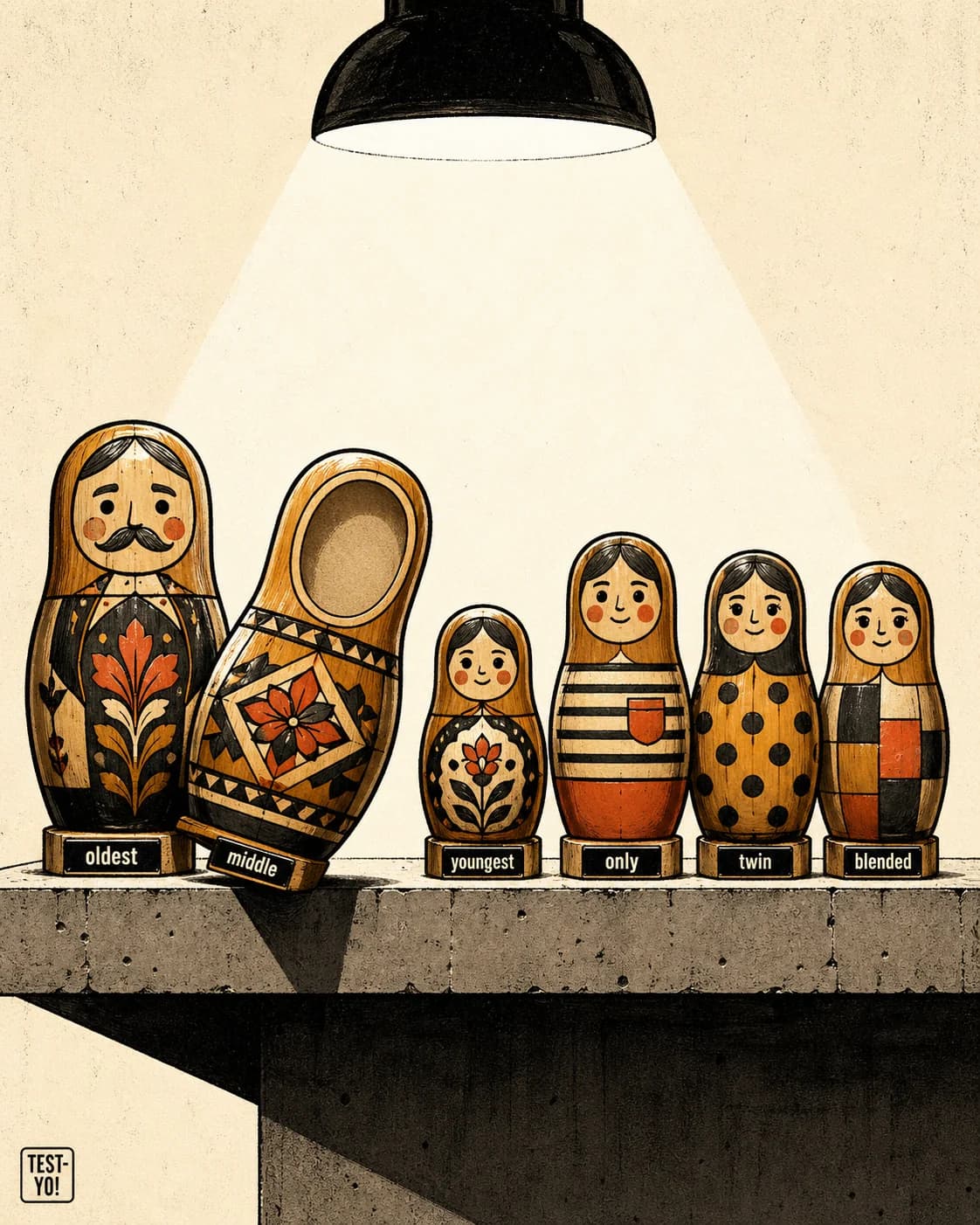
Możliwe wyniki · który pasuje do ciebie?
- Oldest
- Middle
- Youngest
- Only
- Twin-Vibe
- Blended
W skrócie
Explore six sibling role patterns with a free quiz about responsibility, closeness and independence. Reflect on your experience beyond birth order labels.
- 24 pytań · ~3 min
- Koszt: bezpłatnie · bez konta
O tym teście
Birth order is half the story. 24 honest items, one verdict on the role you got handed and what it cost you.
Jak liczymy wynik
24 items, 4 per role, 5-point Likert. Dominant-role scoring across six sibling positions.
What the result types mean
The result labels borrow family positions to describe experiences. They do not establish your actual birth order or prove that a family structure causes a personality.
- Oldest
- Your answers emphasise early responsibility and being the capable one. Consider which responsibilities you chose and which became expected. You can value your competence while allowing others to help and deciding what you no longer want to carry.
- Middle
- You recognise adapting, reading the room and helping people get along. Those habits may make it easier to meet others’ needs than to state your own. Look for situations where you would like to be more visible or ask directly for support.
- Youngest
- You recognise bringing lightness and adapting to older family members. Consider whether people still treat you as less independent than you feel. Give yourself room to show seriousness, make decisions and ask to be seen as you are now.
- Only
- Your answers emphasise independence, time alone and relating closely to adults. These are themes to consider, not assumptions about everyone without siblings. Think about how you balance self-reliance with friendships or chosen family where you can ask for help.
- Twin-Vibe
- You recognise a close shared identity or a bond built around growing up alongside someone. The label does not mean you must be a twin. Consider what you enjoy sharing and which interests or decisions you want to develop independently.
- Blended
- You recognise moving between family settings, expectations or loyalties. Adapting may have helped you navigate those differences, while sometimes making your own preferences less clear. Consider what boundaries and sense of belonging you want to choose now.
How to use your result
Start with a situation you recognise, then choose one useful step:
- Separate the role description from your literal position in the family.
- Recall a specific memory that fits and another that challenges the description.
- Identify one expectation you want to keep and one you would like to renegotiate.
- Discuss your experience in your own words without assigning siblings fixed personalities.
Możliwe typy wyników
- Oldest · Recovering eldest
- You were a parent before you were a teen. You're still trying to log off.
- Middle · Invisible middle
- You were cropped out of the family photo and you became a diplomat about it.
- Youngest · Family wildcard
- You got away with everything and they still order your food. We both know it.
- Only · Tiny adult, alone
- Your group chat is your siblings now. Allergic to needing people.
- Twin-Vibe · Half-person on purp.
- You share an identity with someone and a language no one else has cracked.
- Blended · Two-household kid
- You ran two operating systems before age ten. You spot fake hugs.
Powiązane testy
Najczęstsze pytania + informacja
How accurate is the sibling role result?
It summarises your account of family experiences. It cannot reconstruct your upbringing, establish causes or tell you how siblings remember the same events.
Is this a scientific birth order test?
No. This is a self-reflection quiz using informal family role labels, not a validated assessment or evidence that birth order determines personality.
Can my result change?
Yes. Your role and your understanding of childhood can shift as relationships change. You can also choose different responsibilities in adult life.
Why does my result differ from my actual birth order?
The questions match experiences and habits rather than checking a family record. A result called Oldest can describe responsibility even when you are not the oldest child.
Can I take it if I have no siblings?
Yes. There is an Only pattern, but you may recognise other themes too. Treat the descriptions as prompts rather than a rule about what your family must have been like.