 TEST-YO!· Family Role
What Family Role Were You Cast In?
Explore six family roles, from golden child to scapegoat, with this free quiz. Reflect on patterns you grew up with; this is not a diagnosis.
- 3 min
- 24 pytań
- Bez konta
- Bezpłatnie
Pełny wynik na końcu · bez podawania e-maila
Możliwe wyniki · który pasuje do ciebie?
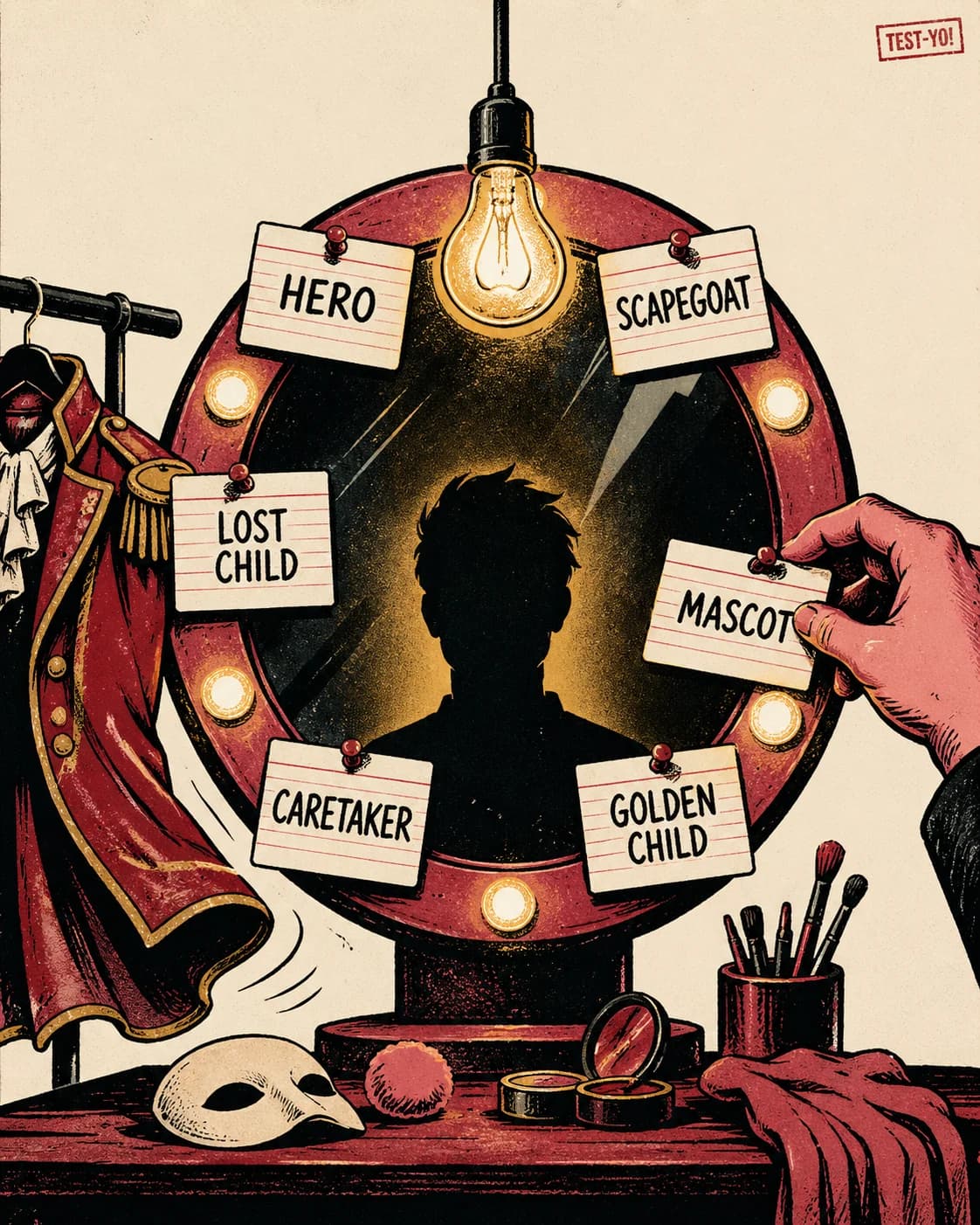
- The Hero
- The Scapegoat
- The Lost Child
- The Mascot
- The Caretaker
- The Golden Child
W skrócie
Explore six family roles, from golden child to scapegoat, with this free quiz. Reflect on patterns you grew up with; this is not a diagnosis.
- 24 pytań · ~3 min
- Koszt: bezpłatnie · bez konta
O tym teście
Many families under stress — addiction, conflict, illness, favoritism — quietly hand each child a part to play. This quiz uses 24 statements to show which of six family roles you lean toward: the four childhood roles described by family therapist Sharon Wegscheider-Cruse (Hero, Scapegoat, Lost Child, Mascot), plus the Caretaker and the Golden Child, two roles widely used in later writing on dysfunctional and narcissistic family dynamics. You get your dominant role, what it gave you, and what it may still cost you in adult relationships.
Jak liczymy wynik
24 statements, 4 per role, each rated on a 5-point agree/disagree scale. Scores are totalled per role and your highest-scoring role is reported as your dominant role. The Hero, Scapegoat, Lost Child and Mascot roles follow the family roles framework developed by therapist Sharon Wegscheider-Cruse; the Caretaker and Golden Child are drawn from later family-dynamics writing. A self-reflection tool, not a validated clinical instrument.
Możliwe typy wyników
- The Hero · Family human trophy
- You were the family's PR campaign. They got the brag, you got the ulcer.
- The Scapegoat · Family villain
- Whatever the real problem was, it ended up wearing your name.
- The Lost Child · Family ghost
- You disappeared into your bedroom for a decade. It worked too well.
- The Mascot · Comedian-on-duty
- You learned to read a room before you could read words. Charm clocks in.
- The Caretaker · Parented my parents
- You were a tiny adult before twelve. You spot a mood shift across rooms.
- The Golden Child · Family's open fave
- You were the family's favorite. Your siblings noticed. You pretended you didn't.
Powiązane testy
Najczęstsze pytania + informacja
What are the family roles in dysfunctional families?
In the family roles framework developed by therapist Sharon Wegscheider-Cruse, children in a stressed or addicted family tend to adopt roles that keep the system stable: the Hero (achieves to make the family look okay), the Scapegoat (acts out and absorbs the blame), the Lost Child (stays invisible to avoid adding pressure) and the Mascot (uses humor to ease tension). Her model also describes the Enabler, usually a partner who covers for the person with the problem. This quiz adds the Caretaker and the Golden Child, two roles common in later writing on family dynamics.
Who created the family roles framework?
Sharon Wegscheider-Cruse, a family therapist who worked with families affected by alcoholism, described these roles in her 1981 book Another Chance: Hope and Health for the Alcoholic Family, building on the family systems work of Virginia Satir. The Golden Child label comes from later writing on narcissistic family dynamics, not from her original model.
Am I the golden child or the scapegoat?
The two often come as a pair. The Golden Child is the one the family praises and holds up as proof things are fine; the Scapegoat is the one blamed for problems, often for noticing or naming them. If you were consistently favored, you likely score higher on Golden Child; if you were consistently blamed, Scapegoat. Some people swap between the two over time — this quiz shows which pattern dominates for you.
Were these roles assigned on purpose?
Almost never. They emerge from family dynamics — children fall into the slots the system needs filled, usually without anyone deciding it.
Can I have more than one family role?
Yes. Most people recognize themselves in more than one. The result names your dominant role; a secondary role often shows up too, and roles can shift when siblings leave home or circumstances change.
Is this only for families with addiction or abuse?
No. The model was developed from work with alcoholic families, but many people from families shaped by chronic conflict, illness, divorce or favoritism recognize these patterns. Healthy families have roles too — they are just more flexible and less rigid.
Do family roles continue into adulthood?
They often do. The habits that helped you cope as a child — overachieving, keeping quiet, making jokes, looking after everyone — can carry into work, friendships and family gatherings long after you have left home. Noticing the pattern is the first step to choosing when to use it.
How do family roles show up in adult relationships?
A Hero may struggle to rest or ask for help; a Scapegoat may expect blame or push back hard against criticism; a Lost Child may avoid conflict and hide their needs; a Mascot may deflect serious conversations with humor; a Caretaker may attract partners who need rescuing; a Golden Child may tie their worth to performing well.
Is this family role quiz a diagnosis?
No. Family roles are a self-reflection framework, not a clinical diagnosis, and they have little formal research support as fixed categories. Use your result as a starting point for reflection. If your family history still causes you distress, a licensed therapist can help.