 TEST-YO!· Growth Mindset
Implicit Theories · Dweck 2006
Are You Fixed or Growing?
Is your mind a fortress — or still growing? 16 honest questions.
- 5 min
- 16 questions
- No signup
- Free
Full result at the end — no email needed
Possible results · which one are you?
- Fixed Fortress
- At the Crossroads
- Rising Learner
- Open Grower
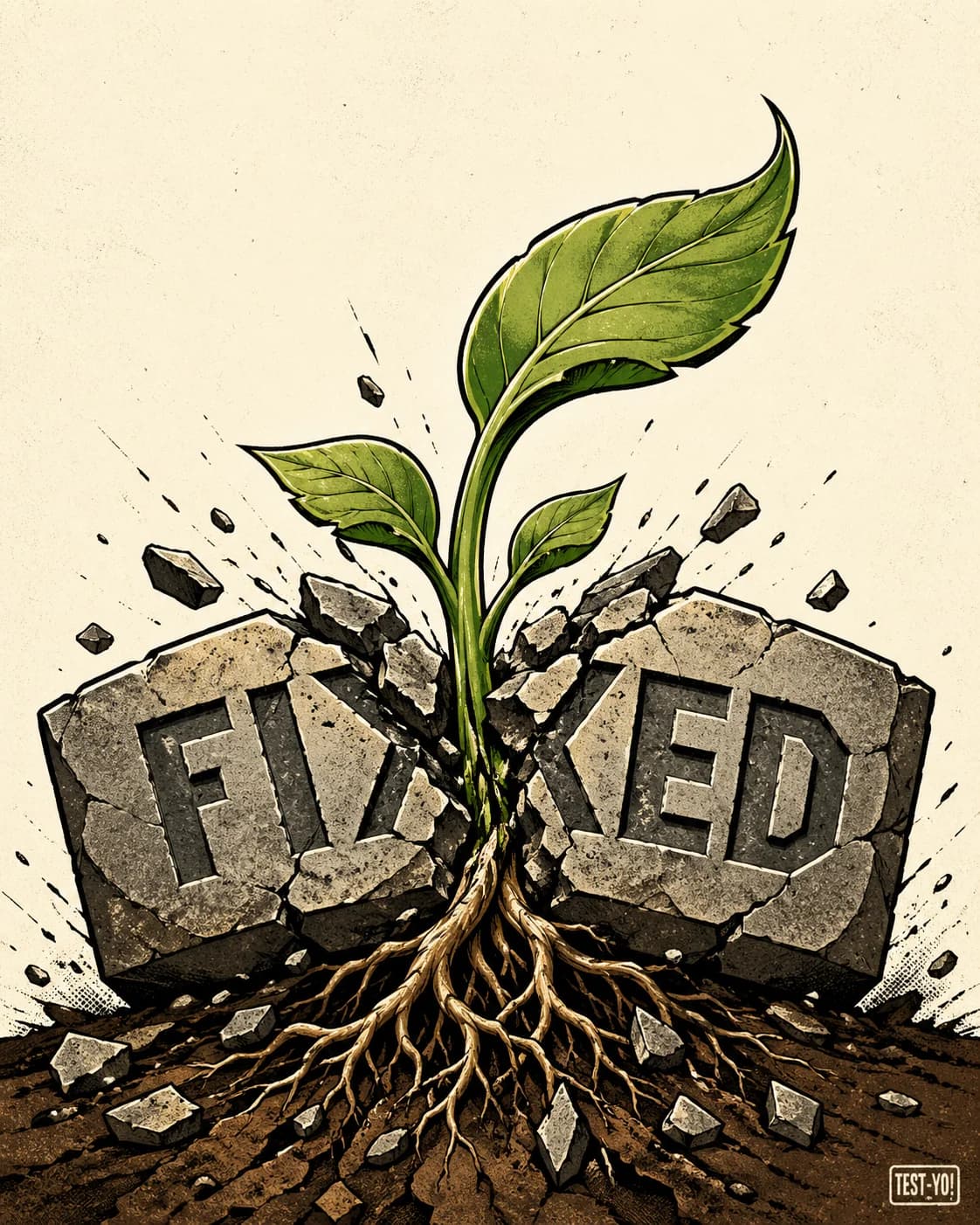
Quick answer
Is your mind a fortress — or still growing? 16 honest questions.
- 16 questions · ~5 min
- Based on: Dweck, C. S. (2006)
- Cost: free · no signup
About this test
A 16-item form drawn from Carol Dweck's Implicit Theories scales (intelligence, personality, and character). Eight items describe a fixed view of ability and character, eight describe a growth view. Your answers are summed (fixed items reverse-scored) to place you on a single axis from Fixed Fortress to Open Grower.
Methodology
Based on Dweck, C.S. (1999) Self-theories: Their role in motivation, personality and development, and Dweck, C.S. (2006) Mindset: The New Psychology of Success. This 16-item form draws on Dweck's Implicit Theories of Intelligence, Personality, and Character scales, pairing 8 fixed-mindset items with 8 growth-mindset items on a 6-point Likert scale; fixed items are reverse-scored and summed (range 16–96).
Possible archetypes
- Fixed Fortress · Born-this-way energy
- You came pre-installed and the receipt is missing. Lo sabemos.
- At the Crossroads · Delulu-meets-real
- Growth, in theory. Talent, in your case. We see the loophole.
- Rising Learner · Failure-as-data
- You treat every L as a tutorial. Annoyingly healthy of you.
- Open Grower · Delulu-but-it-works
- You believe you can become anything. Slightly soñador, fully working.
Related tests
Related reading
The Big Five Personality Traits Explained
What Openness, Conscientiousness, Extraversion, Agreeableness and Neuroticism actually measure — and why researchers trust this model.
Holland's RIASEC Career Model Explained
The six career-personality types behind the most widely used career assessment in the world — and how to read your own profile.
Sources & references
- Dweck, C. S. (2006). Mindset: The New Psychology of Success. Random House.
FAQ + disclaimer
Is this a clinical assessment?
No. It's a short, self-reflection version of Dweck's Implicit Theories of Intelligence scale. It is not diagnostic.
Can mindset change?
Dweck's research shows that mindset can shift with experience, feedback framing, and deliberate practice.