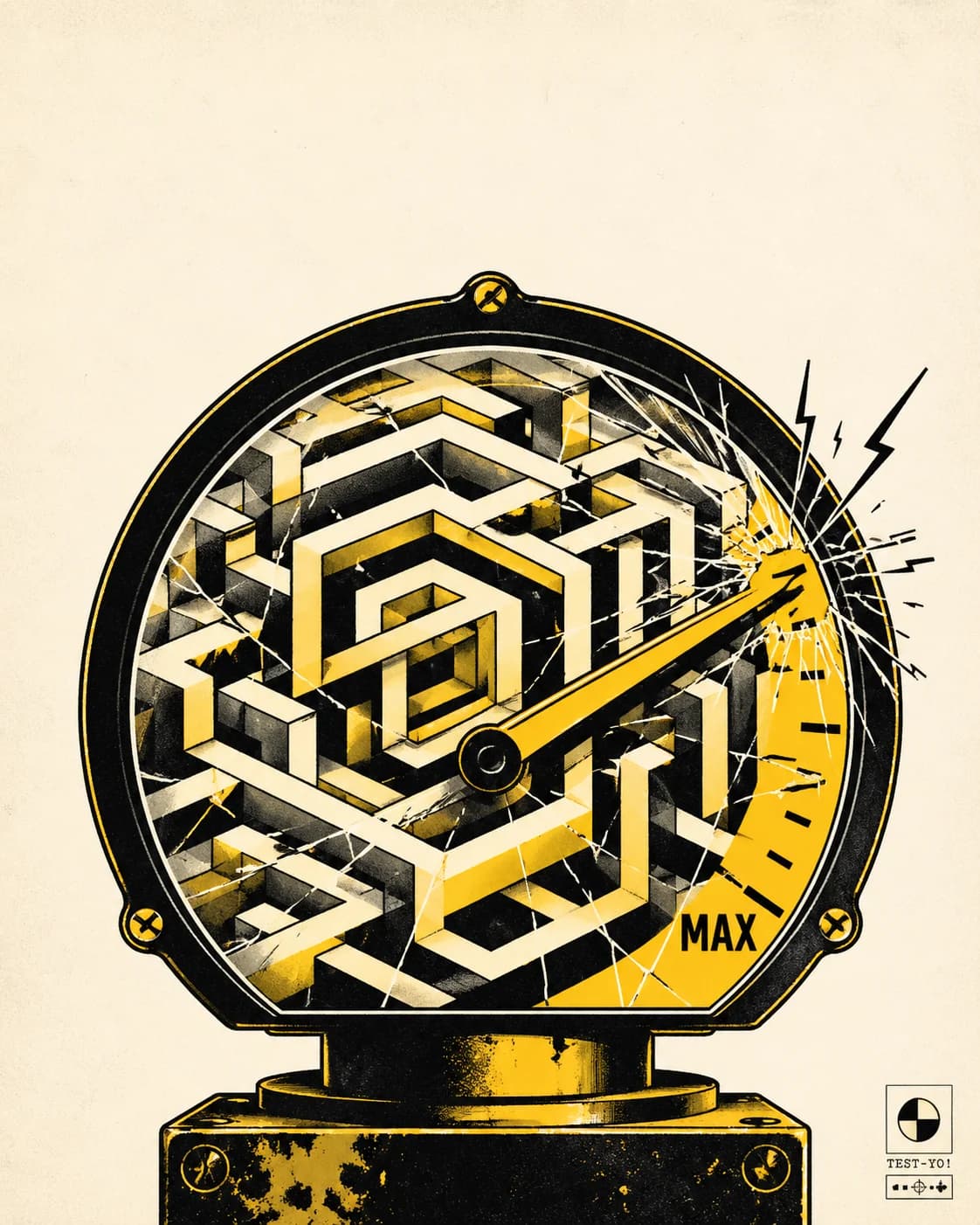
 TEST-YO!· Overthink Meter
Overthink Meter — How (and why) do you overthink?
Explore replaying conversations, analysing choices and imagining worst cases. Read four thought-pattern guides with practical prompts and clear limits.
- 3 min
- 16 pytań
- Bez konta
- Bezpłatnie
Pełny wynik na końcu · bez podawania e-maila
Możliwe wyniki · który pasuje do ciebie?
- Spiraller
- Analyst
- Worrier
- Catastrophizer
W skrócie
Explore replaying conversations, analysing choices and imagining worst cases. Read four thought-pattern guides with practical prompts and clear limits.
- 16 pytań · ~3 min
- Koszt: bezpłatnie · bez konta
O tym teście
A 16-item self-report quiz that maps you to one of four overthinking patterns drawn from research on rumination (Nolen-Hoeksema 1991), worry (GAD-7) and decisional procrastination. Four items per pattern on a 5-point Likert scale. The point isn't to label you anxious — it's to identify which loop your brain runs so you can interrupt the right one.
Jak liczymy wynik
16 self-report items (4 per overthinking pattern) on a 5-point Likert scale. Inspired by published constructs of rumination (Nolen-Hoeksema 1991), worry, and decisional procrastination. Not a clinical instrument.
What the results mean
The four labels are informal patterns in your answers. They do not diagnose anxiety, establish a cause or measure how serious your experience is.
- Spiraller
- Your answers suggest returning to conversations after they have ended and reconsidering what you or someone else said. Notice what is known and what you are guessing. Replaying an exchange does not necessarily provide new information about the other person.
- Analyst
- Your answers suggest spending considerable time comparing options or seeking more information before deciding. Consider whether the missing detail could change the choice. For a small decision, defining the question and a reasonable stopping point may help you move forward.
- Worrier
- Your answers suggest anticipating difficult interactions or interpreting uncertain signals as a concern. Separate the actual message from the meaning you fear it carries. When appropriate and safe, asking a clear question can provide information that repeated guessing cannot.
- Catastrophizer
- Your answers suggest that uncertain situations quickly bring worst-case possibilities to mind. Those possibilities are thoughts, not forecasts. Consider what evidence is available and what support would be useful, without requiring yourself to prove that nothing difficult could ever happen.
If these feelings persist, cause distress or affect daily life, consider speaking with a qualified mental health professional.
How to use your result
Choose a step that fits your circumstances:
- Write one recurring thought and separate observations from assumptions.
- Choose a small decision and define what information would be enough to make it.
- Take a comfortable pause from the loop and consider speaking with someone you trust.
Możliwe typy wyników
- Spiraller · Chronic 3am replayer
- It's 3am and you're replaying that thing you said in 2019. Iconic.
- Analyst · Excel for pizza
- You've had 14 tabs open about a decision since Tuesday. Pick already.
- Worrier · "Ok." with a period
- They sent "ok." with a period. You've been spiraling for two hours. Same.
- Catastrophizer · Pre-grieve mode
- You've already attended your own funeral about a headache. We see you.
Powiązane testy
Najczęstsze pytania + informacja
How accurate is this quiz?
This is a self-reflection quiz, not a prediction. It summarises the answers you give here, without establishing a fixed trait or guaranteeing an outcome. It is not a diagnosis or clinical assessment.
Can my result change?
Yes. Different answers, circumstances or interpretations can produce a different result. If you retake it, compare the individual answers and context as well as the label.
Does this mean I have an anxiety disorder?
No. This is not a clinical assessment and cannot identify a condition, severity or cause. A qualified professional can discuss ongoing concerns in context.
Is the meter a score of how much I overthink?
No. It selects a pattern from your answers rather than measuring the seriousness of repetitive thinking or comparing you with other people.
Can more than one pattern fit?
Yes. You might replay conversations in one setting and analyse decisions in another. Read any descriptions that feel relevant rather than forcing a single label.