 TEST-YO!· Owl or Lark?
rMEQ · Adan & Almirall 1991
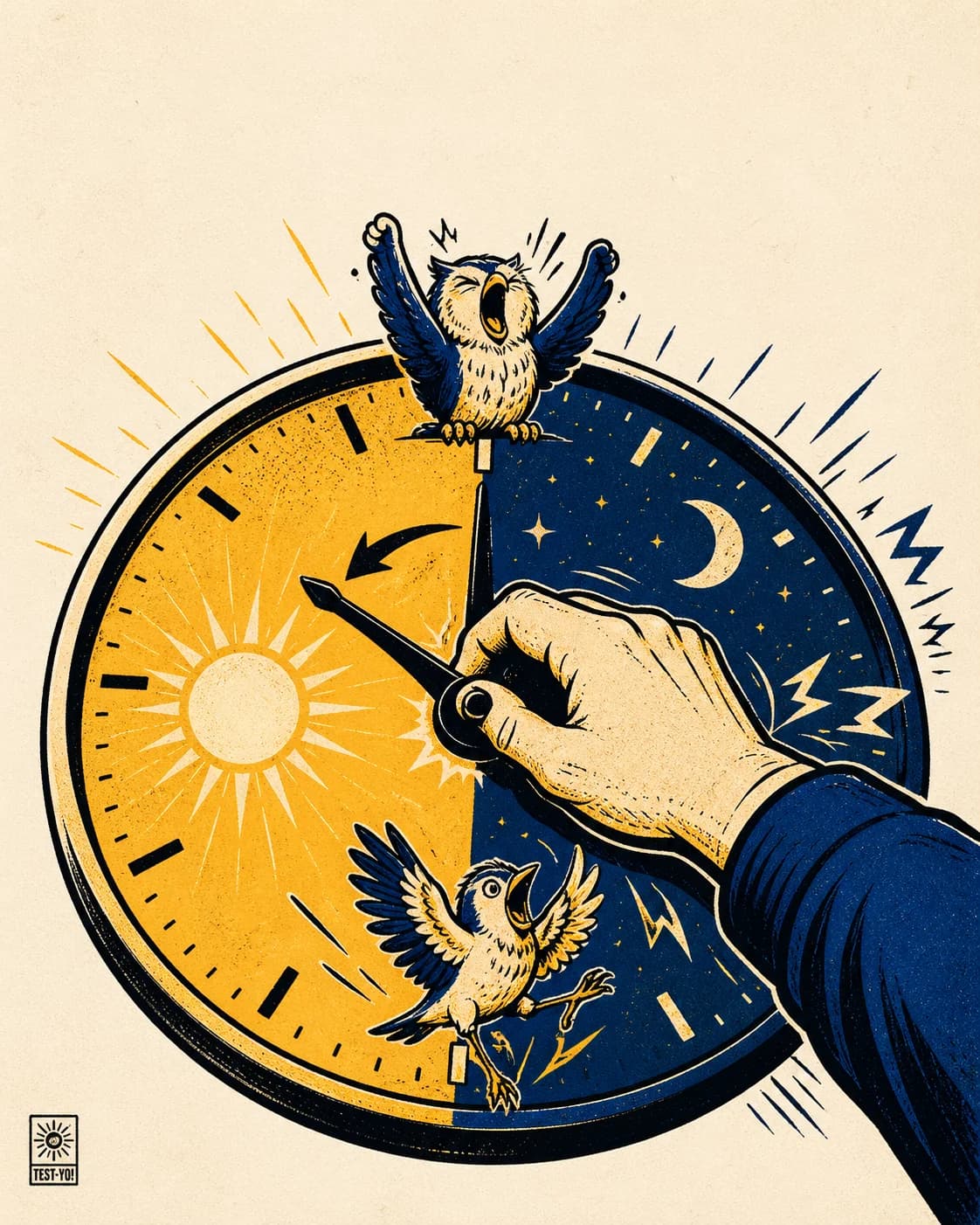
Owl or Lark — When does your brain actually work?
Free chronotype quiz: 5 questions on your natural sleep-wake rhythm place you from night owl to early lark. Inspired by circadian-preference research.
- 3 min
- 5 pytań
- Bez konta
- Bezpłatnie
Pełny wynik na końcu · bez podawania e-maila
Możliwe wyniki · który pasuje do ciebie?
- Night Owl
- Soft Owl
- Soft Lark
- Early Lark
W skrócie
Free chronotype quiz: 5 questions on your natural sleep-wake rhythm place you from night owl to early lark. Inspired by circadian-preference research.
- 5 pytań · ~3 min
- Podstawa: Adan, A., & Almirall, H. (1991)
- Koszt: bezpłatnie · bez konta
O tym teście
A 3-minute self-report quiz about your circadian preference, inspired by the structure of the reduced Morningness-Eveningness Questionnaire (rMEQ; Adan & Almirall, 1991), itself a short form of Horne & Östberg's original Morningness-Eveningness Questionnaire (MEQ, 1976). This quiz is not a licensed reproduction of either instrument or of the Munich ChronoType Questionnaire (MCTQ; Roenneberg et al., 2003). Five items map your self-reported rhythm to one of four playful archetypes — from Night Owl to Early Lark — as a conversation starter, not a lab measurement.
Jak liczymy wynik
This quiz asks 5 self-report items about morning/evening preference, inspired by the structure of the reduced Morningness-Eveningness Questionnaire (rMEQ; Adan, A. & Almirall, H., 1991, "Horne & Östberg morningness-eveningness questionnaire: a reduced scale," Personality and Individual Differences, 12(3), 241–253), which is itself a short form of Horne, J.A. & Östberg, O. (1976), "A self-assessment questionnaire to determine morningness-eveningness in human circadian rhythms," International Journal of Chronobiology, 4(2), 97–110. It is not a licensed reproduction of the rMEQ, the original MEQ, or the Munich ChronoType Questionnaire (MCTQ; Roenneberg, Wirz-Justice & Merrow, 2003) — wording and scoring bands here are this quiz's own, for entertainment and self-reflection rather than clinical or research use.
Możliwe typy wyników
- Night Owl · 3am shower thinker
- Your best ideas arrive at 1am. Your alarm is a personal attack.
- Soft Owl · Soft-launch mornings
- You don't do mornings before 10am. You're fine and you know it.
- Soft Lark · Latte-by-9 girl
- Up before 8, productive by 10, in bed by 11. Smug about it.
- Early Lark · 5am routine person
- You've done a workout, journaled, and answered 3 emails before others wake up.
Powiązane testy
Źródła i literatura
- Adan, A., & Almirall, H. (1991). Horne & Östberg morningness–eveningness questionnaire: a reduced scale (rMEQ). Personality and Individual Differences.
Najczęstsze pytania + informacja
What is a chronotype?
A chronotype is your natural preference for when you feel most awake and most tired across a 24-hour day. It's influenced by genetics, age and light exposure, and is fairly stable in adulthood.
Is this the official Morningness-Eveningness Questionnaire?
No. This quiz is inspired by the structure of the reduced Morningness-Eveningness Questionnaire (rMEQ; Adan & Almirall, 1991) and the original Horne & Östberg MEQ (1976), but it is an independent, non-clinical quiz — not a licensed copy of either instrument.
Is this the Munich ChronoType Questionnaire (MCTQ)?
No. The MCTQ (Roenneberg et al., 2003) calculates chronotype from your actual sleep and wake times on work versus free days, using a different methodology. This quiz asks about general preferences instead and does not reproduce the MCTQ.
Am I a morning person or night owl?
That depends on your answers — roughly a third of adults lean toward "morning", a third toward "evening", and a third fall in between, with the distribution shifting toward later types in adolescence and earlier types in older age.
Is this a medical sleep test?
No. It is a self-report quiz for reflection and conversation, not a clinical diagnostic tool. If you have persistent sleep problems, insomnia or excessive daytime sleepiness, talk to a qualified clinician.
How accurate is a 5-item quiz?
Short circadian-preference screeners can correlate well with longer questionnaires in research settings, but any 5-item self-report is indicative rather than definitive — it is a snapshot, not a lab measurement.
Are chronotypes really "bear, wolf, lion and dolphin"?
That four-animal framework is a popular-science simplification, not a peer-reviewed classification system. Sleep researchers typically describe chronotype on a continuum from strongly morning to strongly evening rather than as four fixed animal types.
Can my chronotype change over time?
Yes, to some degree. Chronotype tends to shift later during adolescence and earlier again with age, and can also be nudged by light exposure, work schedules and habits — though there is a genetic baseline that resists complete change.
Does chronotype affect anything besides sleep?
Research links chronotype to variation in alertness, mood and performance across the day, which is why some people feel sharpest in the morning and others hit their stride at night. It is not evidence of a fixed personality type.