This guide starts with the original TEST-YO! quiz. Its five bars compare your answers with each trait’s possible positive maximum. They are not population percentiles, and the result is not a validated assessment of your personality or abilities.
The five traits
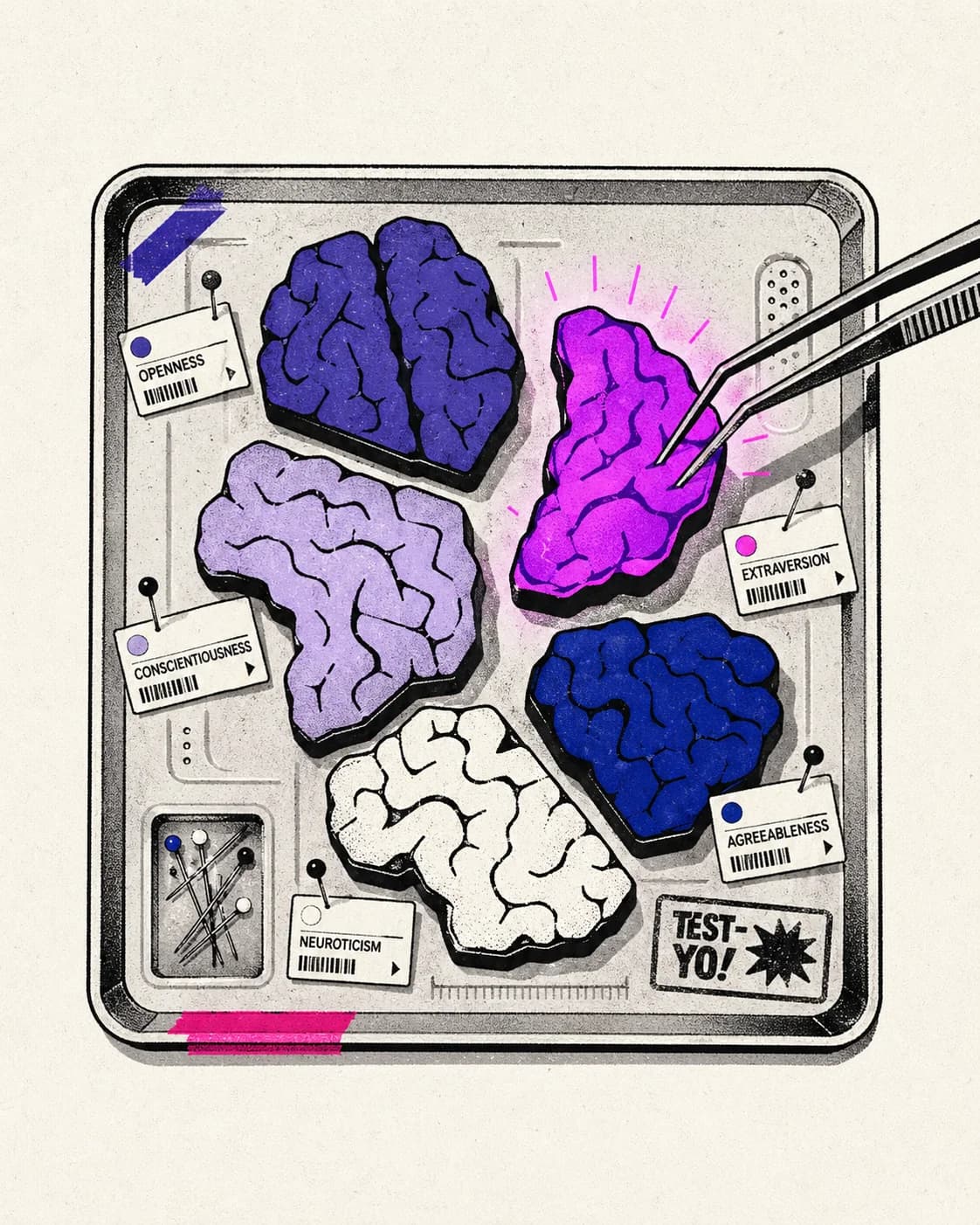
The quiz groups thirty statements into five sets of six: - Openness — interest in unfamiliar ideas and experiences - Conscientiousness — organization and following through - Extraversion — sociability and outward activity - Agreeableness — cooperation and consideration - Neuroticism — emotional reactivity
Your named profile is the trait with the highest total in your answers. It does not mean that trait is high compared with other people. Even when all totals are low, one profile is selected. In a tie, the fixed order is Openness, Conscientiousness, Extraversion, Agreeableness, then Neuroticism. A tied or close result deserves particular caution.
Read this quiz’s bars
Each answer contributes from −2 to +2 to one trait; some statements are scored in reverse. Each trait can total from −12 to +12. A bar maps that full range onto 0–100%: −12 is 0%, zero is 50%, and +12 is 100%. The five percentages do not need to add up to 100.
A total of 9 on the −12 to +12 scale gives 87.5%, displayed as 88%. It does not mean you are more extraverted, curious or organized than 88% of people. A zero bar represents the lowest possible total, −12. It does not mean you have none of that trait, and it does not measure a skill you lack.
Start by checking which statements you agreed with and which situations you had in mind. Compare the five bars within this result. A higher bar is not a better person, and the leading profile is not evidence of talent or competence.
Percentiles belong to other, normed instruments
Some validated personality instruments compare responses with a defined reference group and report percentiles. On such an instrument, the 70th percentile means a position above about 70% of that comparison group. Interpretation depends on the questionnaire, its norms and the group used.
That is a different scale from this quiz’s bars. Do not apply percentile cut-offs or population labels such as “above average” to a TEST-YO! result. For a formal assessment, choose an instrument with suitable validation and reference data.
Explore combinations without assigning roles
Instead of reading the leading label alone, ask how the five sets of answers fit together. A person who agrees with statements about unfamiliar ideas and planning might enjoy both proposing a project and organizing it. That does not establish creativity or reliable delivery; ask for real examples.
Someone who agrees with social statements but less with planning statements might prefer spontaneous plans. Someone else might enjoy company and careful preparation equally. These are possible scenes to discuss, not career recommendations or predictions about relationships. No combination establishes someone’s worth or ability.
Common misreadings
“I got Extraversion, so I must be an extrovert.” It was the highest total in this run. That can happen with a low or tied score. Read the other bars and your answers before choosing a label.
“My Neuroticism bar is high, so I have a mental health condition.” This quiz cannot diagnose one. It groups answers about emotional reactivity; a health concern needs a different kind of assessment.
“My scores changed, so the quiz proved my personality changed.” Mood, context and how you understood a statement can change answers. This original quiz does not establish the cause of a difference.
“Low Agreeableness means I am a bad person.” A set of self-reported preferences is not a judgment of your ethics. Discuss what happened in a specific situation instead.
What your result does not tell you
- Your intelligence
- Your values or ethics
- Your competence at a particular skill
- Whether a job or relationship will suit you
Use your result as a conversation prompt
1. Read the answers behind your highest and lowest bars. 2. Find an example that fits a description and one that does not. 3. Choose a practical question to explore, without treating a lower bar as a defect. 4. If you retake the quiz, note the context before interpreting a difference.
Read the whole profile before choosing a story
Consider an invented profile with higher Openness and Conscientiousness, lower Extraversion, middle Agreeableness and higher Neuroticism. Imagine someone who enjoys redesigning a community newsletter, finishes the layout carefully, prefers written discussion and worries about sending it. The combination gives you questions to ask about that scene. It does not establish creativity, competence or anxiety, and another person with similar answers could describe a different experience.
Now consider an invented profile with lower Openness, middle Conscientiousness, higher Extraversion and Agreeableness, and lower Neuroticism. Someone might recognize themselves in arranging a familiar group walk, chatting easily, changing the plan to accommodate a friend and feeling untroubled by a late start. That is an illustration, not a forecast. The profile would not tell you whether they remembered the route or treated everyone fairly.
Both examples describe all the traits without making the highest one the person's identity. Use combinations as possible conversation prompts, without assigning reliable roles or career advice. A dominant label can leave important parts out. If the quiz displays only that label, it has not supplied a complete numerical profile: do not invent the missing scores. Work with what is actually shown and add your own concrete examples.
A middle score gives you something to explore
A middle result is not an empty space between interesting extremes. Ask what answers contributed to it. Perhaps you welcome visitors you know but rarely introduce yourself at a crowded event. Perhaps you enjoy unfamiliar food but prefer familiar tools for a task with a deadline. These contrasting examples can make a broad middle description useful without turning it into a special personality type.
Do not assume a middle score proves flexibility or balance. You might behave similarly across settings, vary with the situation or have found several questions hard to answer. The number by itself cannot choose among those accounts. Nor should the middle be treated as a target everyone ought to reach; it is not a grade for how well you handle life.
Check what scale the result actually uses. Percentile language applies when an instrument compares answers with a reference group. This site's original quiz does not report population percentiles, so percentile ranges cannot be applied to its result. That distinction matters at the middle as well as the extremes. A position within your displayed result and a position within a population are different comparisons.
Context helps explain apparently conflicting examples
Imagine you organize work tasks carefully because a shared schedule makes each deadline visible. At home, an unfinished cupboard remains open for days because nobody needs it completed yet. Both observations can belong to the same person. Before calling the profile inconsistent, describe the different demands, reminders and consequences around those actions.
The same applies to social situations. You might speak readily when explaining a familiar project and say little at a family gathering where you feel interrupted. That does not let you calculate separate true personalities for work and home. It does give you a reason to say which setting you had in mind when you answered a broad question about sociability.
Include exceptions without using context to excuse every difficulty. If your late reply inconvenienced someone, that effect still matters even when you can explain why it happened. A result does not settle responsibility for a particular action. Put the broad description beside the event: what was expected, what you did and what conditions were different. This keeps the profile tied to what happened. It is not a full explanation of behavior or a prediction for the next situation.
Start a conversation with an example, not a label
Instead of telling a housemate, "You are low in Conscientiousness," describe the shared task: "When the cupboard is left unfinished, I cannot put the plates away. How can we agree when it will be done?" The request remains understandable without a test result. If both of you want to discuss profiles, use them to explore preferences after making the practical issue clear.
For your own result, try a tentative description: "I answered thinking about work, where I like plans. Does that fit what you see when we arrange weekends?" Leave the other person room to disagree. Their example is useful information, but it does not make them the final judge of your personality. Equally, your quiz label is not a reason to dismiss their experience.
Ask permission before sharing or interpreting someone else's result, and allow them to keep it private. Avoid turning the conversation into a competition about whose traits are better. End with something specific you both understand, such as an agreed way to arrange plans, or an open question where your accounts differ. A profile can support that discussion without becoming a rule about who each person must be.
Results are descriptive, not prescriptive. They tell you where you currently are — not where you have to stay.