 TEST-YO!· The Big Five Personality Model — Complete Guide
The Big Five Personality Model — Complete Guide
If you only learn one personality framework, learn this one. The Big Five is the single most studied, most replicated, most predictive personality model in psychological science. It's used in academic research, peer-reviewed clinical work and validated hiring tools — not because it's fashionable but because every decade of data has confirmed the same five dimensions.
The five traits, defined
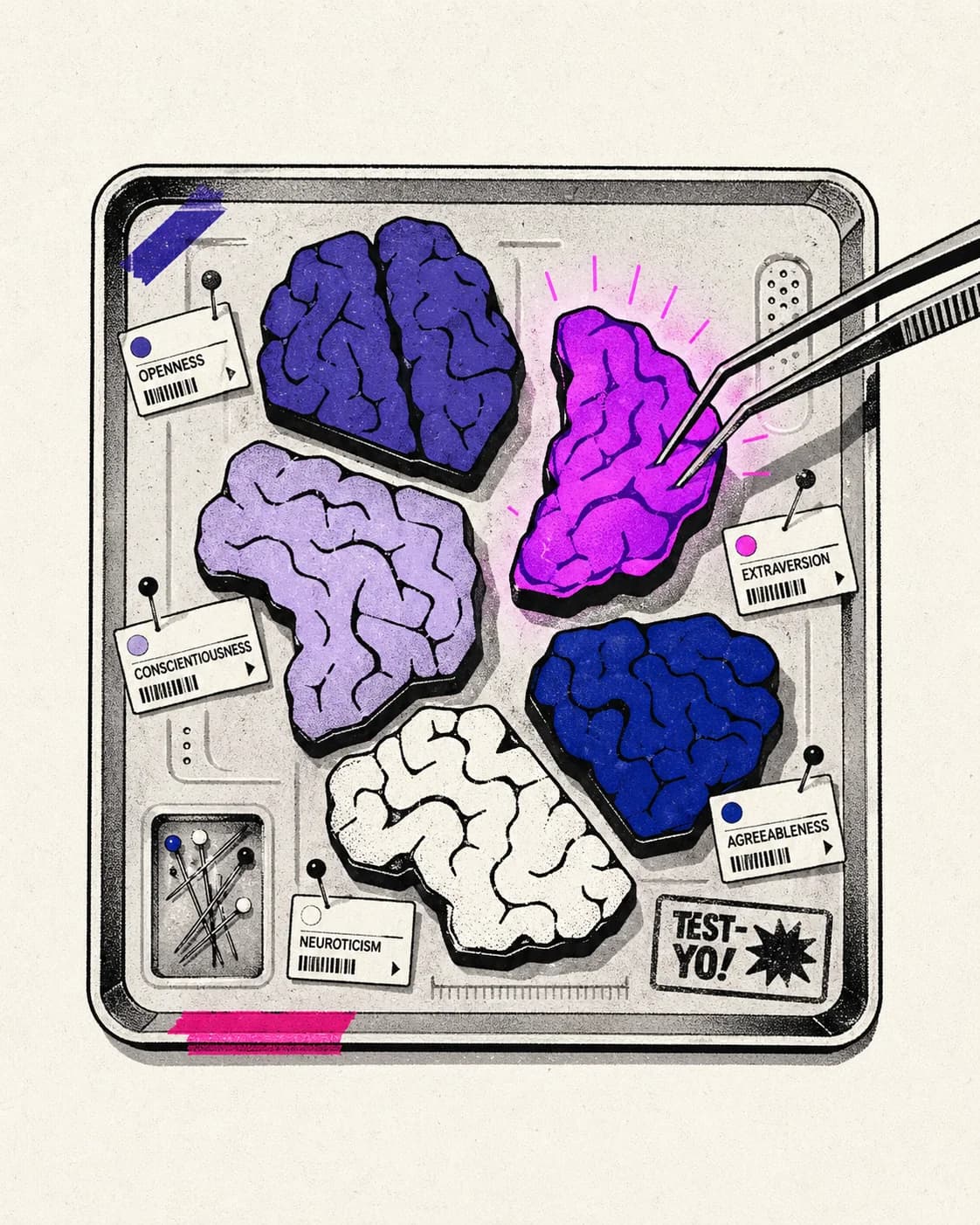
Openness captures curiosity and engagement with novelty and abstraction. Conscientiousness captures self-discipline, order and follow-through. Extraversion captures energy drawn from external stimulation. Agreeableness captures warmth, cooperation and trust. Neuroticism (or Emotional Reactivity) captures intensity of negative emotion. Each trait is independent — your score on one tells you nothing about your score on another.
How the model was built
The Big Five emerged bottom-up, from data. Researchers starting in the 1930s extracted every personality-describing adjective from English dictionaries — about 18,000 — and ran factor analyses over decades. Five broad clusters kept reappearing. The same five later appeared in studies across Mandarin, Arabic, German, Spanish, Turkish and dozens of other languages. That cross-cultural replication is what moved it from one lab's theory to the field's consensus.
What each trait predicts
Conscientiousness predicts job performance across 92% of occupations studied (Barrick & Mount, 1991) and correlates with health behaviours and longevity. Agreeableness predicts relationship satisfaction and team cohesion. Neuroticism correlates with stress response and mood disorder vulnerability (a correlate, not a cause). Extraversion predicts leadership emergence and short-term happiness. Openness predicts creative output, career choice breadth and political orientation.
How traits change with age
The "maturity principle" is the cleanest finding in personality psychology. Between 20 and 40, people become more Conscientious, more Agreeable and less Neurotic on average. Openness peaks in the twenties and drifts down slowly afterwards. Rank-order stability stays high: if you were more extroverted than your friend at 25, you probably still are at 55, even though both your absolute scores may have shifted.
How to read your Big Five result
Big Five scores are percentiles, not verdicts. A 60 means "higher than 60% of people," not "average." The interesting information is the pattern across all five — e.g. high Openness + low Conscientiousness is a different profile from high-both. Extreme scores on Neuroticism are worth discussing with a professional; other trait extremes don't signal risk, they just mean you're further from the median.
Take the primary test
Who Are You, Really?
A free personality type test built on the Big Five: 30 questions, five character archetypes, and how it compares with MBTI, DISC and four-type models.
Start the testTests in this line
Personality
A free personality type test built on the Big Five: 30 questions, five character archetypes, and how it compares with MBTI, DISC and four-type models.

Introvert or Extrovert
Introvert, extrovert or somewhere in between? Find out in 2 minutes.

Dark Side
Three dark traits everyone has a little of. How much of each do YOU?

Emotional Smart
Smart is one thing. Emotional smart is another. Where are you?
Articles
Traits & dimensions
Openness to Experience
Openness in the Big Five: what it is, what high and low scorers look like, where it shows up in life.
Conscientiousness
Conscientiousness in the Big Five: the strongest predictor of job performance and long-term outcomes.
Extraversion
Extraversion in the Big Five: the trait behind the introvert vs extrovert distinction.
Agreeableness
Agreeableness in the Big Five: warmth, cooperation and trust — the trait behind strong relationships.
Neuroticism (Emotional Reactivity)
Neuroticism (emotional reactivity) in the Big Five: a sensitivity trait, not a disorder.
Frequently asked
Is the Big Five more accurate than MBTI?
Yes. The Big Five replicates across cultures, uses continuous scales, and predicts real-world outcomes. The MBTI uses binary categories, about half of retakers get a different type, and many of its distinctions (like S/N) don't replicate well in data.
How many items does a valid Big Five test need?
At least 30 items (6 per trait) for a reliable result. Clinical instruments like NEO-PI-R use 240 items across 30 facets. Any test with fewer than 20 items should be treated as indicative only.
Can I change my Big Five scores?
Yes, slowly. Volitional personality change studies show that 15–20 weeks of deliberate behavioural practice can shift a trait by a small amount. Conscientiousness and emotional stability respond best; Openness is the stickiest.
References
- Goldberg, L. R. (1993). The structure of phenotypic personality traits.. American Psychologist
- Barrick, M. R., & Mount, M. K. (1991). The Big Five personality dimensions and job performance: a meta-analysis.. Personnel Psychology
- Roberts, B. W., Walton, K. E., & Viechtbauer, W. (2006). Personality trait development in adulthood.. Psychological Bulletin
- Hudson, N. W., & Fraley, R. C. (2015). Volitional personality change: A systematic review.. Journal of Personality and Social Psychology